




Skip to content
  • Facebook
  • X
  • Linkedin
  • WhatsApp
  • Associate Journalism
  • About Us
  • Privacy Policy
  • 033-46046046
  • editor@artifex.news
Artifex.News

Artifex.News

Stay Connected. Stay Informed.

  • Breaking News
  • World
  • Nation
  • Sports
  • Business
  • Science
  • Entertainment
  • Lifestyle
  • Toggle search form
  • Budget 2024 date and time: When and where to watch the Union Budget on July 23, 2024? Business
  • Shadow of former PM Chandra Shekhar dominates Ballia’s political landscape in Uttar Pradesh Nation
  • Canada To Start Evacuating Citizens From Israel And Palestine World
  • Is it time to reopen Bengaluru’s HAL Airport or build a third aerodrome? Nation
  • Moscow to begin spring military draft amid mobilisation fears World
  • Can Joe Biden Be Replaced As Democratic Presidential Nominee? The Best Way Is… World
  • Denmark to liberalise its abortion law to allow the procedure until 18th week of pregnancy World
  • IPL 2024 Points Table: Kolkata Knight Riders, Chennai Super Kings Take Massive Steps Towards Playoffs Sports

Hidden craters suggest earth once had a Saturn-like ring

Posted on September 17, 2024 By admin


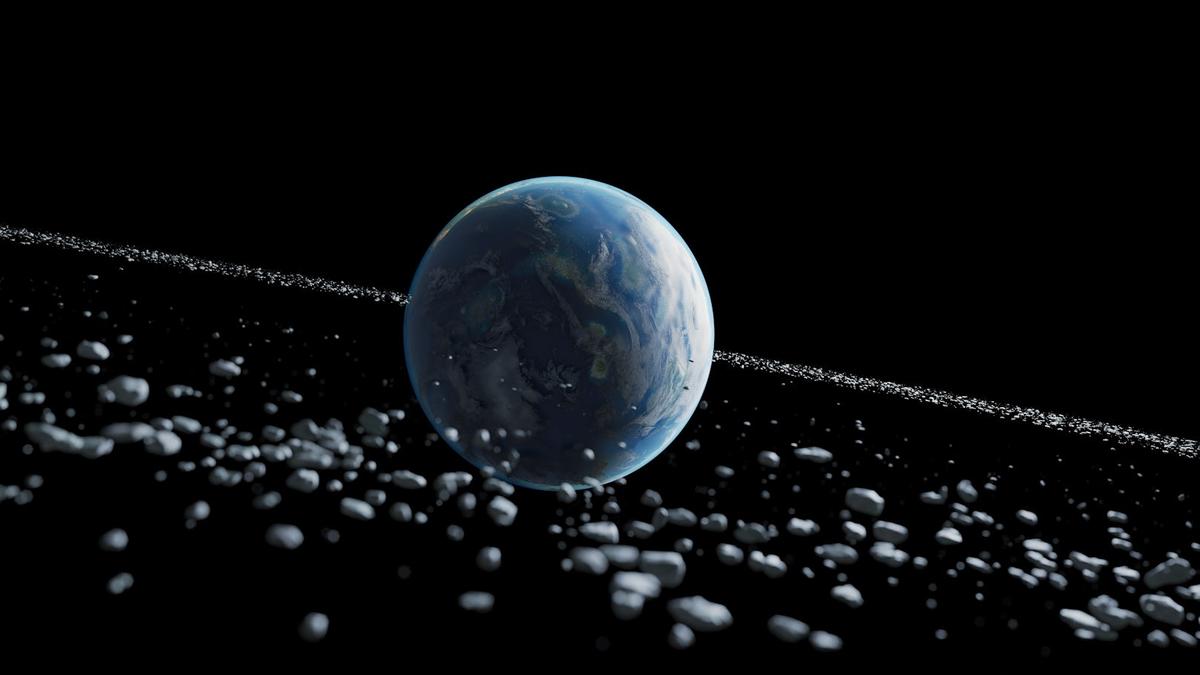
The rings of Saturn are some of the most famous and spectacular objects in the Solar System. Earth may once have had something similar.

In a paper published last week in Earth & Planetary Science Letters, my colleagues and I present evidence that Earth may have had a ring.

The existence of such a ring, forming around 466 million years ago and persisting for a few tens of millions of years, could explain several puzzles in our planet’s past.

The case for a ringed Earth

Around 466 million years ago, a lot of meteorites started hitting Earth. We know this because many impact craters formed in a geologically brief period.

In the same period we also find deposits of limestone across Europe, Russia and China containing very high levels of debris from a certain type of meteorite. The meteorite debris in these sedimentary rocks show signs that they were exposed to space radiation for much less time than we see in meteorites that fall today.

Many tsunamis also occurred at this time, as can be seen from other unusual jumbled up sedimentary rocks.

We think all these features are likely related to one another. But what links them together?

A pattern of craters

We know of 21 meteorite impact craters that formed during this high-impact period. We wanted to see if there was a pattern in their locations.

Using models of how Earth’s tectonic plates moved in the past, we mapped out where all these craters were when they first formed. We found all of the craters are on continents that were close to the equator in this period, and none are in places that were closer to the poles.

So all the impacts occurred close to the equator. But is this actually a fair sample of the impacts that occurred?

Well, we measured how much of Earth’s land surface suitable for preserving a crater was near the equator at that time. Only about 30% of the suitable land was close to the equator, with 70% at higher latitudes.

Under normal circumstances, asteroids hitting Earth can hit at any latitude, at random, as we see in craters on the Moon, Mars and Mercury.

So it’s extremely unlikely that all 21 craters from this period would form close to the equator if they were unrelated to one another. We would expect to see many other craters at higher latitudes as well.

We think the best explanation for all this evidence is that a large asteroid broke up during a close encounter with Earth. Over several tens of millions of years, the asteroid’s debris rained down onto Earth, creating the pattern of craters, sediments and tsunamis we describe above.

How rings form

You may know that Saturn isn’t the only planet with rings. Jupiter, Neptune and Uranus have less obvious rings, too. Some scientists have even suggested that Phobos and Deimos, the small moons of Mars, may be remnants of an ancient ring.

So we know a lot about how rings form. Here’s how it works.

When a small body (like an asteroid) passes close to a large body (like a planet), it gets stretched by gravity. If it gets close enough (inside a distance called the Roche limit), the small body will break apart into lots of tiny pieces and a small number of bigger pieces.

All those fragments will be jostled around and gradually evolved into a debris ring orbiting the equator of the larger body. Over time, the material in the ring will fall down to the larger body, where the larger pieces will form impact craters. These craters will be located close to the equator.

So if Earth destroyed and captured a passing asteroid around 466 million years ago, it would explain the anomalous locations of the impact craters, the meteorite debris in sedimentary rocks, craters and tsunamis, and the meteorites’ relatively brief exposure to space radiation.

A giant sunshade?

Back then, the continents were in different positions due to continental drift. Much of North America, Europe and Australia were close to the equator, whereas Africa and South America were at higher southern latitudes.

The ring would have been around the equator. And since Earth’s axis is tilted relative to its orbit around the Sun, the ring would have shaded parts of Earth’s surface.

This shading in turn might have caused global cooling, as less sunlight reached the planet’s surface.

This brings us to another interesting puzzle. Around 465 million years ago, our planet began cooling dramatically. By 445 million years ago it was in the Hirnantian Ice Age, the coldest period in the past half a billion years.

Was a ring shading Earth responsible for this extreme cooling? The next step in our scientific sleuthing is to make mathematical models of how asteroids break up and disperse, and how the resulting ring evolves over time. This will set the scene for climate modelling that explores how much cooling could be imposed by such a ring.

This article is republished from The Conversation under a Creative Commons license. Read the original article.

Published – September 17, 2024 03:19 pm IST


Source link

Science Tags:astronomy news, Earth had a ring like saturn?, Earth’s ring, hidden craters on earth’s surface, science news

Post navigation

Previous Post: “Maze Lene Do Unko…”: Rohit Sharma Mocks Test Rivals Ahead Of Bangladesh Series
Next Post: Brain undergoes major changes in pregnancy, some fleeting, some enduring, new study shows

Related Posts

  • Two forerunners that set the stage for ISRO’s Gaganyaan test Science
  • India’s Aditya-L1 solar mission spacecraft commences collecting scientific data Science
  • Sci-Five | The Hindu Science Quiz: On Indian Scientists Science
  • VELC payload aboard Aditya-L1 will send 1,440 images of sun in a day Science
  • ZSI names a newly discovered head-shield sea slug after President Droupadi Murmu Science
  • IAU approves ‘Statio Shiv Shakti’ as name for Chandrayaan-3 landing site Science

More Related Articles

A colossus who helped shape Kerala’s scientific establishment Science
The Silent Killer: tackling hypertension in India Science
April temperatures in east and south India posted record highs Science
How quantum algorithms solve problems that classical computers can’t Science
Sprouting a sandalwood sapling – The Hindu Science
Collision with NASA spacecraft altered shape of asteroid Dimorphos Science
SiteLock

Archives

  • September 2024
  • August 2024
  • July 2024
  • June 2024
  • May 2024
  • April 2024
  • March 2024
  • February 2024
  • January 2024
  • December 2023
  • November 2023
  • October 2023
  • September 2023
  • August 2023
  • July 2023
  • June 2023
  • May 2023
  • April 2023
  • March 2023
  • February 2023
  • January 2023
  • December 2022
  • November 2022
  • October 2022
  • September 2022
  • August 2022
  • July 2022
  • June 2022
  • May 2022

Categories

  • Business
  • Nation
  • Science
  • Sports
  • World

Recent Posts

  • India Gets US Court Summons In Alleged Plot To Murder Khalistani Terrorist
  • R.G. Kar hospital rape-murder case: voices of disquiet as systemic issues vie with justice at Kolkata stir
  • Venezuela’s opposition ex-candidate says forced to sign letter that effectively admits defeat
  • Sri Lanka vs New Zealand 1st Test Day 2: Live Score Updates
  • Tupperware files for bankruptcy protection

Recent Comments

  1. TpeEoPQa on UP Teacher Who Asked Students To Slap Muslim Classmate
  2. xULDsgPuBe on UP Teacher Who Asked Students To Slap Muslim Classmate
  3. KyJtkhneiLmcq on UP Teacher Who Asked Students To Slap Muslim Classmate
  4. mOyehudovB on UP Teacher Who Asked Students To Slap Muslim Classmate
  5. GFBvgSrWPcsp on UP Teacher Who Asked Students To Slap Muslim Classmate
  • Deepika Kumari Enters Pre-Quarterfinals In Women’s Individual Archery Event Sports
  • Watch | Campus protests in U.S. | Will it impact presidential elections? World
  • Amit Shah Bihar Jhanjharpur Rally Opposition Named Its Alliance INDIA UPA Associated With Corruption Nitish Kumar JDU Ramcharitmanas Nation
  • “Cannot Fix A Problem By Creating Another Problem”: Zimbabwe Skipper Sikandar Raza After Defeat vs India In 3rd T20I Sports
  • India vs Pakistan: “Virat Kohli Got 100” But This Player Was Best Performer For Gautam Gambhir Sports
  • Lok Sabha Election 2024 Hyderabad: “Amit Shah Has Patent On ‘Razakar’, People Will Reply”: Asaduddin Owaisi Nation
  • Man Arrested For Making Death Threat Calls To Businessman In Noida: Cops Nation
  • Hamas proposes new six-week Gaza truce, hostage-prisoner exchange: official World

Editor-in-Chief:
Mohammad Ariff,
MSW, MAJMC, BSW, DTL, CTS, CNM, CCR, CAL, RSL, ASOC.
editor@artifex.news

Associate Editors:
1. Zenellis R. Tuba,
zenelis@artifex.news
2. Haris Daniyel
daniyel@artifex.news

Photograher:
Rohan Das
rohan@artifex.news

Artifex.News offers Online Paid Internships to college students from India and Abroad. Interns will get a PRESS CARD and other online offers.
Send your CV (Subjectline: Paid Internship) to internship@artifex.news

Links:
Associate Journalism
About Us
Privacy Policy

News Links:
Breaking News
World
Nation
Sports
Business
Entertainment
Lifestyle

Registered Office:
72/A, Elliot Road, Kolkata - 700016
Tel: 033-22277777, 033-22172217
Email: office@artifex.news

Editorial Office / News Desk:
No. 13, Mezzanine Floor, Esplanade Metro Rail Station,
12 J. L. Nehru Road, Kolkata - 700069.
(Entry from Gate No. 5)
Tel: 033-46011099, 033-46046046
Email: editor@artifex.news

Copyright © 2023 Artifex.News Newsportal designed by Artifex Infotech.