






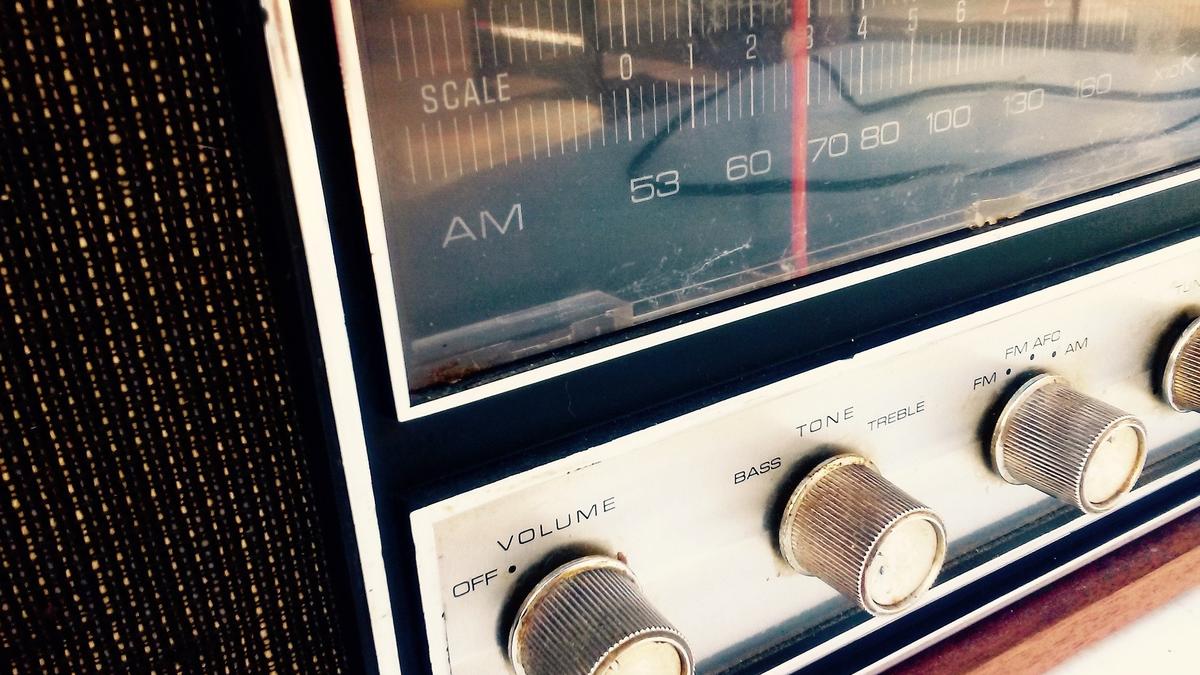
When you tune in to the radio, the announcer says, “Welcome to 100.1 FM Gold” or “You are listening to Akashvani at 783 AM”. The terms ‘AM’ and ‘FM’ refer to forms of signal modulation — a method at the heart of modern long-distance communications. Signal modulation simplifies the technologies required to send and receive good-quality signals carrying information, like the news and songs on the radio.
How do we ‘measure’ waves?
Imagine a vast, quiet lake. The water is as still as a statue. At the centre of the lake is a small island of pebbles. You pick up and drop a pebble into the water. A single wave ripples across the lake, forming a circle that expands in all directions. That is: a single, short disruption triggered the release of a single wave. After the wave passed, the lake became quiet again.
If you dropped a small gravel, the resulting wave would have had a short height. If the stone had been heavier, the impact would have been more energetic and the wave would have been taller. This height is called the wave’s amplitude. A high amplitude sound wave will be louder; a high amplitude light wave will be brighter.
Dropping a stone every second will create a series of waves, traversing the surface one after another in concentric circles. If I’m sitting in a boat at some distance from the tower, and the wave strikes the boat, it will heave up and down. By measuring how much the boat is lifted, I can calculate the amplitude and from that the weight of the rock you dropped. I can also determine how frequently you drop new stones by counting how often my boat seesaws
The number of successive crests arriving at a spot per second is the wave’s frequency, measured in hertz (Hz). One Hz equals one cycle per second. This means the Chennai Akashvani radio station produces radio waves with 783,000 crests in one second. The interval between two successive crests (or troughs) is called the wavelength, measured in metres.
What are FM and AM?
Suppose we agree to use the Morse code: two stones dropped in quick succession equals a dot (•) and a longer gap between two stones is a dash (–).
When two stones are dropped one after the other, the waves are closely spaced, resulting in a higher frequency. If we drop the pebbles with a big time gap, the frequency drops.
By monitoring the frequency of the incoming waves far from the shore, I can distinguish between • and –. And based on the series of • and –, I can decipher the message.
This technique of information communication is called frequency modulation (FM). Here, we modulate, or adjust, the frequency to transmit a message.
We can also agree to another code: a heavy stone indicates a • and a light stone indicates a –. To convey • – • • • – • (Morse for ‘air’), you drop heavy, light, heavy, heavy, heavy, light, heavy in that order, at regular intervals. The resulting waves will have varying amplitudes: tall, short, tall, tall, tall, short, tall. I can figure out the pattern by observing how much my boat sways and decipher your message.
This is amplitude modulation (AM). You fix the frequency by dropping the stones at fixed intervals. Instead you change the pebbles’ weight, resulting in waves of different amplitudes.
What is phase modulation?
We can have two waves with the same frequencies but different phases, meaning one wave starts slightly later than the previous one. It’s like in march-past in which one set of people are out of step. So the corresponding crests (or troughs) of the waves will be slightly out of phase.
When a crest meets another crest, they combine and become more prominent. When a crest hits a trough, they cancel out. This way, out-of-phase waves can be made to stack up uniquely to produce a bigger wave.
People use the phase difference between two waves of the same frequency to encode a message.
The advantage of PM is that slight changes in the signal amplitude won’t degrade the information it carries. This is because the modulating signal is not transmitted by the amplitude of the pulses, so pulse modulation is nearly impervious to amplitude fluctuations produced by interference and noise.
This is why operators choose PM over AM or FM for crystal-clear digital transmission, such as in Wi-Fi.
What are digital and analog?
PM is unsuitable for analog radio or TV broadcasts because it’s digital. When we use AM, FM or PM modes to transmit • and – (or 0s and 1s), we have digital transmission. When we use AM or FM to propagate composite waves, it’s analog transmission. Analog signals are continuous while digital signals are discrete.
In one critical respect, water waves and electromagnetic waves — such as radio signals — differ. Water waves travel on a medium. Electromagnetic waves consist of electrical and magnetic fields oscillating in the three spatial dimensions.
This said, an electromagnetic wave’s phase, frequency, and amplitude can communicate messages the same way waves on the surface of an ideal lake can.
How is signal modulation used?
An important advantage of modulation is that multiple signals modulated differently can travel in the same channel — like the airwaves in a city or a fibre-optic cable — without interrupting each other.
In the same vein, lightning produces radio waves that interfere with signals, resulting in static and noise. They have little influence on digital transmission thanks to modulation. This is why we have advanced communications technologies like the internet.
Operators prefer television and signals to be analog instead because analog receivers are cheaper. This is why TV and radio broadcast signals are AM or FM.
The International Telecommunication Union allocates frequency bands to different services to minimise interference and increase transmission efficiency.

AM’s frequency range, from 535 to 1,705 kHz, makes room for high wavelength signals that can pass over mountains and buildings, providing more coverage.
FM provides superior quality since it is unaffected by static. However, because its frequency range is 88-108 MHz, the waves have lower wavelengths and the transmission distance is limited to line of sight. The receiver is also more expensive.
Nonetheless, as the prices of electronic components continue to decline, the world at large is moving from analog to digital broadcasting.
T.V. Venkateswaran is a science communicator and visiting faculty member at the Indian Institute of Science Education and Research, Mohali.
Published – September 14, 2024 07:09 am IST