




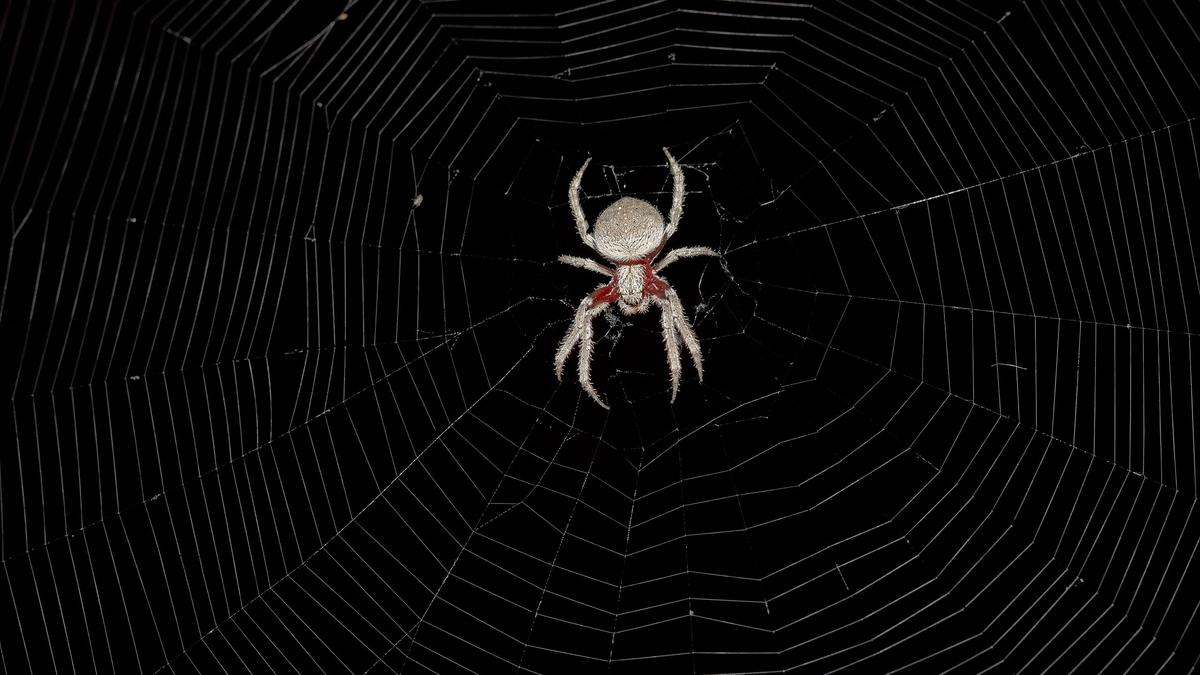
A female Australian garden orb weaver (Eriophora transmarina) in her web, January 21, 2016. These spiders only build their webs at night.
| Photo Credit: Thennicke (CC BY-SA 4.0)
As darkness falls, the nocturnal half of the animal kingdom starts its day. Nocturnal species are perfectly adapted to navigate and survive the dark of night that has existed for countless millions of years.
What happens to these creatures when the darkness they call home is transformed by streetlights and other artificial night lighting?
In new research published in Biology Letters, we studied how light pollution affects the development of Australian garden orb weaving spiders. We discovered it makes their brains smaller, particularly in the regions devoted to vision – with unknown effects on their behaviour.

What light pollution means for animals
Artificial light is one of the fastest-growing ways humans are polluting the world, and it has a huge range of effects on animals, plants and ecosystems. Recent evidence suggests the stress of living with light pollution may impair the growth and development of the brain in some birds and mammals.
This may be catastrophic. To survive in novel environments where light pollution is most common, such as cities, animals may actually need larger and more complex brains.
But what about insects and spiders and other, smaller creatures that inhabit the night? Could light pollution similarly affect the growth and development of their brains?
Our study on the nocturnal Australian garden orb weaving spider suggests it does.
More insects, fewer offspring
The Australian garden orb weaving spider is a perfect species to explore this question. It lives happily in cities and rural areas where it constructs its webs each night in wide open areas (even under streetlights).
In previous studies we found urban spiders that build webs under streetlights catch more insect prey. We also showed that light at night has a cost because it accelerates juvenile development resulting in smaller adults that produce fewer offspring.
In this current study we investigated whether developing under light at night also affects brain size in males and females.

To explore this question, we took late-juvenile spiders from relatively dark parks in Melbourne, Australia and reared them in the laboratory until they were adults.
During rearing we kept half the spiders under darkness at night and exposed the other half to nocturnal lighting equivalent to the brightness of a streetlight.
Smaller brains, but why?
A few weeks after the spiders were fully grown we assessed whether light at night had affected the development of their brains. As a spider brain is around the size of the nib of a ballpoint pen (less than a cubic millimetre) we used micro-CT imaging technology to visualise what was inside.
We found that short-term exposure to light at night resulted in overall smaller spider brain volumes. The strongest effects were seen in the area of the brain linked to vision in the spider’s primary eyes.
These results are a first for invertebrates (animals with no backbone, such as insects and spiders), but they mirror what has been described in vertebrates. We can only speculate how these differences came about.
It is possible that the presence of light at night created a stressful environment that disrupted hormonal processes related to growth and development. However, if this was the case we might expect to see all parts of the brain affected, which was not the case.
An alternative explanation is that spiders forced to develop under light at night changed their “investment” in different parts of the brain. Proper brain function is essential for an animal to navigate its environment, so under stressful conditions, limited resources may be directed to the more important parts of the brain. For spiders that don’t rely on vision, like orb-weavers, they may compensate by reducing investment in the visual parts of the brain, as we found here.
Other invertebrates such as desert ants (Cataglyphis fortis) show similar “neuroplastic shifts” in the visual centre of their brain when they move from subterranean nest-tending to above-ground, vision-based foraging.

Why spiders and their brains matter
All this is quite interesting, but you might be wondering why we should care about light pollution affecting the size of a spider’s brain.
Well, spiders are very important in an ecosystem. They eat other invertebrates, including many pest species such as flies and mosquitoes. Spiders are also important prey for other predators, such as birds and lizards.
If spiders’ brains get smaller, it may affect their cognitive function and ability to perform these vital roles. We know from other species of birds and mammals that larger brains can help individuals survive in novel city environments and it is likely the same may be true for spiders.
This research also shows that the effects of light pollution on brain development extend to invertebrates as well as birds and mammals. The full effects of humanity’s love of artificial lighting are likely much bigger than we yet understand.
Therésa Jones is a professor in evolution and behaviour and Nikolas Willmott is a PhD researcher in the Urban Light Lab, both at the University of Melbourne. This article is republished from The Conversation.

Published – September 10, 2024 01:21 pm IST