








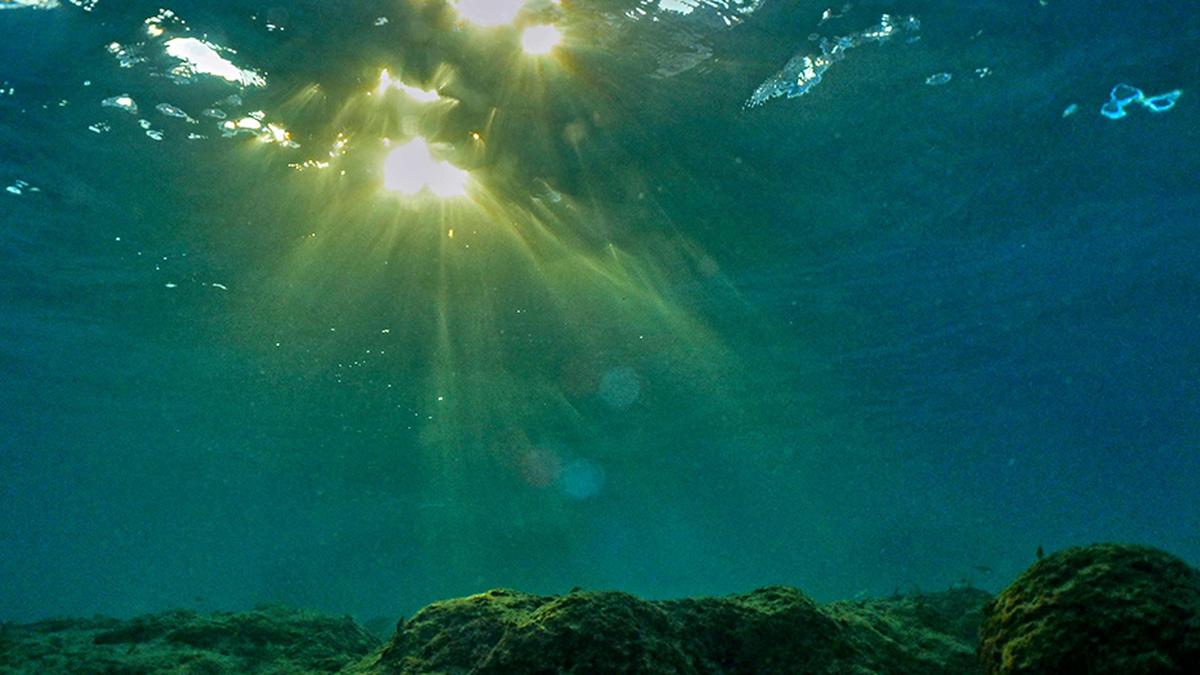
This underwater photograph shows light penetrating the water surface in the Mediterranean Sea off the coast of Batroun city on August 1, 2023.
| Photo Credit: AFP
Underwater avalanches are powerful natural events that happen all the time under the surface of the ocean. They are impossible to see and extremely difficult to measure, which means we know little about how they work.
Yet these phenomena pose a hazard to our global communication networks. The proliferation of the internet has required an ever-expanding network of fibre-optic seabed cables, which carry practically all global internet traffic.
My new study of an ancient underwater avalanche challenges our understanding of how underwater avalanches develop and may change the way geologists assess their risk potential.
It is estimated that there are now over 550 active seafloor cables around the world with a combined length of 1.4 million km – enough to wrap around the circumference of the Earth 35 times.
When a underwater avalanche breaks seafloor cables, the effects can be widespread and expensive. The 2006 Pingtung earthquake in Taiwan triggered underwater avalanches that cut many seafloor cables connecting southeast Asia with the rest of the world. The largest internet operator in China reported 90% loss of traffic to the US at the peak of the event and Taiwan experienced between 74-100% loss in internet traffic to neighbouring islands.

This damaged global markets by slashing the amount of financial transactions that could happen. Repairing the network to full capacity took 39 days and millions of US dollars in ship time. The underwater avalanche that broke these cables was fast-moving with a top speed of 72km per hour. But it was relatively small compared to giant underwater avalanches I have investigated in the Atlantic.
The good news is there are so many seafloor cables it’s extremely unlikely an underwater avalanche could shut down the internet worldwide. The Pingtung earthquake is an example of how even when primary routes are cut, at least some traffic will be able to travel on an alternate route.
In a new research paper, myself and colleagues mapped the devastation of a giant underwater avalanche that happened 60,000 years ago from its source area, offshore of Morocco.
It travelled 400km through the largest submarine canyon in the world, and for another 1,600km across the Atlantic seabed. It is the second largest underwater avalanche ever documented.
We mapped the avalanche using a combination of detailed seafloor topographic mapping and hundreds of sediment cores, which penetrated the deposits of the avalanche over a massive area. In every core we analysed the deposits for fossils, which enabled us to determine the age of the event to be 60,000 years ago. It also meant we could correlate the individual avalanche layer over thousands of kilometres.
The avalanche contained enough sediment to fill 140,000 Wembley Stadiums (162km³). It was the height of a skyscraper (more than 200 metres), travelling at least 54km per hour, ripping out a trench 30 metres deep and 15km wide for 400km (the distance from London to Liverpool) that destroyed everything in its path. It then spread out over an area the size of Germany, burying it in about a metre of sand and mud.
However, we show that the avalanche actually started out as a small landslide, which then grew in size by over 100 times along its pathway. This extreme growth in size is much larger than in land based avalanches, which typically grow between four to eight times in size and are tiny by comparison. This challenges scientists’ view that big avalanches start life as big slope collapses.
Instead, we know now that underwater avalanches can start small and grow along their path into catastrophic events of extraordinary power. So these insights may change how we assess the geohazard potential of these phenomena, and may lead us to focus more on the avalanche pathway rather than the initial landslide zone.

How often these events happen depends on where you are. Seafloor canyons that start relatively close to river mouths with high rainfall catchments can experience several small avalanches per year. Other systems far from river discharges like the Agadir Canyon, off northwest Morocco, only have one giant avalanche every 10,000 years.
There are a variety of potential triggers for underwater avalanches including earthquakes, tides, typhoons, river floods and even volcanic eruptions. Climate change will make some of these triggers more frequent and intense.
However, triggers do not guarantee that an avalanche will happen, nor do they relate to the size of the event. For example, in 1755 a large earthquake hit the coast of Portugal destroying large parts of Lisbon and killing tens of thousands of people. However, it only triggered a tiny underwater avalanche. By comparison, in 1929 a large earthquake off the coast of Newfoundland, Canada triggered the largest underwater avalanche ever documented.
Myself and colleagues used detailed seafloor surveys and sediment cores to reconstruct the properties of this event, which travelled at 68km per hour carrying a concentrated mixture of boulders, sand and mud, and snapping 11 seabed cables on its journey downhill. The avalanche was so large that it produced a tsunami, which killed 28 people along the local coastline. This remains the first and only giant underwater avalanche to have been directly measured by cable breaks.
Our understanding of underwater avalanches is still in its infancy but research continues to provide new insights into where they happen, how they work, and just how powerful and destructive they can be. These fascinating events are a reminder of the many wonders still hidden within the deep sea.
This article is republished from The Conversation under a Creative Commons license. Read the original article.
Published – September 05, 2024 02:33 pm IST