




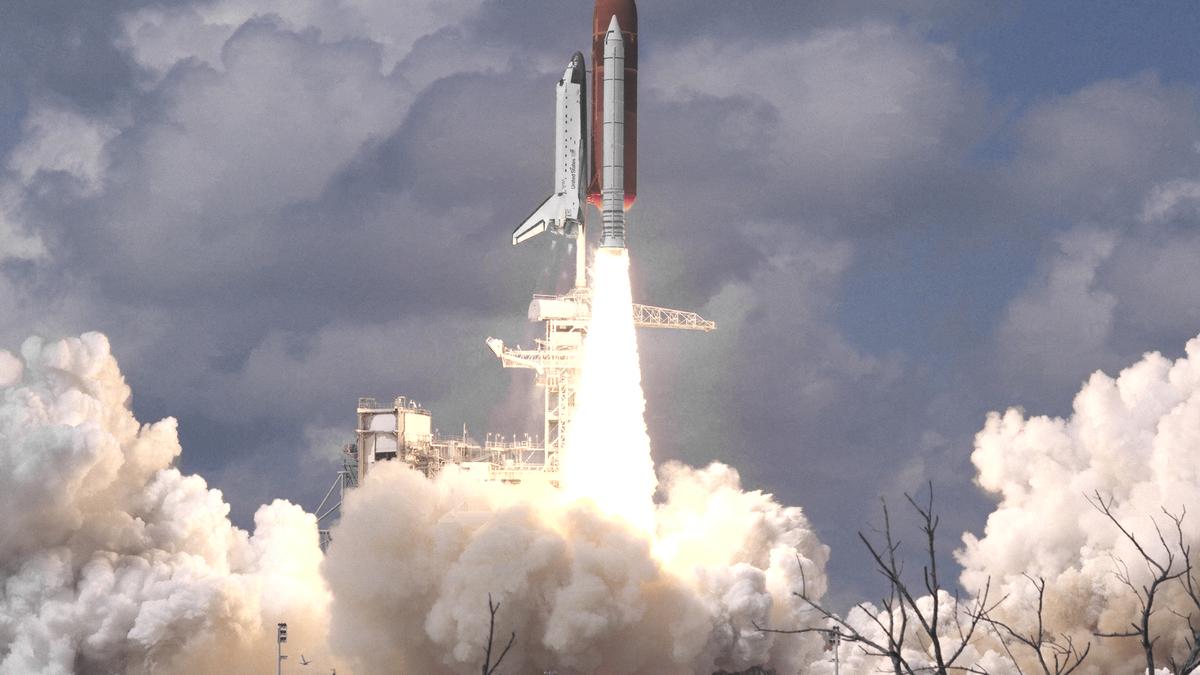
The Space Shuttle Discovery takes off from Launch Pad 39-B at the Kennedy Space Center, Florida, during the launch of the STS-26 mission on September 29 1988.
| Photo Credit: NASA
January 28, 1986 is a dark day in human spaceflight history. On a cold morning, following a night in which temperatures had dipped below freezing, the space shuttle Challenger was launched, only to burst in flames just 73 seconds after liftoff! Every one of the seven-member crew died, in what was the worst space disaster until then.
It shook the entire world, and the U.S. in particular. Bouncing back from an event like that is always hard, as the immediate aftermath is filled with emotions. What followed was a period of reflection, which highlighted the near non-existence at NASA of a safety reporting system. The fundamental problem of the space agency trying to achieve too much with too little money was also identified and necessary steps were put in place to try and avoid another mishap of this scale.
STS-26 mission
An intense period of investigation and redesign ensued, followed by implementing the modification deemed necessary. STS-26 was the mission that was set to take Americans back to space.
Frederick “Rick” H. Hauck, who served as the commander for the mission, had unlimited access to attend any of the senior management meetings related to mission preparation. When questioned by the media ahead of the launch as to whether he was ready, he answered in the affirmative, adding that “everything had been done that could be done” to aid the return to space.
Exhaustive testing
For instance, the Space Shuttle Discovery was fitted with redesigned solid booster rockets. Before being rolled out of the Vehicle Assembly Building on its mobile platform on July 4, 1988, it had spent more than 200 days in the Orbiter Processing Facility. Here, technicians had diligently worked on it, effecting more than 200 modifications in addition to disassembling, checking, and reassembling many of the orbiter’s key systems. It was extensively tested in the weeks that followed, before making its way to Launch Pad 39-B at Kennedy Space Center by September, where final preparations for STS-26 took place.
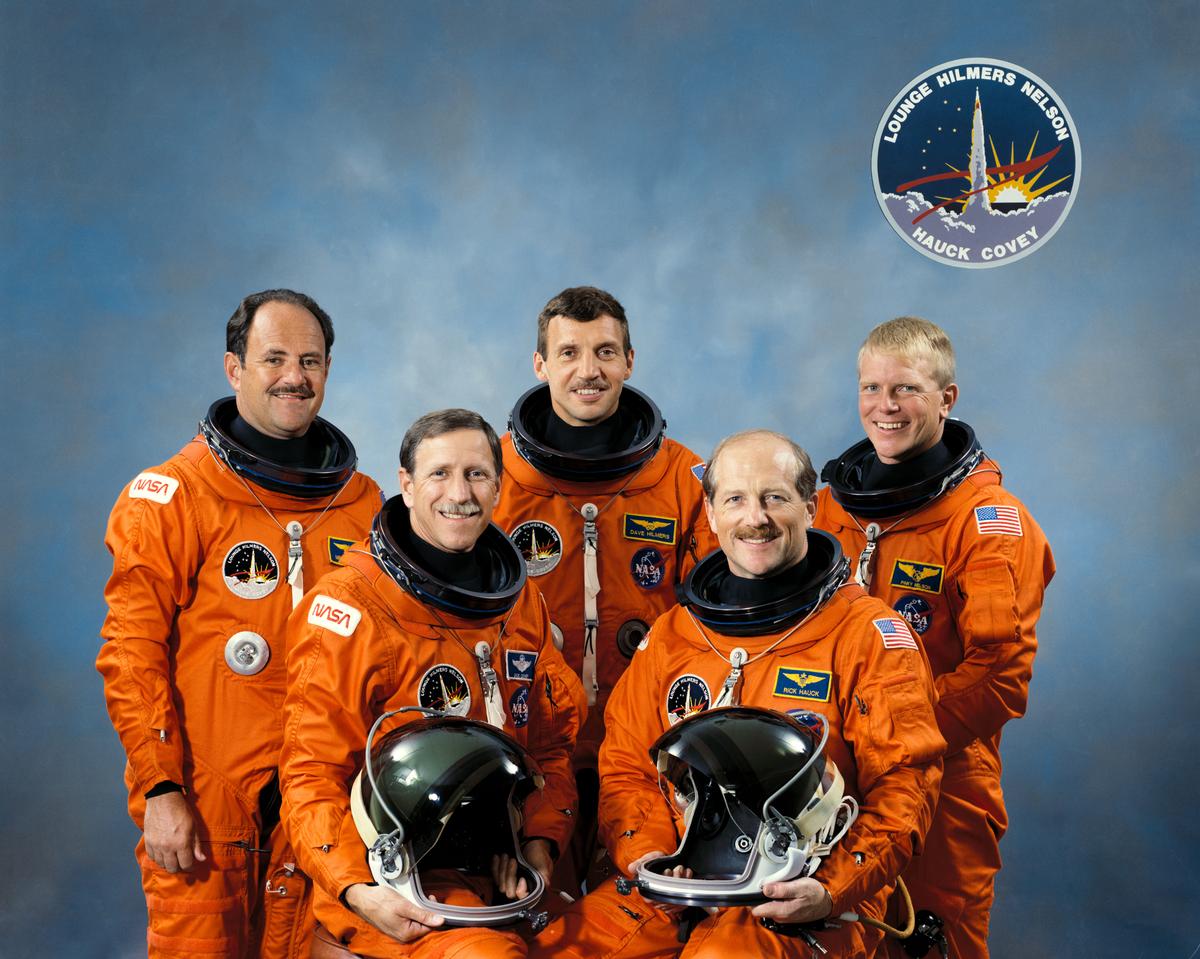
Five veteran astronauts trained for over a year to serve as NASA’s crew aboard the Space Shuttle Discovery for STS-26.
| Photo Credit:
NASA
All-veteran crew
For the first time since the historic Apollo 11 mission, during which humans set foot on the moon for the first time, NASA assembled a crew full of spaceflight veterans for STS-26. Apart from Commander Hauck, there was Pilot Richard O. Covey and Mission Specialists John M. Lounge, David C. Hilmers, and George D. Nelson.
Wearing new, bright orange space suits, the five-member crew went on board on a sunny September 29 morning. These suits, dubbed the Advanced Crew Escape Space Suit System, were full-pressure space suits with their own oxygen supply and liquid cooling system. Additionally, they included parachutes that were designed to deploy automatically during high-altitude emergencies, and also had automatic-inflation life preservers. The idea behind these features was to make these suits capable of creating an environment for survival for the astronauts during emergencies, be it during launch or reentry, and at altitudes as high as 1,00,000 feet.
The 73-second mark
The upper atmospheric wind conditions along the Florida coast were unfavourable, meaning that there was an hour and 37 minutes delay before the STS-26 was eventually launched successfully at 11:37 a.m. Even as the crew members and ground controllers continued to tick off the milestones of the flight with every passing second, a major psychological barrier had to be crossed. When the 73-second mark passed, the time at which the Challenger had been lost, many involved were still thinking about what panned out the last time they had gotten to that point.
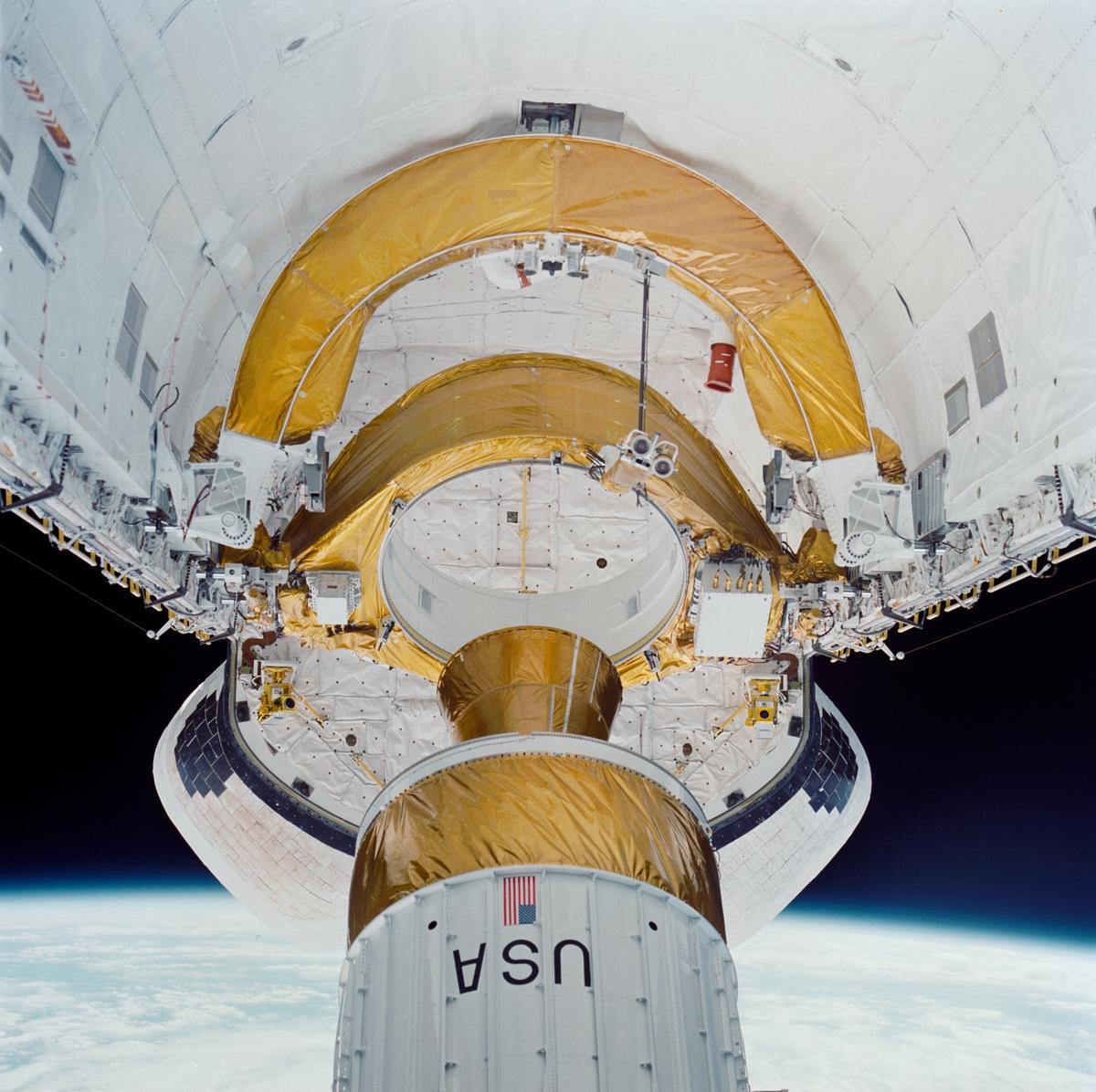
Image from September 29 shows inertial upper stage (IUS) with the tracking and data relay satellite C (TDRS-3 was called TDRS-C before it reached orbit) drifting above Discovery.
| Photo Credit:
NASA
Tasked mainly with overcoming many barriers, both technical and psychological, the four-day STS-26 mission was pretty straightforward on paper. The main goal was to deploy the second of NASA’s Tracking and Data Relay Satellites, TDRS-3, an advanced communications satellite. Once it reached geosynchronous orbit, it became part of a system that relays data to Earth from satellites, the International Space Station, and the Hubble Space Telescope.
While in orbit, the crew conducted scientific experiments. Each member of the crew also spoke briefly during a ceremony held near the end of the mission to honour Commander Francis “Dick” Scobee, Pilot Michael J. Smith, Mission Specialists Ellison S. Onizuka, Judith A. Resnik, and Ronald E. McNair, and Payload Specialists Gregory B. Jarvis and S. Christa McAuliffe – the seven people who had lost their lives aboard the Challenger.
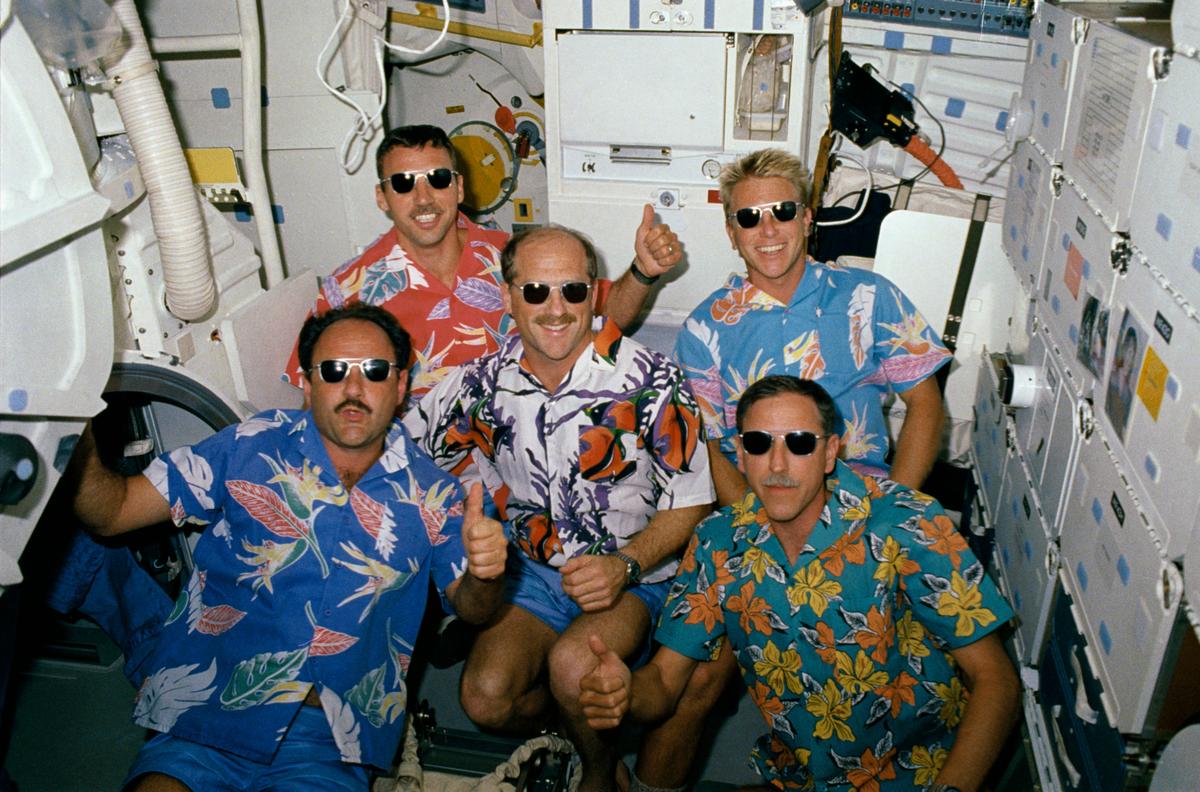
STS-26 crewmembers wear Hawaiian attire and sunglasses while giving the “thumbs up” signal as they pay tribute to the Hawaii tracking station during an unscheduled television downlink on October 2, 1988.
| Photo Credit:
NASA
After travelling 2.7 million km, Discovery returned to Earth on October 3 and landed without incident at Edwards Air Force Base, California. In the days and weeks that followed, the five-member crew travelled to all of the space centres and the contractors, thanking the workers involved for preparing them for the STS-26 mission. Even though the memories of the Challenger disaster would live on for a long time, NASA learnt what they could from it and America was back in the business of human spaceflight just 32 months after a horrific accident.
Published – September 29, 2024 12:51 am IST