



“Most people are scared of them. Why would you want to look at something that’s scaly and has a creepy crawl?” Levi Storks, assistant professor at University of Detroit, asked this with a chuckle. Yet that’s exactly what got him interested in lizards when he was a child. He would catch them, pet them, and spend hours observing them.
Now, as an evolutionary biologist, Dr. Storks studies reptiles like lizards in a bid to bridge a research gap: we don’t have a complete picture of how brains and the behaviour of their animals are linked.
Traditionally, complex behaviour has been linked to brain size and the brain-to-body size ratio. But researchers have unearthed new insights that complicate this picture. Analysing the brains of closely related lizard species from the lush green biodiversity of Puerto Rico, for example, Dr. Storks and his team found signs of a relationship between diverse habitats and brain complexity.
In a paper published recently in the journal Biology Letters, the researchers wrote, “Cognitive demands are likely higher in more complex habitats, as an animal must coordinate movement along a larger number of potential paths.”
Similar lizards, different habitats
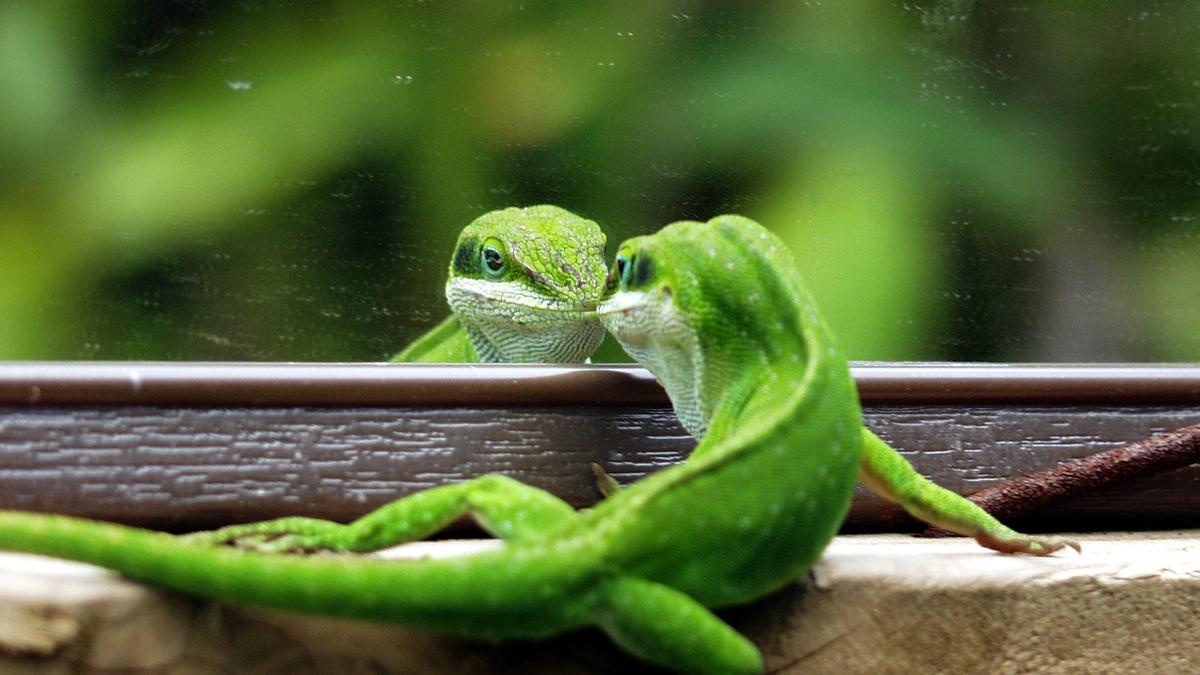
Lizards are a broad group of reptiles that includes a large variety of species with diverse characteristics. Anoles are a specific type of lizard known for their distinctive features, including an ability to change skin colour, the presence of a dewlap (a throat fan), and adhesive toe pads to climb vertical surfaces. Anoles are particularly common in the Americas, especially in tropical and subtropical regions.
Puerto Rico is an island in the Caribbean sea. Its forests are a mosaic of diverse ecosystems, including tropical rainforests like the El Yunque (montane cloud forests) meeting dry forests. The island is home to unique flora and fauna, including endangered species, and is very biodiverse.
It was summer both times — in 2019 and 2021 — when Dr. Storks went to Puerto Rico to collect specimens with his team members.“There were lizards literally everywhere,” he remembers. “That’s one of the reasons why people study anoles here,” in their rich natural environment.
The team collected 64 anoles belonging to six species but to the same ecomorph class. That is, though these anoles belonged to different species but essayed the same ecological roles and thus shared many physical traits. Genetic data also revealed these species shared a common ancestor 20-30 million years ago — not a long time in evolutionary history.
The relationship between anoles is important. Among members of other unrelated species, it’s hard to know which cause led to which effect when studying brains and behaviours. But the “anoles are very close in terms of a lot of things. This means when comparing their brains, there’s a lot of stuff that is similar except the habitat part. And so we can be very certain the habitat is doing something,” Dr. Storks said.
The team had collected anoles of the following species: Anolis evermanni, Anolis stratulus, Anolis cristatellus, Anolis gundlachi, Anolis krugi, and Anolis pulchellus.
From a 2014 study conducted by other researchers, the team had data about how complex the anoles’ habitat was. Those scientists followed more than 80 anoles of six species for at least 20 minutes and recorded (in drawings) how their movements responded to features in their surroundings. They paid attention to how many options an anole had and which ones it preferred. For example, they observed the number of branches an anole could access, the barriers in the way, and the distance to travel.
Based on the anoles’ habitats and behaviours, the team divided the six species into three groups: ‘grass bush’, ‘trunk ground’, and ‘trunk crown’.

Dr. Storks said a lizard that lives on a tree trunk is kind of navigating a country road. It can just go up and down, side to side. But the lizards that live up in the tree crown must navigate small branches as well, a challenge more like winding through a city’s stress. They need to figure out how best to negotiate a network of options to get to their destination.
In this way, different habitats impose different levels of complexity.
Neurons in complex habitats
After the team airlifted the lizards from Puerto Rico to their laboratories in the University of Detroit, team members dissected their brains to analyse differences in their neurological anatomies.
The way the brain processes information depends on many factors, including neuron number, neural plasticity, signal processing speed, synapse density, and diversity of cell types. But of late researchers have preferred analysing the neuron density because it seems to be a good indicator of a brain’s processing capacity.
The team investigated the neuron number in three regions of the anoles’ brains: the telencephalon, the cerebellum, and the rest of the brain.
Each of these parts contributes to the brain’s complex functions, from basic survival to complex thought processes. In particular, the telencephalon is involved in sensory integration and higher cognition; the cerebellum is responsible for motor coordination and learning; and the rest handles sensory inputs and motor output.
Across the six species, the study found that except in the cerebellum, the number of neurons increased with habitat complexity in the telencephalon and the rest of the brain. The anoles living in the more complex habitats, including in the tree canopy, were found to have a higher density of neurons than the anoles living on tree trunks and among grasses and shrubs.
The findings suggest that differences in neuroanatomy among Puerto Rican anoles, which have similar social structures, diets, and sensory systems, could be the result of differences in their habitats.
Similar studies in other vertebrates like Aegean wall lizards, three-spined sticklebacks, and zebrafish have also found individuals living in more complex habitats performed better at spatial learning tasks. Other studies have reported similar findings at the level of neuroanatomy and cognition.
Brain’s role in evolution
Some 320 million years ago, reptiles, mammals, and birds had a common ancestor. Over the course of evolution, that common ancestor developed into organisms that looked, behaved, and functioned spectacularly differently from each other.
“We have all these animals that derive from one kind of brain. It’s crazy to think that now we have all these animals that have a very similar brain, but also slightly different,” Dr. Storks says. “It’s a really powerful organ that is constantly changing.”
Many studies discuss brains, specifically the human brain, but not much research has been conducted to find out how brains have evolved over time or how differently brains function in various species.
“Those differences are really interesting, especially when you’re thinking about evolution,” Dr. Storks said.
Monika Mondal is a freelance science and environment journalist.
Published – September 05, 2024 05:30 am IST