

India is on its way to achieve its target of blending 20% of petrol with ethanol by 2025-26, going by the milestones on blending percentages crossed so far and the increase in ethanol production capacity.
However, the food versus fuel equation continues to hang over the ethanol economy as recent events have shown. For example, maize import has increased from April to June of this year compared to last year at a time when maize has been used to produce more fuel ethanol to compensate for restrictions on using sugarcane products. The industry, however, opines India has enough grain and sugar surpluses. Tarun Sawhney, Vice-Chairman and Managing Director, Triveni Engineering and Industries, says, “With big food stocks across the country, there is absolutely no concern about food security in the near future. I am concerned the supplies and stocks are so large that it could lead to wastage and spoiling,” he said.
All the emphasis has been on first generation (1G) ethanol that is directly made from foodgrains and sugarcane. The government should diversify and move to 2G and 3G that are more benign in terms of impact on food security.
Status of ethanol production capacity
Twenty per cent by 2025-26 would mean producing some 1,000 crore litres of ethanol for blending with petrol. “We are now seeing 13% to 15% blending with a sharp increase since 2021,” says Sourabh Banerjee, consultant on ethanol and biofuels. In 2021, the blending was around 8%. Deepak Ballani, director general of Indian Sugar and Bio-energy Manufacturers Association, says the sugar industry has invested some ₹40,000 crore in the last few years in capacity expansion. In just two years, 92 crore litre capacity was added.
The roadmap for achieving ethanol blending targets, prepared by the Niti Aayog, had laid down that the capacity of sugarcane-based distilleries would need to increase from 426 crore litres in 2021 to 760 crore litres in 2026, while grain-based distilleries’ capacity should increase from 258 to 740 crore litres. In other words, a lot more of grain-based distilleries were to come up. Besides fuel ethanol, some 310 crore litres would be needed for making ethanol for consumable liquor as well as industrial uses. Taking stock in December 2023, the government said India’s ethanol production capacity had already increased to 1,380 crore litres — some 875 crore litres capacity from sugarcane and 505 crore from foodgrains. This means the targeted total ethanol capacity is nearly achieved although with a greater sugarcane-based component.
Two interest subvention programmes for establishing new distilleries had facilitated the ramping up of ethanol generation capacity. Industry has been demanding, that to maintain momentum and create surplus capacity for other uses such as blending with diesel, these programmes should be extended and that Oil Marketing Companies (OMCs) should sign more long-term contracts with distilleries until the supply chain is well and truly formed.
Sugarcane gives rise to three main related products — sugarcane juice and syrup, B-heavy molasses and C-heavy molasses, in the order of decreasing sugar content. The first two would typically go to making sugar while the third will be used for ethanol production. In a bid to up fuel ethanol production, the government had started permitting the diversion of the first two away from sugar production to fuel ethanol. Ethanol pricing depends on the sugar content of the input. In 2022-23, 63% of fuel ethanol came from B-heavy molasses and 33% from molasses. In December, 2023, the government restricted the diversion of the first two over fears of falling sugar stocks.
Mr. Ballani, however, believes the restrictions will be removed this year. He says that out of a total production of 340 lakh tonnes of sugar in 2023-24, consumption was only 285 lakh tonnes. Some closing stock is therefore available for 2023-24, he says, adding that fears of depleting sugar surpluses are unfounded.
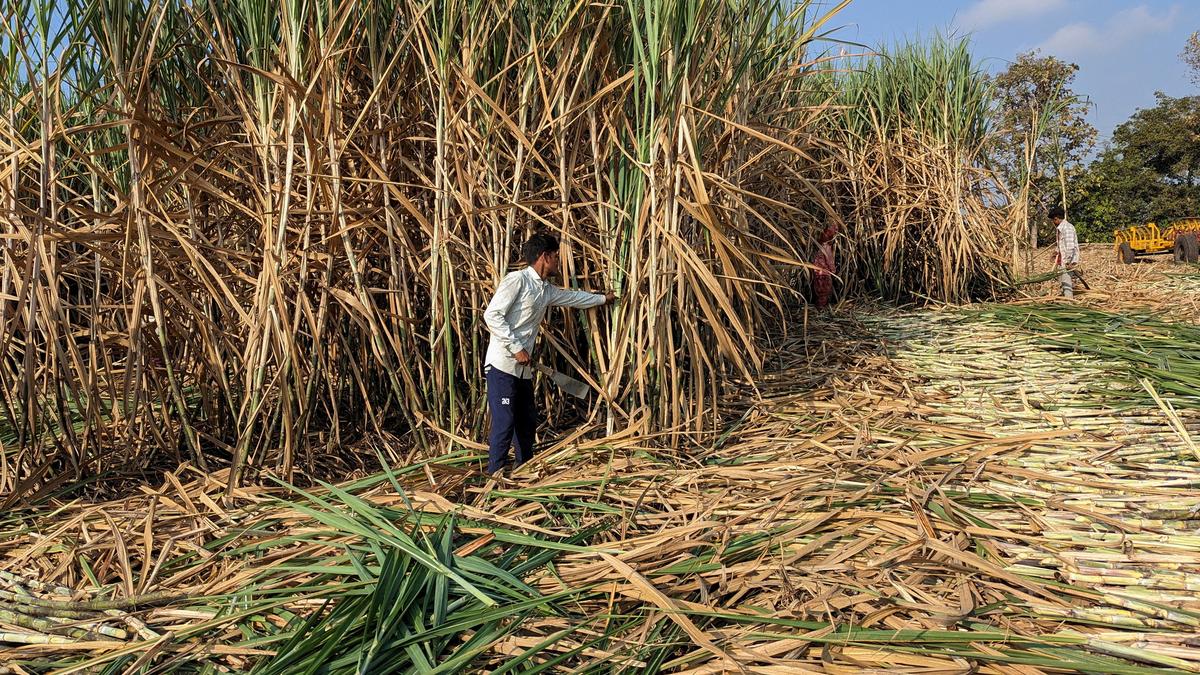
Expanding sugarcane production will have to be sustained by higher water use. Souvik Bhattacharjya of The Earth Research Institute says to sustain 50% of 1,000 crore litres from sugarcane, 400 billion litres of water would be needed additionally. Expanding sugarcane cultivation would redirect irrigation water from essential food-grain crops, exacerbating concerns about agricultural sustainability, he says. To make up for the shortfall due to restrictions on B-heavy molasses, grain-based distilleries, mainly maize, have likely been operating at full capacity to keep up with the blending percentages this year.
Government policy is that maize as well as surplus rice and damaged grains will be used to feed grain-based distilleries.
India ranks as a major maize producer globally, but domestic consumption consistently outpaces production, says TERI’s Bhattacharjya. Over the last few years, Indian maize imports have been hovering around 0.4 to 0.5 million tonnes a year. A rapid diversion to ethanol will drive up prices and negatively impact its major uses — the poultry sector by 47%, followed by livestock feed (13%) and starch (14%). At 3 to 4 tonnes per hectare, India’s maize yield is much lower than other countries, he adds.
While maize production has jumped in the last few years, ministry of commerce data shows that in 2023-24, Indian maize (corn) imports were $39 million. This year, from April to June, the import is already worth $103 million. As per NITI Aayog’s estimates, some 4.8 million hectares will have to be added to maize cultivation area to meet the 20% target, which is almost half of the typical maize cultivation area.
On fuel efficiency in automobiles
Ethanol will not only reduce greenhouse gas emissions, it will also prevent an estimated foreign exchange outgo of some $4 billion per year, as per Maruti Suzuki company estimates, and bolster the rural economy by promoting the cultivation of various crops through an assured market. Many vehicle makers say the government deadline of E20 (20% ethanol and 80% gasoline) compliance is achievable, but questions remain over existing vehicles whose performance would be affected by higher ethanol content.
The NITI Aayog report notes that ethanol brought down fuel efficiency in vehicles not suited for ethanol by an average of 6%.
Many vehicle makers say they are in line with the government deadline of 2025. A Maruti Suzuki spokesperson told The Hindu that all Maruti vehicles have been compatible with E-20 fuel since April 2023. Existing vehicles may have to go for an engine retuning and change over to E20 supported material depending on what grade they are.
How different States view the policy
Meanwhile, the developing ethanol economy has impacted States differently. While the fuel ethanol pricing is the same across India, States determine the pricing of Extra Neutral Alcohol (ENA) that goes into making liquor for consumption and other uses. That pricing has been a decider for sugarcane-based distilleries in opting for highly pure fuel ethanol vis-a-vis ENA and other forms.
In Uttar Pradesh, the government reserves some 25% of the ethanol for ENA. Mr. Sawhney says that ENA is less attractive since it offers lower value. Ethanol made from molasses, especially B-heavy molasses, offers significantly higher value, he adds. U.P. is fully aligned with the central government’s mission on ethanol, says Mr. Sawhney. U.P. is the single largest contributor to the ethanol blending program nationwide, he adds. “Most of the distilleries especially in U.P., as well as new capacity coming up, are multi-fuel, allowing them to process both sugarcane juice and molasses, and grain, including rice and maize. For the upcoming year, it is anticipated that 55% of the national requirement of ethanol will be met from sugarcane and the balance 45% would be met by grain distilleries.”
In Tamil Nadu, where liquor is a highly lucrative market for distilleries, fuel ethanol has not yet caught on as much. The State government procures and sells all the liquor. Liquor revenue is one-sixth of all government revenue.
An increase in sugarcane cultivation may not be possible because of water requirements, industry sources say. Broken rice may not be made available either. A highly placed government source said it would be bad politics in Tamil Nadu to supply rice, even broken rice, to ethanol since people will relate it to liquor and oppose. M. Ponnuswamy, Chairman and Managing director of Pon Pure Chemicals, advocates that the government should support maize cultivation as an alternative. “Maize is not water intensive. It degrades soil and cannot be the sole crop either. It can be used in rotation with sugarcane to ensure that soil fertility is not degraded,” he says. Some half a dozen distilleries for fuel ethanol are on the drawing boards and at various stages of completion. Assuring feedstock supply can help to promote a non-sugarcane distillery base in the State.
Vishal Kamat, Chairman Confederation of Indian Industry (CII) Maharashtra, says in Maharashtra it is more profitable to make ENA and supply it for other uses such as manufacturing activities, fashion and medicine than for ethanol blending. “All segments besides liquor are experiencing good demand thanks to a booming economy. This said, if there is a steady contract for procurement in blending then fuel ethanol can be attractive since additional processing will not be required after purity is ensured,” he said.
Many across the industry demand an increase in ethanol pricing.