Skip to content
  • Facebook
  • X
  • Linkedin
  • WhatsApp
  • Associate Journalism
  • About Us
  • Privacy Policy
  • 033-46046046
  • editor@artifex.news
Artifex.News

Artifex.News

Stay Connected. Stay Informed.

  • Breaking News
  • World
  • Nation
  • Sports
  • Business
  • Science
  • Entertainment
  • Lifestyle
  • Toggle search form
  • Nawaz Sharif will return to Pakistan from Dubai on October 21: report World
  • 2 Trainee Pilots From Mumbai Among 3 Killed In Canada Plane Crash Nation
  • Nepal To Export “Close To 1000 MW Electricity To India”: S Jaishankar Nation
  • Case Filed Against Sarpanch For Raping, Cheating Nurse In Palghar: Cops Nation
  • South Africans vote in a pivotal election as president says he has no doubt his ANC party will win World
  • Tremors felt in Delhi, parts of north India after four quakes hit Nepal World
  • White House Jokes About Vladimit Putin, Xi Jinping Meeting World
  • PM Modi congratulates Putin on re-election, says World

NASA just shut down a planetary defence mission that tracks asteroids. Now what?

Posted on August 15, 2024 By admin


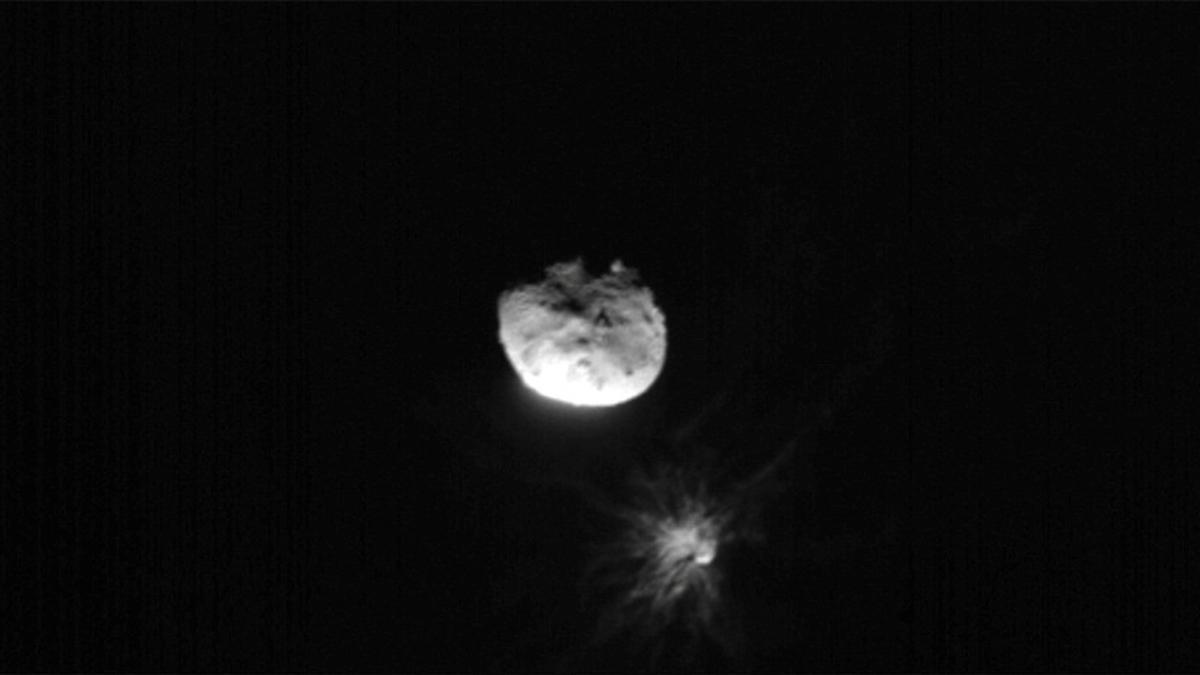
View of Didymos, Dimorphos, and the plume coming off of Dimorphos after the Double Asteroid Redirect Test, or DART mission, purposefully made impact, in this image acquired by ASI’s LICIACube satellite just before its closest approach to the Dimorphos asteroid, September 26, 2022.
| Photo Credit: Reuters

Launched in 2011, NASA’s NEOWISE mission operated in Earth’s orbit until late last week. It detected more than 3,000 near-Earth objects or NEOs – asteroids or comets whose orbits can bring them close to Earth, even with the possibility of a collision. NEOWISE was shut down on August 8.

Surveying the population of NEOs is central to the emerging concept of planetary defence. That is, understanding and mitigating the risk of collision from asteroids large enough to do significant damage to Earth.

NEOWISE has made fundamental contributions to establishing the knowledge base for planetary defence, with more than 200 of the 3,000 objects it studied not known to us previously.

Now at mission end, and commanded by NASA to shut itself down, NEOWISE will re-enter Earth’s atmosphere before the end of this year. Where does that leave us with defending our planet?

From astrophysics to planetary defence

NEOWISE started life as a different mission, simply called WISE (Wide-field Infrared Survey Explorer). It was designed to study the infrared radiation from distant galaxies in the universe.

Infrared means “beyond red” – infrared light sits just past the red end of the spectrum of colours humans can see. We know infrared radiation better as the heat from the Sun, for example, or from a radiator keeping us warm in winter.

When the coolant on the WISE mission ran out and these sensitive observations of galaxies couldn’t be carried out any more, NASA granted a mission extension under the NEOWISE name. They realised the telescope system was still sensitive enough to detect asteroids and comets that come close to Earth and the Sun, thereby having a very strong infrared signal.

NASA has an extraordinary history of squeezing extra life out of missions that reach completion. In this case, NEOWISE represented an entire second life, in an entirely different area of research.

How will we defend Earth now?

As well as the discovery and study of thousands of NEOs, NEOWISE established the foundation of knowledge that has informed a new, dedicated planetary defence mission. NASA’s NEO Surveyor will be launched in 2027.

NEO Surveyor’s goal is to discover approximately two thirds of all NEOs larger than 140 metres in diameter, over a five year baseline survey. This is a big step toward fulfilling the mandate United States Congress has provided to NASA: to discover 90% of all NEOs in this size range.

If they hit Earth, asteroids of this size could cause mass casualties if the impact were over a large metropolitan region.

You might think this poses a bit of a risk – shutting down NEOWISE three years before launching NEO Surveyor. What happens if one of these big asteroids comes our way in the next few years?

The risks are very small, as estimates show asteroids 140 metres in diameter impact Earth only approximately every 20,000 years. So, we would have to be extremely unlucky to have one in any given three-year period, especially impacting a place that would cause a large amount of damage. Only around 3% of Earth’s surface is occupied by urban areas.

NASA doesn’t really have much of a choice with the end of NEOWISE. The Sun’s 11-year activity cycle is picking up and causing Earth’s upper atmosphere, the ionosphere, to thicken. NEOWISE is flying through this ionosphere and can’t raise its orbit, so the ionosphere is inevitably dragging NEOWISE back to Earth.

NEO Surveyor started construction in 2023, so a 2027 launch is pretty impressively rapid, which is minimising the gap between NEOWISE and NEO Surveyor.

NEOWISE is scheduled to enter Earth’s atmosphere before the end of the year, but we don’t know precisely when.

Weighing almost 700kg, some of NEOWISE itself is likely to impact the surface of Earth. Hopefully it stays away from populated areas in the process – some recent re-entry events have resulted in space debris falling reasonably close to populated areas.

An asteroid is coming! What next?

Knowing about an asteroid on a collision course with Earth is one thing. Doing something about it is another thing altogether.

Huge steps toward planetary defence occurred two years ago, when the DART mission flew to an asteroid, impacted it, and changed its trajectory. This demonstrated it’s possible to change the course of asteroids, which could be used in the future to protect Earth from a collision.

Predicting potential Earth impacts as far as possible in advance, years preferably, gives the DART-style technology approach a chance.

The pioneering work of NEOWISE, and the upcoming comprehensive observations of NEO Surveyor, will place an enormous amount of information in our scientific bank, which will never go out of date and will be the basis for planetary defence for perhaps hundreds of years into the future.

This article is republished from The Conversation under a Creative Commons license. Read the original article.



Source link

Science Tags:astronomy news, NASA, NEOWIS mission, Planetary defence mission, science news

Post navigation

Previous Post: Channapatna Assembly Bypoll: “I Am The Candidate
Next Post: US State Arizona’s Ballot Can Describe Fetuses As “Unborn” Humans: Court

Related Posts

  • Crocodiles yield to flower power, study finds  Science
  • Explained | Drilling in the North Sea — history and environmental concerns Science
  • Watch | Somnath S. on ‘Transformative Leadership in ISRO’ Science
  • Genes fuel antibiotic resistance in Yemen cholera epidemic Science
  • Subclinical TB is the reason for slow drop in TB incidence, says Soumya Swaminathan Science
  • The Science Quiz | Non-classical states of matter Science

More Related Articles

Mouse embryos grown in space for first time: Japan researchers Science
Launch was critical for Chandrayaan-3 success: ISRO chairman Somanath Science
Nobel laureate supports India’s pursuit for a neutrino lab Science
How does using the AC affect a car’s mileage while driving? Science
The Science Quiz: The evolutionary edge to human survival Science
Libya dam collapse: engineering expert raises questions about management Science
SiteLock

Archives

  • August 2024
  • July 2024
  • June 2024
  • May 2024
  • April 2024
  • March 2024
  • February 2024
  • January 2024
  • December 2023
  • November 2023
  • October 2023
  • September 2023
  • August 2023
  • July 2023
  • June 2023
  • May 2023
  • April 2023
  • March 2023
  • February 2023
  • January 2023
  • December 2022
  • November 2022
  • October 2022
  • September 2022
  • August 2022
  • July 2022
  • June 2022
  • May 2022

Categories

  • Business
  • Nation
  • Science
  • Sports
  • World

Recent Posts

  • Trump campaigns to ‘make America safe again’ as Democratic convention zeroes in on his felony record
  • Sunita and Barry will be on the ISS longer than expected. What next?
  • Google Must Face Class Action Lawsuit Over Chrome’s Data Collection: US Court
  • UN Rights Expert Barred From Afghanistan: Report
  • Lodz Governor Ahead of PM Modis Visit

Recent Comments

  1. TpeEoPQa on UP Teacher Who Asked Students To Slap Muslim Classmate
  2. xULDsgPuBe on UP Teacher Who Asked Students To Slap Muslim Classmate
  3. KyJtkhneiLmcq on UP Teacher Who Asked Students To Slap Muslim Classmate
  4. mOyehudovB on UP Teacher Who Asked Students To Slap Muslim Classmate
  5. GFBvgSrWPcsp on UP Teacher Who Asked Students To Slap Muslim Classmate
  • Chunk of India’s forests ‘missing’ after 27-year-delay to file reports | Analysis Science
  • 27-Year-Old Stabbed To Death In Delhi’s Trilokpuri, Probe Underway: Cops Nation
  • Government Slashes Prices Of 41 Medicines, Including Those For Diabetes, Heart Ailments Nation
  •  EU Parliament sees a Right tilt but a dominant centre to ensure continuity  World
  • Gold rises ₹150; silver climbs ₹100 Business
  • India’s FY24 pulses imports hit 6-year high as red lentil purchases jump Business
  • Indonesia plans import duties on clothing, ceramics, minister says Business
  • Sydney blanketed by smoke for a 4th day due to hazard reduction burning World

Editor-in-Chief:
Mohammad Ariff,
MSW, MAJMC, BSW, DTL, CTS, CNM, CCR, CAL, RSL, ASOC.
editor@artifex.news

Associate Editors:
1. Zenellis R. Tuba,
zenelis@artifex.news
2. Haris Daniyel
daniyel@artifex.news

Photograher:
Rohan Das
rohan@artifex.news

Artifex.News offers Online Paid Internships to college students from India and Abroad. Interns will get a PRESS CARD and other online offers.
Send your CV (Subjectline: Paid Internship) to internship@artifex.news

Links:
Associate Journalism
About Us
Privacy Policy

News Links:
Breaking News
World
Nation
Sports
Business
Entertainment
Lifestyle

Registered Office:
72/A, Elliot Road, Kolkata - 700016
Tel: 033-22277777, 033-22172217
Email: office@artifex.news

Editorial Office / News Desk:
No. 13, Mezzanine Floor, Esplanade Metro Rail Station,
12 J. L. Nehru Road, Kolkata - 700069.
(Entry from Gate No. 5)
Tel: 033-46011099, 033-46046046
Email: editor@artifex.news

Copyright © 2023 Artifex.News Newsportal designed by Artifex Infotech.