





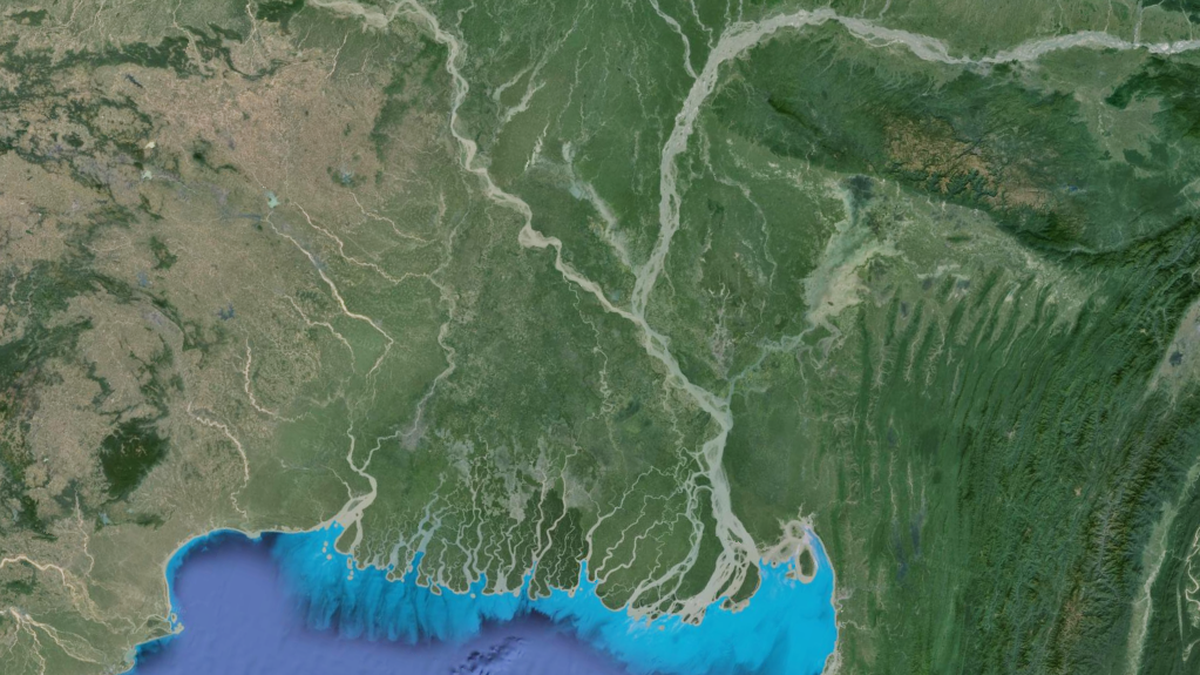
In 2018, geochronologist Elizabeth Chamberlain, an assistant professor at the Wageningen University & Research, Netherlands, and her team were in Bangladesh to study the movement of river channels in the Ganga delta. They were exploring an almost 2-km-wide “paleochannel” — a well-preserved mud and sand archive of the river’s ancient course — about 45 km to the south of the modern Ganga river. Today, the area is used to cultivate rice.
Based on geological measures in this area, they found the Ganga had abruptly changed its course — or avulsed — about 2,500 years ago, leaving behind the palaeochannel.
During their fieldwork, the team also chanced upon two large sand dikes a kilometre to the east of the palaeochannel. These dikes are formed when earthquakes disturb the river bed and cause sediments to flow as if they were liquid. Scientists call this process liquefaction.
When Dr. Chamberlain’s team spotted these sand dikes, they had a hunch they were looking at a “big event — the type that is rarely recorded and studied by scientists,” she told this reporter. They were right: these sand dikes held the first proof that earthquakes can move rivers. In their June 2024 paper published in the journal Nature Communications, the team reported an earthquake of magnitude 7 to 8 was responsible for shifting the course of the Ganga more than two millennia ago.
The study’s findings call for urgent forecasting of major earthquakes that can cause avulsion of rivers like the Ganges, Till Hanebuth, a professor of marine geosciences at Coastal Carolina University in the U.S., said. He added that making decision-makers and the people at large aware of the risk is of paramount importance so they can prepare better for such events in future.
How earthquakes move rivers
The sand dikes and their composition, consisting of “fine sands” and “silty muds”, as the researchers reported in their paper, provided conclusive evidence of a major ancient earthquake. The team figured that if this earthquake indeed caused the Ganga to avulse, the time of the earthquake and the time of avulsion should coincide.
To find the time when these two events occurred, Dr. Chamberlain used a technique called optically stimulated luminescence (OSL) dating. This method relies on estimating how long a mineral grain (i.e. a mineral particle less than a few millimetres in size, like quartz grains in sand or mud) has been buried by measuring the amount of natural radiation stored in it.
The researchers extracted mineral samples from the sand dikes and the paleochannel and treated the grains in these samples to light and heat. “As buried grains absorb low doses of natural radiation, energy builds up in their crystals,” Dr. Chamberlain explained. This is because the natural radioactivity forces electrons in the minerals to escape their atoms and become trapped in the crystal structure — or the space between the atoms — of these minerals.
“The stored energy increases over time. By estimating how much energy is stored in the grains, and measuring how radioactive their surroundings are, we can obtain how long the grains have been buried,” Dr. Chamberlain said.
To estimate the amount of energy stored, the researchers shine blue light on the grains, causing the trapped electrons to escape the crystal structure and return to the atoms. When they do so, they emit a photon of light. A photomultiplier tube captures the photons and estimates their number, leading to a measure of the trapped energy.
The subsequent OSL dating of samples from the paleochannel told the researchers that the avulsion occurred around 2,500 years ago. When the authors used the technique to date samples from the sand dikes and surrounding sand and mud, they found the dikes had been formed around the same time, strengthening their hypothesis that the earthquake led to the avulsion.
But one piece of the puzzle still remains: where did the earthquake originate? The researchers speculated in their paper that it was either born in the Indo-Burma mountain ranges or in the hills of Shillong, both locations where the Indian and the Eurasian tectonic plates meet. But “its impact was immense” irrespective of the origin, they wrote in their paper.

Future hazards
“This discovery that large earthquakes can potentially trigger major river avulsions suggests that the impact of large earthquakes can be even more devastating than previously thought,” Vamsi Ganti, a sedimentologist and associate professor at the University of California, Santa-Barbara, said.
This is because, Dr. Ganti added, “avulsions have caused some of the deadliest floods in human history, and the cascading impacts of earthquakes and flooding can be severe for heavily populated regions like the Ganges-Meghna-Brahmaputra delta.” One 2011 analysis estimated 630 million people to be living in the delta.
The risk is exacerbated by human activities and climate change, Dr. Hanebuth, the Coastal Carolina University geoscientist, said. According to him, rivers like the Ganges are more prone to avulsion now owing to two factors: the “rapid subsidence”, i.e. sinking of the ground near the river banks due to “widespread embankment”; and climate-change–induced rise in sea levels and extreme weather events.
Dr. Hanebuth further said future research should focus efforts to find out how often such quake-driven avulsions have happened and how such major earthquakes can be forecast. He added that decision-makers and the residents of the Ganga delta should prepare themselves against the risk from such avulsions. Such preparedness would require India, Bangladesh and Myanmar to work “closely together in terms of research, monitoring, preparedness, and support coordination,” he said.
“Geological and climatic issues of such magnitude do not care about political borders.”
Sayantan Datta is a science journalist and a faculty member at Krea University. They tweet at @queersprings.