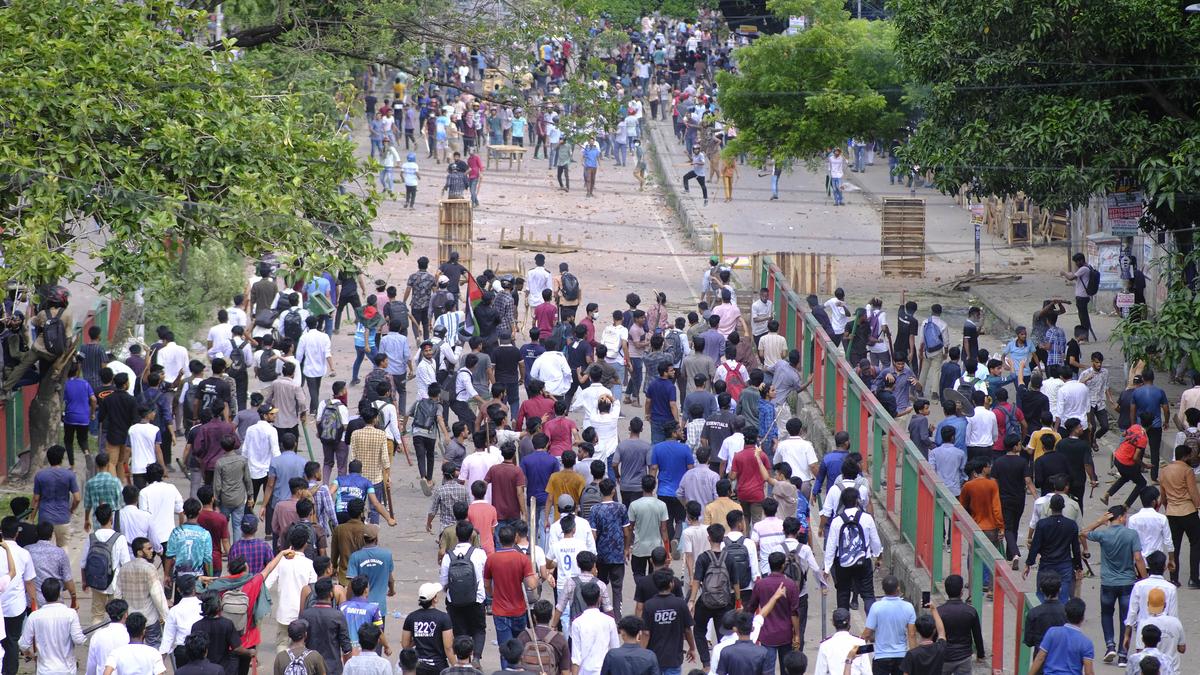



The story so far: In a shocking turn of events, Bangladesh’s Prime Minister Sheikh Hasina resigned and fled Dhaka on August 5, as protests in the capital escalated, with thousands of protestors soon entering the Prime Minister’s official residence. She is currently in India, considering asylum options in a third country.
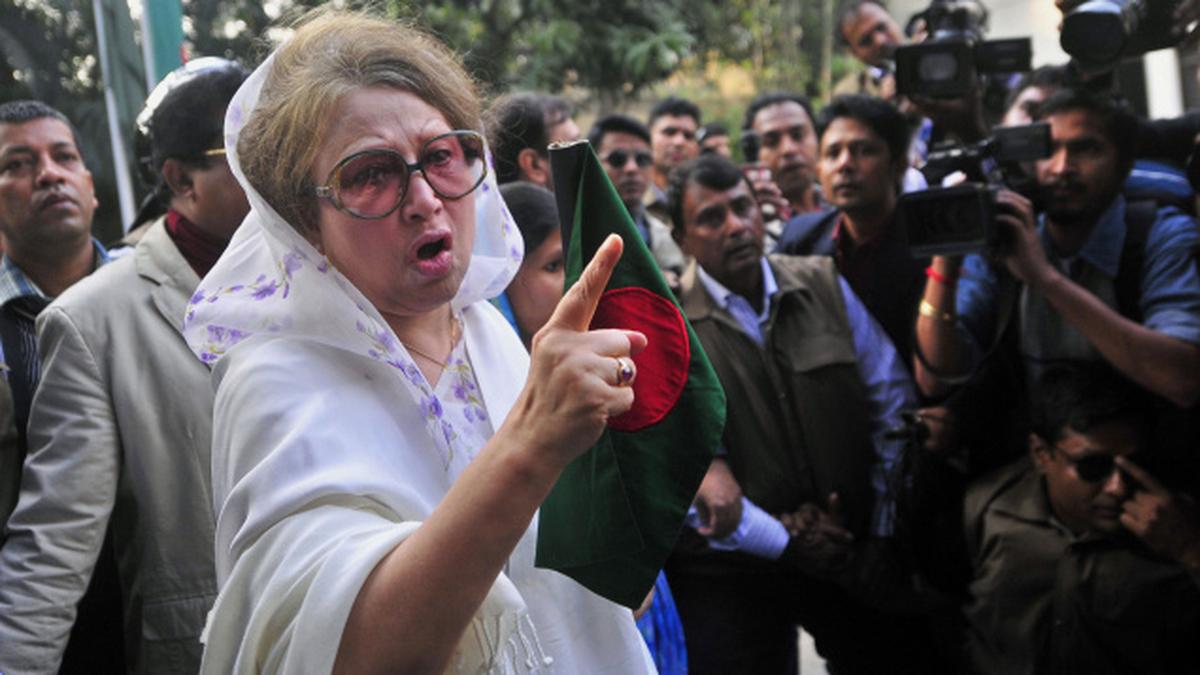
Khaleda Zia, ex-Prime Minister and head of the Bangladesh Nationalist Party (BNP) as well as imprisoned protestors have now been released. Nobel laureaute Mohammed Yunus will head an interim government, fulfilling a chief demand of the student protestors; he took oath on Thursday (August 8, 2024) along with 13 of his 16 member cabinet.
Also Read: Bangladesh protests updates
What started as a student protest over quotas accorded to freedom fighters in government jobs morphed into a protest against Ms. Hasina and the Awami League Party. Protestors demanded the resignation of Ms. Hasina as a single-point priority, while the government alleged that the BNP and the Jamaat-e-Islami were behind the agitation.
The BNP has been a dominant political force in the nation since it was founded in 1978. We take a look at the party as it stands today, its participation in the protests and its calls for Ms. Hasina’s resignation, alleging erosion of civil liberties under her regime.
What is the Bangladesh Nationalist Party?
The BNP was founded on September 1, 1978 by General Ziaur Rahman Bir Uttam, who was to later become president of Bangladesh, and a host of freedom fighters, including physician A. Q. M. Badruddoza Chowdhury, lawyer Moudud Ahmed and politician Mashiur Rahman.
The BNP’s core tenet is Bangladeshi Nationalism, which it has defined on its website as “an ideology that recognizes the right of Bangladeshis from all walks of life, irrespective of their ethnicity, gender or race.” The party had adopted a 19-point programme for the foundation of a ‘New Bangladesh’ after the Liberation War of 1971.

Under the BNP’s rule, Bangladesh’s economy opened up and moved towards capitalism, from its previous socialist bent The BNP and its student wing also spearheaded protests against Gen. Hussain Muhammad Ershad’s martial rule in the late 1980s, which eventually resulted in the ouster of his regime in 1990, and the restoration of democracy in the country.
Begum Khaleda Zia has been serving as the chairperson of the party since 1983. Her oldest son Tarique Rahman serves as the senior vice-chairman and Mirza Fakhrul Islam Alamgir is the secretary-general. The body has an affiliated student wing— the Bangladesh Jatiotabadi Chatra Dal, and an affiliated labour wing called the Bangladesh Jatiyatabadi Sramik Dal.
Political journey
The BNP saw early success after its formation. It won Presidential elections in 1978, and Gen. Ziaur became President. He launched economic reform and privatisation. In 1979, the BNP won 207 of 300 seats in the second election, coming to power with a solid majority.
However, Gen. Ziaur was killed by a group of army officers in 1981, and Abdus Sattar became the head of the BNP. Ziaur’s widow— 35-year-old Khaleda Zia, mother of two young sons and a political novice — took over as the party’s vice president.

Ms. Zia, however, proved her mettle quickly, rising to the rank of BNP President in 1989. In the 1991 elections, BNP emerged triumphant, and Begum Zia was elected as the first woman prime minister of Bangladesh. This also made her the second woman prime minister among all the Muslim-majority nations, after Pakistan’s Benazir Bhutto in 1988.
Ms. Zia followed through on economic reforms, further liberalising Bangladesh’s economy during her first term in the early 1990s. Ms. Zia was known for her determination, but her uncompromising attitude prevented her from making important deals with allies, both at home and abroad.
She was re-elected for a second term in 1996, in an election boycotted by the Awami League, which saw a paltry 21% voter turnout. There were growing demands for fresh elections, following which Ms. Zia’s government passed the thirteenth Amendment to the constitution, that allowed the creation of a neutral caretaker government to allow for peaceful transfer of power. Her term was short– after a mere 12 days, Ms. Zia resigned. She handed over the reins to a caretaker government headed by former Chief Justice Mohammad Habibur Rahman.
She ran for reelection but the BNP lost. It, however, came second to the Awami League in the polls and emerged as the largest opposition party in the history of Bangladesh’s Parliamentary elections, winning 116 seats.
In 2001, the BNP returned to power again in coalition with three Islamist parties, sweeping 215 seats. Ms. Zia returned for her second term as Prime Minister. This term however, was marked by turmoil. There was a series of Islamist attacks which undermined her regime. On August 17, 2005, 469 bomb blasts took place in 63 locations across Bangladesh, killing two and injuring more than a hundred. Another area of controversy was Ms. Zia’s reported patronage of Siddique ul-Islam alias Bangla Bhai pivotal in forming the militant outfit Jama’atul Mujahideen Bangladesh (JMB). Further, she created an anti-crime Rapid Action Battalion police unit, which came under heavy criticism for alleged extrajudicial killings.
Lastly, there were graft allegations against Ms. Zia and her sons, framed by the BNP as a politically motivated effort to expel Ms. Zia and her legacy from politics.

In January 2007, a political crisis led to an emergency rule by the military, which set up a caretaker government, headed by then-Army Chief Gen. Moeen U. Ahmed. This government launched a ‘fight against corruption’ and arrested both Ms. Hasina and Ms. Zia on allegations of bribery and corruption. After months of imprisonment with others of her family, Ms. Zia was released in September 2007.
In the 2008 election, the BNP and its allies won more than 40% of the vote, but lost to the Awami League, which got an absolute majority. The BNP only managed to secure 29 seats — a start of a fall from grace.
In 2009, Sheikh Hasina began her second term as Prime Minister with an absolute majority of 263 seats— the start of a 15-year rule over Bangladesh.
Battle of the Begums
The feud between Ms. Zia and Ms. Hasina is well-known, and called the “Battle of Begums” in Bangladesh, with “begum” being an honorific used in South Asia among the Muslim community for powerful women. The feud dates back to 1975, with its roots in the murder of Ms. Hasina’s father — Bangladesh’s ‘founding father’ Sheikh Mujibur Rahman — along with her mother, three brothers and many other relatives in a military coup.
It was Ms. Zia’s husband Ziaur Rahman who was the then deputy army chief, and who effectively took control of the government three months later.

Notably, Ms. Zia and Ms. Hasina fought shoulder to shoulder to push Ershad out in a wave of protests in 1990 and then faced off in Bangladesh’s first free polls. Ms. Zia won and led from 1991-96, and again in 2001-2006, as she and Ms. Hasina alternated in power.
Their feud carried on well after Ms Hasina came to power– even in personal life. When Ms. Zia’s youngest son died due to a heart attack in Malaysia in 2015, Ms. Hasina visited her home to offer her condolences. But Ms. Zia would not even open the door.
Boycott of elections and current status
The BNP did not have representation in the Parliament after it boycotted the national elections of 2014, calling them a farce. The elections that year were marked by very low turnout.
Ahead of the 2018 elections, Ms. Zia was sentenced to a five-year jail term, which was later extended to 10 years. In February 2018, she was sentenced to 17 years in prison for two graft cases. She was placed under house arrest since March 25, 2020, following a conditional release sanctioned during the COVID-19 pandemic. She was not allowed to leave her house in Dhaka’s Gulshan area, where she took up residence after the Hasina government cancelled the allotment of her late husband’s palatial house in the Cantonment area in 2010.
Due to her conviction, Ms. Zia was barred from contesting polls, as the Constitution prohibits the participation of a convicted person sentenced to over two years in prison. Mr. Rahman, her son, led the BNP from exile in London. But he, too, was convicted in absentia in Bangladesh and sentenced to life imprisonment over his alleged participation in a bomb attack on a 2004 Hasina rally.
In October 2023, the 17-doctor panel treating Ms Zia claimed she was at “high risk” of dying without urgent medical intervention abroad. She was, however, denied permission to leave the country by the Hasina government.

The BNP boycotted the next national elections as well, which were held on January 7, 2024. The BNP leaders dubbed the polls fake and engaged in an anti-government movement through a “peaceful public engagement programme,” which included several strikes. The ensuing elections saw a fall in voter turnout — from over 80% five years ago to 40%— and a return of Sheikh Hasina, yet again, to the Premier’s post.

The BNP has been vocal about its belief that Ms. Hasina has caused a severe curtailing of democracy in the nation. In an interview with The Hindu last year, Iqbal Hasan Mahmud, part of the BNP’s standing committee, said: “India should support the people of Bangladesh in the same way that it supported us in 1971. Today, the people of Bangladesh are living without their right to a transparent election. As a citizen of my country, I hope India will not stay silent in the face of erosion of democracy in Bangladesh.”
Now, too, senior BNP leaders have emphasised the importance of ties between India and Bangladesh, but also expressed that it was “natural to evoke adverse reaction” in Bangladesh that India had given refuse to Ms. Hasina.
“It would have been better had she not fled to India, as we are yearning to have good relations with India. Bangladesh and its people believe and see India as a friend,” BNP Vice-Chairman Abdul Awal Mintoo said to PTI..
Role in current protests
The key issue at the centre of the storm that led to Ms. Hasina’s eventual downfall was an unpopular quota system for government jobs, which was introduced by Sheik Mujibur Rahman soon after Bangladesh attained freedom. More than 50% of government jobs in the country were reserved for different sections of society, with 30% being set aside for the descendants of freedom fighters. Ms. Hasina removed the quota following protests in 2018. But in June 2024, the Bangladesh High Court reinstated this old quota system, triggering an outcry from students. Protests first sprung up on university campuses, and later spread across the country.

After the first round of protests, the Bangladesh Supreme Court curtailed the quota system, setting the reservation cap for the descendants of freedom fighters at 5%. But the fire had been stoked.
Ms. Hasina’s actions to tackle the protests did not aid her cause. She had called the protesters ‘razakars’, a denigrating term used for those Bangladeshis who had helped Pakistani troops during the Liberation War. She also deployed excessive force in her effort to quell the uprising.
On August 4, a new round of protests was launched by the students with a single, forceful demand — Sheikh Hasina must go. The protestors also sought accountability for the deaths of over 200 of their comrades.
Dhaka, a megacity of 10 million people, was set for a major standoff between student protesters, backed by the BNP and Jamaat, and the security personnel and Awami League activists. It was following this major protest that Sheikh Hasina resigned and fled the nation.
The road ahead
Now, the interim government headed by Mr. Yunus will be in power till the next steps for the nation become clearer. President Mohammed Shahbuddin dissolved parliament and announced that the country will soon have a general election.
Mr. Yunus will be advised by 16 individuals, chosen after consultation with the student protestors and civil society. The Cabinet members are: Saleh Uddin Ahmed, Asif Nazrul, Adilur Rahman Khan, Hasan Arif, Tauhid Hossain, Syeda Rizwana Hasan, Brig. Gen. (Retd) M. Sakhawat Hossain, Supradip Chakma, Farida Akhtar, Bidhan Ranjan Roy, A.F.M. Khalid Hossain, Nurjahan Begum, Sharmin Murshid, Md. Nahid Islam (students’ representative), Asif Mahmud Sajib Bhuiyan (students’ representative) and Farooqui Azam.
Notably, no representative from the Awami League was at the swearing-in ceremony.
Ms. Zia has been released. She is at present in poor health, confined to a wheelchair with rheumatoid arthritis and dealing with diabetes, heart problems and liver cirrhosis. Reports say that her son Tarique Rahman is expected to return to Bangladesh now.
As the nation undergoes a political transformation, it remains unclear what role the BNP will play. But with Ms. Hasina temporarily out of the picture, the resurgence of BNP remains a distinct possibility.