



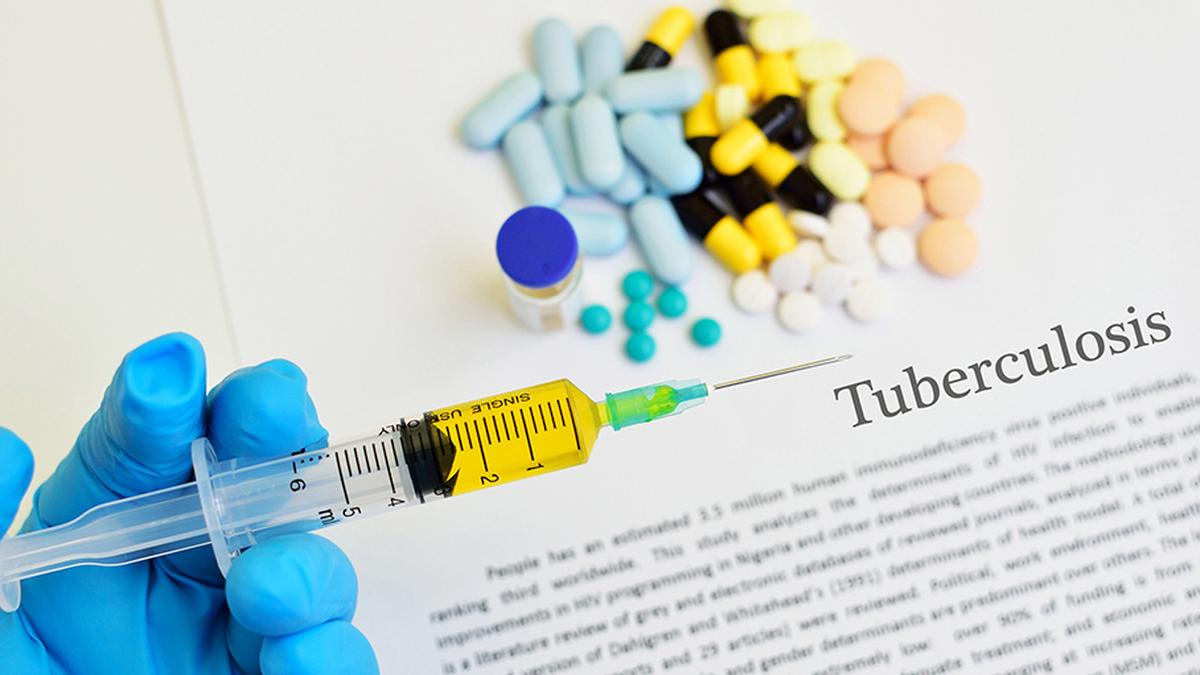
Tuberculosis dates back more than 9,000 years. It is the most infectious bacterial disease and in 2022 10.6 million people fell ill with it.
| Photo Credit: Getty Images/iStockphoto
Tuberculosis dates back more than 9,000 years. It is the most infectious bacterial disease and in 2022 10.6 million people fell ill with it. Of these 23% occurred in Africa.
The only vaccine against tuberculosis, the Bacillus Calmette-Guérin (BCG) vaccine, is more than 100 years old and is primarily effective for infants and young children.
Researchers at the University of the Witwatersrand School of Pathology have made a significant breakthrough in vaccine development by gene-editing the BCG to make it more effective.
Mice vaccinated with the modified BCG vaccine were better able to limit tuberculosis growth in their lungs than mice that had received the original vaccine.
Microbiologist Bavesh Kana, one of the lead researchers, explains to Nadine Dreyer from The Conversation Africa the science behind this breakthrough and the potential it holds for other vaccines.
 How do vaccines work?

Vaccines primarily work by mimicking dangerous infectious agents. You want your immune system to recognise the vaccine as an “invader” and then mount an immune response to it. But you don’t want the invasive agent to make you sick.
To understand how vaccines work, it helps to look at how the immune system works, because vaccines harness the natural activity of your immune system.
The immune system: There are about 100 trillion bacteria and viruses in the gastrointestinal tract.
The proteins and sugars on the surface of bacteria, viruses or other disease-causing pathogens have different shapes to any of the ones in the human body. These markers are pathogen-associated molecular patterns, commonly known as PAMPs. Think of the spikes on coronavirus.
So, your immune system quickly recognises the invaders. And the body fights back with a complex chain of events involving many different types of white blood cells working together. See video below on how the immune system works.
One type of white blood cell is able to make antibodies to fight the invaders. These antibodies can stick to the proteins or sugars on the bacteria’s surface, and this kills the bacteria or disables them. They have to be exactly the right shape, a bit like a key fitting a door. These white blood cells are known as B-cells.
Producing antibodies of the right shape can take several days. By this time there could be billions of disease-causing bacteria in your body.
Once the right cells are activated, they quickly divide and turn into a production line, making masses of antibodies that stick to the invading agents and disable them.
Eventually, your body gets rid of all the invaders and you recover.
Antibodies remain in the blood, and some white blood cells may also become memory cells for specific bacteria in case they invade the body again.
So with this stored arsenal of tools the immune system will respond quickly to future invasions.
Vaccines: Vaccines work in the same way as the immune system. They contain weakened or dead bacteria or viruses or even just a few proteins or sugars from the surface. This is enough to convince the immune system that a real invader has entered the body.
So the same process takes place as when real bacteria or viruses invade our bodies, except you don’t get ill afterwards. Vaccines are engineered to look like pathogens but are made in such a way that they do not make you sick.
When you do encounter the real agent, you have immunological memory, because your body has been exposed to something that looks very similar.
And that immunological memory allows you to withstand the infection or even prevent establishment of full infection, or to manage the infection without getting too sick.

How did you go about modifying the TB vaccine?
TB vaccines are very challenging to develop. The bacterium that causes the disease is complex. It is also proficient at evading the human immune system, which is why there is only one vaccine that has been developed against the disease in 100 years.
Our laboratory does a lot of TB research and for a long time we’ve been interested in the cell wall of these bacteria. We noticed that the cell wall has a small chemical decoration on the surface and that chemical decoration allows the bacteria to hide an important marker (PAMP), called the NOD-1 ligand, from the immune system.
Both the tuberculosis and the live bacteria used in the BCG vaccine are able to hide the NOD-1 ligand from the immune system, making it harder for the body to detect them.
We thought that modifying the BCG bacterium so it cannot hide this NOD-1 ligand might lead to a new, more effective vaccine.
To investigate this possibility we turned to CRISPR, a gene editing technology that allows scientists to modify DNA.
We used CRISPR to develop a modified version of the BCG bacterium which is unable to hide its NOD-1 ligand.
Mice vaccinated with the modified BCG vaccine were better able to limit tuberculosis growth in their lungs than mice that had received the original vaccine.
Further studies will be needed to modify the vaccine for use in humans.

What happens now?
Our findings offer a new candidate vaccine in the fight against tuberculosis.
With some novel vaccine candidates in the pipeline, we can finally begin to address this devastating illness adequately.
This work is very exciting because it demonstrates that gene editing is a powerful way to develop vaccines and may help develop more effective vaccines for other diseases in the future.
Bavesh Kana is the Head of the Centre of Excellence for Biomedical TB Research at the University of the Witwatersrand. This article is republished from The Conversation.