



Skip to content
  • Facebook
  • X
  • Linkedin
  • WhatsApp
  • Associate Journalism
  • About Us
  • Privacy Policy
  • 033-46046046
  • editor@artifex.news
Artifex.News

Artifex.News

Stay Connected. Stay Informed.

  • Breaking News
  • World
  • Nation
  • Sports
  • Business
  • Science
  • Entertainment
  • Lifestyle
  • Toggle search form
  • US NSA Jake Sullivan in India; NSA Ajit Doval holds wide-ranging talks with his American counterpart Sullivan World
  • US May See Deep Recession, Could Impact India’s Markets, Exports: Economist Nation
  • Without A Single Word, Rohit Sharma’s Post On Mumbai Indians Says It All Sports
  • “Spent Last 3 Days In Bed, Was On Painkillers”: Riyan Parag, After Match-Winning 84 Sports
  • Crowd’s Special Gesture For Hardik Pandya At Wankhede Stadium Months After He Was Booed – Watch Sports
  • Kane Williamson Bounces Back To Captain New Zealand At ODI World Cup Sports
  • Russia’s Putin says world conflicts ‘strengthen’ ties with China World
  • What Shaped Tibet’s Modern History? New Book Delves Into Its Complex Dynamics Nation

Scientists report trees absorb methane as well

Posted on July 26, 2024 By admin


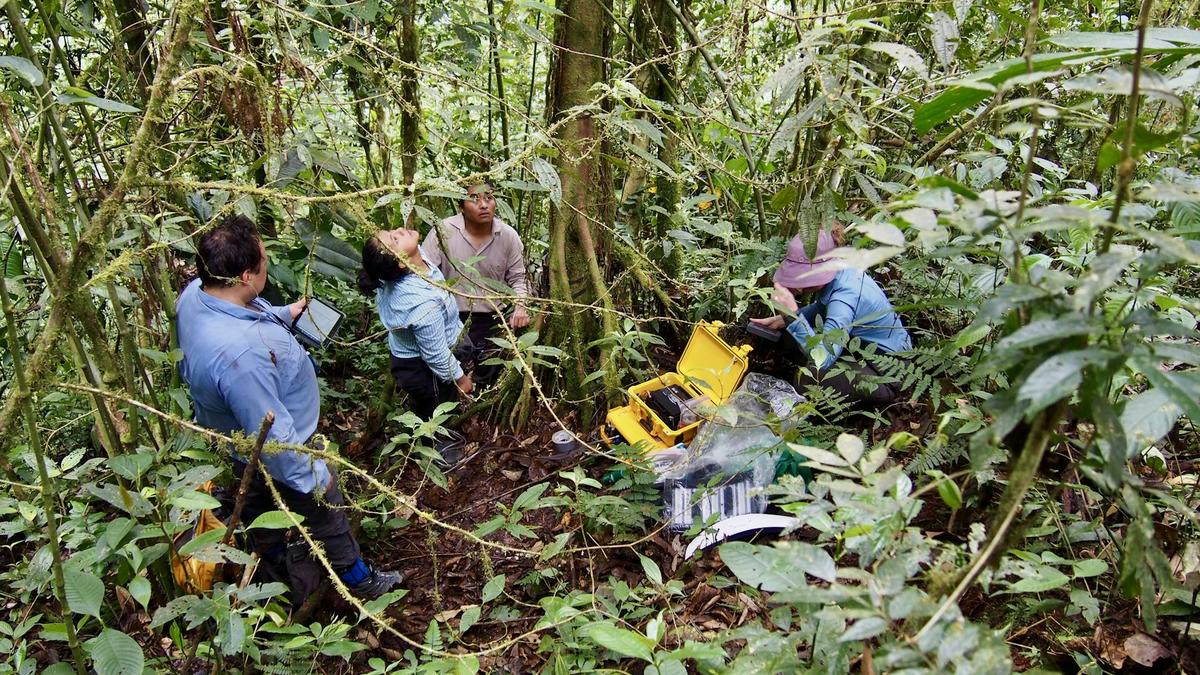
Researchers measure methane exchange on upland trees in Peru.
| Photo Credit: Vincent Gauci (CC BY-ND)

Tree bark in the world’s forests absorbs the greenhouse gas methane, my colleagues and I have demonstrated for the first time on a global scale – a discovery that could have big implications for tackling climate change.

As trees photosynthesise, their leaves take up carbon dioxide (CO₂) and lock it away as biomass in their trunks and branches providing a long-term store of carbon. But now, our large-scale study proves that there’s another way that trees absorb greenhouse gases – so forests can provide even more climate benefits than previously thought.

Methane has contributed about a third of the observed climate warming since preindustrial times. Concentrations of methane in the atmosphere have been rising rapidly for the best part of two decades.

That’s a real problem for Earth’s climate because methane traps much more heat in the atmosphere than the equivalent amount of CO₂. But while CO₂ can last in the atmosphere for hundreds of years, methane has a lifetime of around ten years.

This short atmospheric lifetime means that any changes to sources of methane or processes that remove methane from the atmosphere (known as methane sinks) can have rapid effects. If removal is enhanced, this can be a quick climate win helping to mitigate escalating climate change.

That’s why researchers are so interested in understanding how methane gets into the atmosphere and how different processes remove it. It’s why my team of ecologists and climate scientists have been studying the exchange of methane between tree bark, a surface that had previously been overlooked for its climate contribution, and the atmosphere.

Wetlands are known to be the primary natural source of methane – trees in swamps and floodplains can emit methane from the lower portions of their trunks. But methane exchange in trees growing on free-draining soils that don’t flood – that includes most of the world’s forests – has not been well-studied, until now.

We measured methane exchange on hundreds of tree stems in forests along a climate gradient spanning the Amazon and Panama, through to Sweden and forests near Oxford in the U.K. We used a simple plastic chamber that wrapped around the tree trunk which was then connected to a laser-based methane analyser.

At first, we looked for methane emissions from trees, and some do emit a small amount from their trunk base. But the surprise happened when we measured higher up the trunks: trees were taking up methane from the atmosphere and this methane removal grew stronger the higher up we went, with methane removal from the atmosphere dominating overall exchange.

Next, we investigated whether this was a globally important process. To do this we needed to calculate the global area of tree bark. Using a technique called terrestrial laser scanning, we mapped tree woody surfaces down to the finest twig.

We discovered that, if the bark from all the world’s trees were laid flat, it would cover all of Earth’s land surface. Potentially, this represents a vast area for gas exchange between tree bark and the atmosphere but this mechanism is still poorly understood.

An untapped sink

In total, our cautious first estimate is that trees take up between about 25 and 50 million tonnes of atmospheric methane each year, with most taken up by tropical forests.

This is similar to the only other land-based methane sink – soils – and it makes temperate and tropical trees 7%-12% better for climate than they are currently credited for.

But unlike soil, which isn’t changing in area, forests are contracting and expanding through deforestation and reforestation – these changes can influence atmospheric methane. If we reforest and plant trees in the right place, more methane could be drawn down from the atmosphere.

Clearly, decarbonisation of the global economy and energy system is the key way to address climate change. But, this capacity for tree bark to absorb methane offers another angle of attack as a nature-based climate solution.

There may be new ways to improve methane uptake in plantation forestry, by selecting trees that are particularly good at atmospheric methane removal or modifying tree bark microbial communities.

Nations could be given greater incentives to preserve existing natural forest and avoid further deforestation. Expensive reforestation projects may become more economically viable under reputable carbon offset schemes that consider methane.

This new evidence reinforces the importance of trees and forests for our climate system while demonstrating there is still much to learn about these valuable ecosystems.

Vincent Gauci is Professorial Fellow, School of Geography, Earth and Environmental Science, University of Birmingham. This article is republished from The Conversation.

The Conversation


Source link

Science Tags:methane capture, Methane emissions, methane formula, methane gas, trees absorb methane

Post navigation

Previous Post: Smriti Mandhana, Renuka Thakur Shine As India Beat Bangladesh, Enter Women’s Asia Cup Final
Next Post: Tax Body Clarifies Acquisition Cost Of Real Estate Bought Before 2001 For LTCG

Related Posts

  • Sci-Five | The Hindu Science Quiz: On weird animals  Science
  • President Murmu congratulates ISRO for successful deployment of Pragyan Rover Science
  • How was popcorn discovered? An archaeologist explains Science
  • The man behind the Mersenne primes Science
  • In pictures | Rare blue supermoon dazzles stargazers around the globe Science
  • What is micellar water and how does it work? Science

More Related Articles

Climate change is causing marine ‘coldwaves’ too, killing wildlife Science
Predatory fish use rapid colour changes to coordinate attacks Science
Like India’s PRATUSH, astronomers want to put telescopes on, around the moon Science
NASA shifts UFO debate from sensationalism to science | Data Science
NASA touts space research in anti-cancer fight Science
India’s ‘heat trap’ cities make summers worse, says government official Science
SiteLock

Archives

  • July 2024
  • June 2024
  • May 2024
  • April 2024
  • March 2024
  • February 2024
  • January 2024
  • December 2023
  • November 2023
  • October 2023
  • September 2023
  • August 2023
  • July 2023
  • June 2023
  • May 2023
  • April 2023
  • March 2023
  • February 2023
  • January 2023
  • December 2022
  • November 2022
  • October 2022
  • September 2022
  • August 2022
  • July 2022
  • June 2022
  • May 2022

Categories

  • Business
  • Nation
  • Science
  • Sports
  • World

Recent Posts

  • Court Extends Stay On Order Allowing Indrani Mukerjea To Travel Abroad
  • Married Woman Tied To Tree, Face Blackened, Hair Chopped Over Affair In UP: Cops
  • Man Dies In Spain After Contracting ‘Ebola-Like Disease’ From Tick Bite
  • Heat Warning Issued For Paris During Games On Tuesday
  • Sensex, Nifty retreat from record highs to close flat ahead of key US Fed rate decision

Recent Comments

  1. KyJtkhneiLmcq on UP Teacher Who Asked Students To Slap Muslim Classmate
  2. mOyehudovB on UP Teacher Who Asked Students To Slap Muslim Classmate
  3. GFBvgSrWPcsp on UP Teacher Who Asked Students To Slap Muslim Classmate
  4. ywdVpqHiNZCtUDcl on UP Teacher Who Asked Students To Slap Muslim Classmate
  5. bRstIalYyjkCUJqm on UP Teacher Who Asked Students To Slap Muslim Classmate
  • 50 Ambulances To Be Stationed At Venue, Hotels, Airport During G20 Summit Nation
  • Adani group shares fall after media report on alleged over-invoicing of coal imports  Business
  • Mcap of six of top 10 firms jumps ₹70,527.11 crore; Reliance Industries biggest gainer Business
  • Former fire chief who died at Trump rally used his body to shield family from gunfire World
  • Indian economy shining as beacon of hope in challenging times, says PM Modi Business
  • Baltimore bridge collapse: Crew of cargo ship that collided with Baltimore bridge all Indian, says shipping company World
  • “Yuzvendra Chahal Or…”: Rahul Dravid’s Mega Hint On Change In India XI vs Afghanistan In T20 WC Super 8 Sports
  • What We Know About Shooting At Concert Venue Near Moscow World

Editor-in-Chief:
Mohammad Ariff,
MSW, MAJMC, BSW, DTL, CTS, CNM, CCR, CAL, RSL, ASOC.
editor@artifex.news

Associate Editors:
1. Zenellis R. Tuba,
zenelis@artifex.news
2. Haris Daniyel
daniyel@artifex.news

Photograher:
Rohan Das
rohan@artifex.news

Artifex.News offers Online Paid Internships to college students from India and Abroad. Interns will get a PRESS CARD and other online offers.
Send your CV (Subjectline: Paid Internship) to internship@artifex.news

Links:
Associate Journalism
About Us
Privacy Policy

News Links:
Breaking News
World
Nation
Sports
Business
Entertainment
Lifestyle

Registered Office:
72/A, Elliot Road, Kolkata - 700016
Tel: 033-22277777, 033-22172217
Email: office@artifex.news

Editorial Office / News Desk:
No. 13, Mezzanine Floor, Esplanade Metro Rail Station,
12 J. L. Nehru Road, Kolkata - 700069.
(Entry from Gate No. 5)
Tel: 033-46011099, 033-46046046
Email: editor@artifex.news

Copyright © 2023 Artifex.News Newsportal designed by Artifex Infotech.