


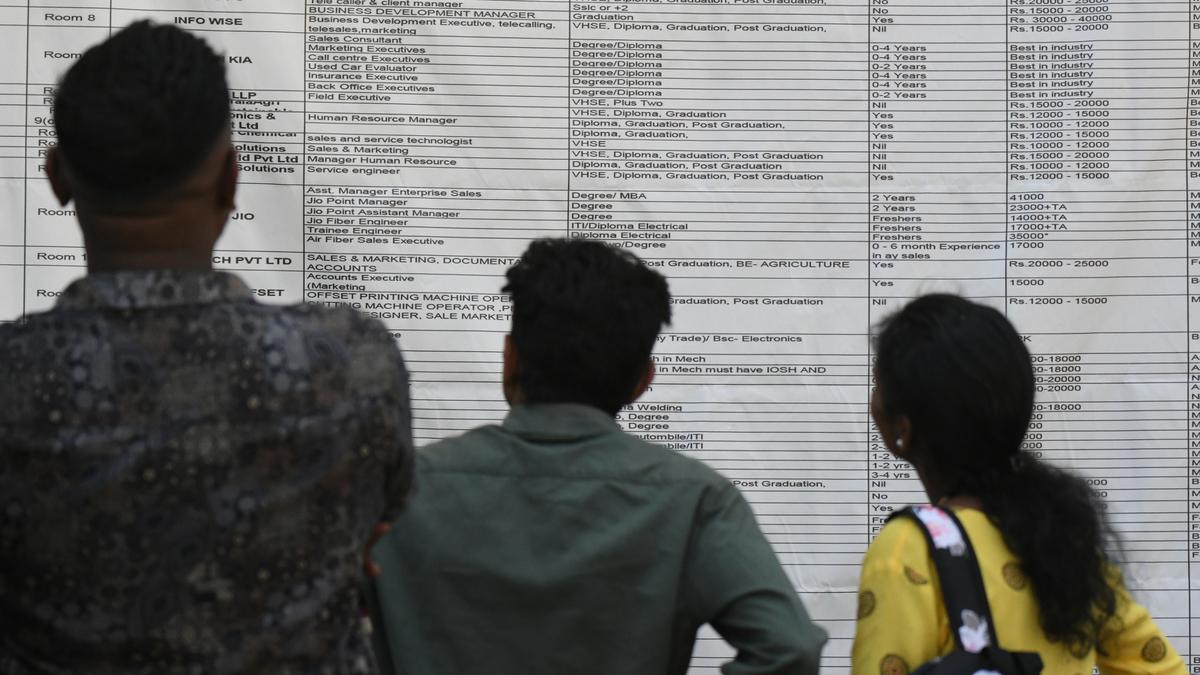
Job seekers in Kerala.
| Photo Credit: The Hindu
The chapter on employment in the Economic Survey starts with the observation: “Employment is the crucial link between growth and prosperity, and its quantity and quality determine the extent to which economic output translates into better quality of life for the population.” This “crucial link” between growth of economic output, measured by official GDP estimates, and gainful employment, especially decent jobs in the formal economy, has become increasingly tenuous.
The Survey cites official data to corroborate the jobless growth experience. Factory jobs in manufacturing have grown only by 32 lakh between 2013-14 and 2021-22, with only three States (Tamil Nadu, Gujarat and Maharashtra) accounting for 40% of total factory sector employment in India. There was an overall reduction of 16.45 lakh in total employment in unincorporated non-agricultural establishments in manufacturing and services (2015-16 to 2022-23).
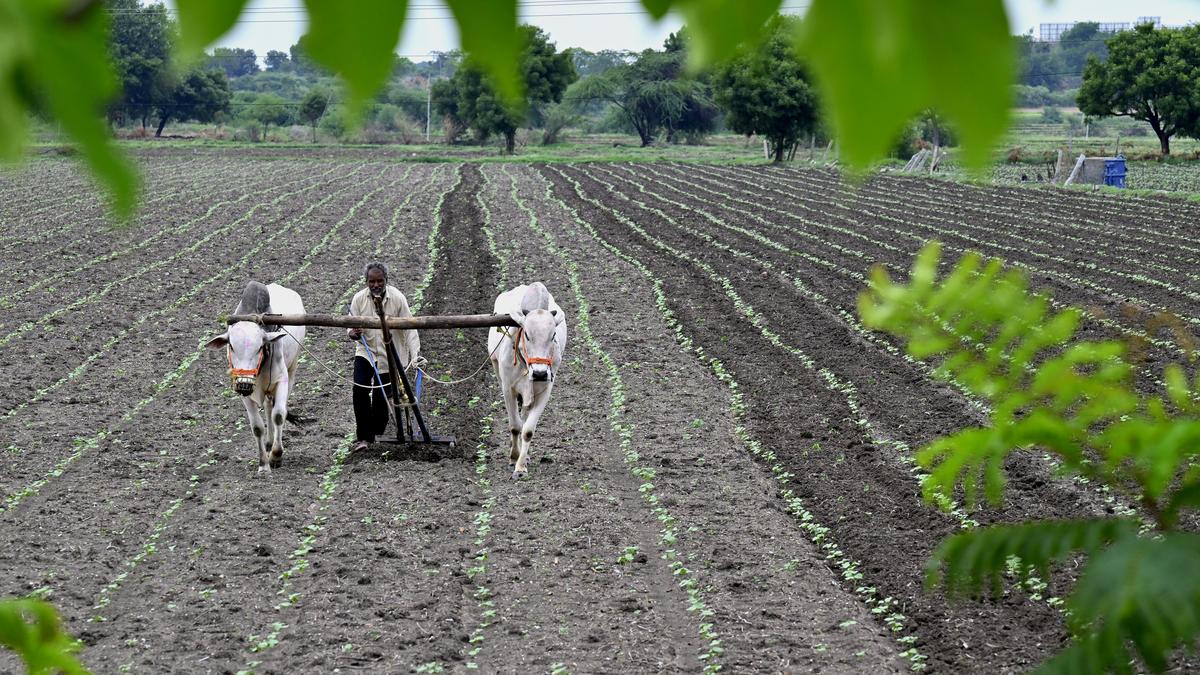
India’s total workforce was estimated at 56.5 crore in 2022-23, of which over 57% were self-employed with average monthly earnings at ₹13,347. Over 18% worked as “unpaid workers in household enterprises”. The proportion of the workforce engaged in agriculture increased from 44% in 2017-18 to almost 46% in 2022-23. In this backdrop, the Survey has estimated that the economy needs to generate an average of nearly 78.5 lakh non-farm jobs annually until 2030 to cater to the rising workforce.
Supply side incentives
The Finance Minister has attempted to address the challenge of employment generation by unveiling three ‘employment linked incentive’ schemes. The first proposes to provide the first month’s wage to all first-time employees, registered in the EPFO, up to a ceiling of ₹15,000. The second scheme is also a wage subsidy for first-time employees in the manufacturing sector, to be paid partly to the employer and partly to employees. The third scheme is for employers providing additional jobs, envisaging a reimbursement of ₹3,000 per month in EPFO employer contribution for two years.
Additionally, 1,000 Industrial Training Institutes are to be upgraded with a total outlay of ₹60,000 crore in five years, where the Union government’s expenditure would be half and the rest to be borne by the State governments and CSR funds. Further, a 12 months ‘Prime Minister’s Internship’ with a monthly allowance of ₹5,000 per month plus one-time assistance of ₹6,000 has been announced, with youth aged 21 to 24 being eligible.
The government has announced an outlay of ₹2 lakh crore for five years on a ‘Prime Minister’s Package for Employment and Skilling’ and claims that 4.1 crore youth would emerge as “beneficiaries”. It is clear that this has been designed to meet the 78.5 lakh to 81 lakh annual non-farm jobs requirement in the next decade.
The flaws with this approach
Whatever incentivisation occurs through these schemes, the jobs created under them in the short run are unlikely to last beyond the subsidy period. Large-scale job shedding in the medium run can further complicate the situation. The incentive schemes based on EPFO enrolment can also turn out to be conduits for siphoning off public funds by fudging payrolls and misreporting wages.
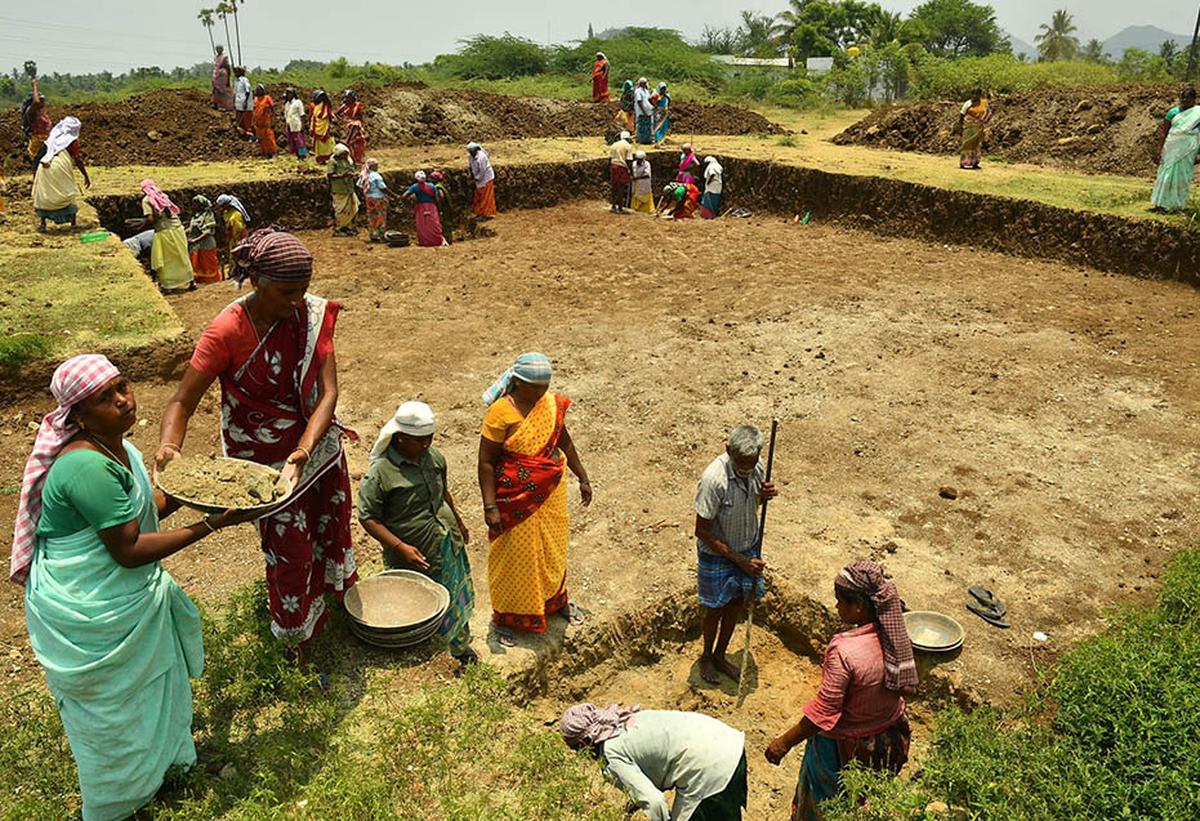
If the government can spare ₹2 lakh crore for creating employment opportunities, why is it not attempting to generate employment directly by expanding MGNREGA to urban areas and increasing its entitlement beyond 100 days? Why not expand capital expenditure by the profit-making Central PSEs in labour intensive sectors of the economy?
The fundamental flaw with this supply side incentive-based strategy lies in the presumption that labour demand in the non-agriculture sector is already sufficient to absorb around 80 lakh first-time employees annually, and only wage subsidies and skill development of labour would nudge small and large businesses to expand payroll employment, without any concern for market conditions and profitability.
The problem here partly lies with the government’s dogged insistence on the accuracy of the official GDP estimates, whose veracity has been questioned by many. The latest provisional estimates of India’s GDP shows real growth in 2023-24 at 8.2% while nominal growth is estimated to be 9.6%; which implies an annual inflation rate of 1.4% only. The combined Consumer Price Index, however, shows retail inflation at 5.4%. This glaring discrepancy, arising out of the disproportionate weightage given to a carelessly estimated wholesale price index, is just one of the several problems in India’s official GDP estimates.
The point is that the economy is not growing as fast as the official GDP estimates suggest. The absence of dynamism in private consumption and investment has been described in the Survey. Economic growth in the past few years has been largely caused by fiscal stimulus, which has resulted in a significant rise in the public debt to GDP ratio. Both the Survey and Budget presume that a reduction in the fiscal deficit and provision of supply-side incentives would spur a virtuous investment cycle led by private corporations.
The deep corporate tax cut in 2019 did little to enhance capital expenditure of the non-financial private corporate sector. The Budget’s reliance on a similar supply side strategy of incentivising private sector employment through wage subsidies and skill development, to solve the unemployment crisis, reflects a dogmatic mindset out of sync with ground realities.
Prasenjit Bose is an economist and activist