


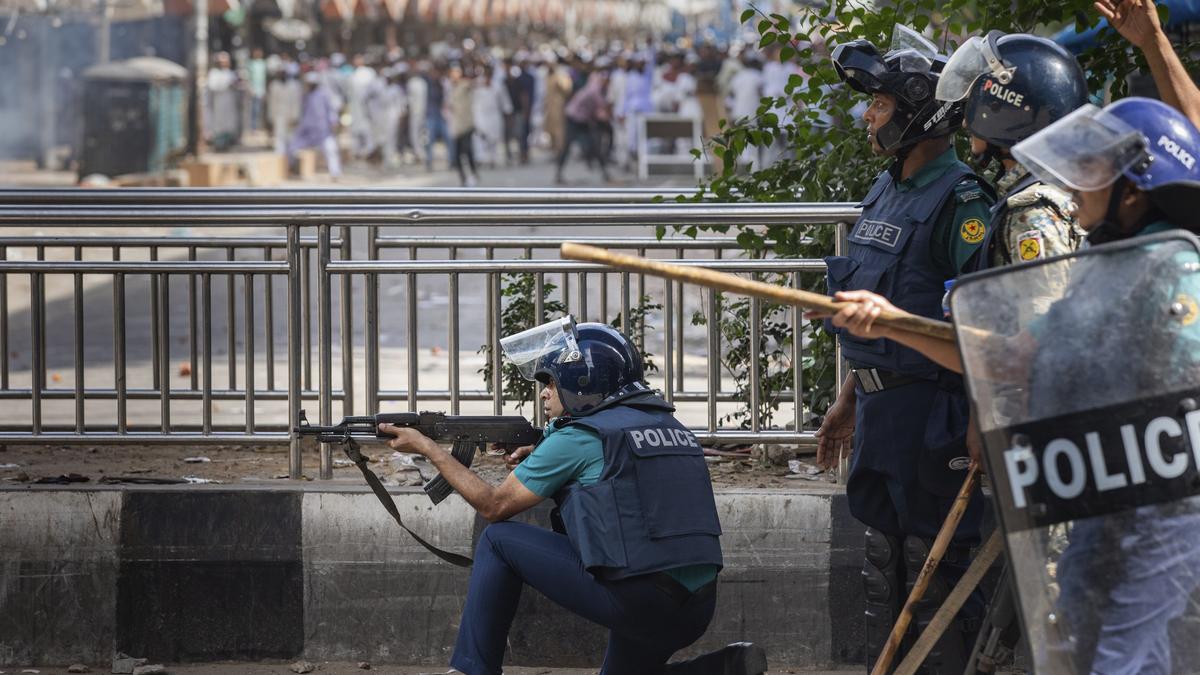
Police take position to disperse students protesting over the quota system, in Dhaka, Bangladesh, on July 19.
| Photo Credit: AP
The story so far: At least 130 people have been killed in the student protest clashes against quotas for government jobs in Bangladesh. In a new development, the Appellate Division of the Supreme Court dismissed the order of the High Court that had precipitated the crisis, and reserved 93% of the seats in government services for merit, allocating just 5% jobs for freedom fighters and their descendants. A one per cent quota each has been allocated for tribes, differentially abled people and sexual minorities.
Also Read: Bangladesh unrest: At least 105 dead, TV news off air, jail stormed
What do the protests mean for the Sheikh Hasina government?
The anti-quota protests have come at a time when Bangladesh Prime Minister Sheikh Hasina was settling down to power after winning a controversial election in January that gave her an unprecedented fourth consecutive term. Ms. Hasina was aware that the biggest challenge this time was high inflation and unemployment, and had started looking for solutions from partner countries like India and China as she wanted to increase employment opportunities in the manufacturing sector. The agitation, coupled with her own intemperate remarks, has created one of the biggest crises that she has faced since coming to power for her first term in 1996.
How did the agitation begin?
The seeds of the present quota reform movement lies in the smaller anti-quota movement of 2018. On March 8, 2018, the Bangladesh High Court rejected a petition challenging the legality of the quota system in the country that had existed since the early 1970s. In this backdrop, Ms. Hasina declared that she would maintain the quota for the descendants of the veterans of the liberation war. It was broadly understood that this quota which was started by her father Sheikh Mujib was an emotional matter for her. But this declaration of support for the quota for the descendants of the liberation war triggered a major agitation by students.

Responding to the agitation, Ms. Hasina cancelled all quotas in the Bangladesh Civil service through an executive order. This was a jolt for the students who just wanted a reform of the quota system and not abolition. It was clear that if freedom fighters were not to get any quota then no one else would either. During the next two years, over several rounds of discussion, Ms. Hasina stuck to her decision to abolish all quotas and in 2020, the executive order became operational.
What role did the court play in the quota agitation?
On June 5, 2024, the Bangladesh High Court nullified Ms. Hasina’s executive order that had dissolved all quotas. This action by the judiciary restored all quotas in the Bangladesh civil service. This judicial intervention was brought upon by an appeal filed by the descendent of a freedom fighter and six other individuals. Responding to the High Court’s verdict, the government filed an appeal with the appellate division of the Supreme Court. It became apparent that since the court had brought back the quota system, Ms. Hasina would try and ensure that the earlier system of 30% quota for descendants of freedom fighters is reintroduced in the new quota system. This triggered the current protests.
Also Read:Bangladesh protests: UN chief Antonio Guterres concerned by ongoing violence, urges restraint on all sides
The appellate division of the Supreme Court then issued an order halting the High Court’s order till the government’s appeal was fully heard. Ms. Hasina appealed to the students to allow the Supreme Court’s appellate division to complete the hearing. However, there was uncertainty about the judiciary’s decision. Students wanted the Prime Minister to consult them and other stakeholders and come up with an inclusive quota system and implement the same through an executive order. It was felt that if Ms. Hasina could abolish the quota system as she did in 2018, she could also bring in a quota as per the demand of the protesters.
At the core of the negotiations was the concern of the protesters about the 30% quota for freedom fighters and their descendants and the possibility that Ms. Hasina would bring back the quota for freedom fighters in jobs through either an appellate tribunal or executive decision which would limit the availability of merit-based jobs.
What triggered the clashes?
In the backdrop of the hearing in the appellate division and the protests, Ms. Hasina termed the protesters who opposed quota for freedom fighters’ families as ‘razakars’ or traitors who supported the Pakistani military in carrying out large-scale atrocities against men and women in 1971. This enraged the students who demanded an apology from her and occupied public squares. The situation escalated as the police and the Rapid Action Battalion (RAB) cracked down on protesters. The Awami League, the ruling party of Bangladesh, was also accused of using its student leaders to crack down on the protests.
This led to further confrontation and finally the military had to be pressed into service. As violence spiralled out of control, the protesters were offered a dialogue with the law minister but protesters refused stating “no dialogue while bloodshed continues”.
What is the quota for freedom fighters?
After the war of 1971, Bangladesh was remodelled and one of the main planks of the creation of the state was Sheikh Mujibur Rahman’s promise to do justice to those who had sacrificed and endured atrocities by the Pakistani military. In 1972, immediately after returning to Dhaka he resolved to create a quota for freedom fighters. Apart from freedom fighters, Mujib also gave a quota for the women who were tortured by Pakistani soldiers. After the assassination of Sheikh Mujib, the quota system was diluted and extended to unrepresented sections of the country. Thus Bangladesh’s varying and evolving quota system spanned freedom fighters, women, underdeveloped areas and ethnic minorities or tribes.
Over the years, the quota system at times remained underutilised as the number of freedom fighters dwindled, and therefore possibilities of abuse of the quota arose. The argument of the critics was that as long as Mukti joddhas (freedom fighters) were young and seeking jobs, it was fair to give them reservation. After the mukti joddhas passed, their children have been getting reservation in jobs. And now the grand children of the mukti joddhas are also going to benefit from the revived quota system. At times, when the families were not available, there were suspicions that the quota was extended to party operatives of Ms. Hasina’s Awami League.
Bangladesh’s political system has been dominated by Ms. Hasina and the Awami League for a long time. There has been a growing sentiment among opposition parties and critics that the quota for freedom fighters was essentially an attempt to create a group of close supporters for the Awami League within the bureaucracy or civil service who would perpetuate the Awami League’s rule. This is one of the main reasons that prompted the students to launch the quota reform movement after the government filed an appeal with the appellate division of the court.
Why does the govt. feel strongly about the freedom fighters quota?
From the beginning, Ms. Hasina has fashioned her government around the agenda of Sheikh Mujib. She feels that the quota for freedom fighters and women who survived the torture camps of the Pakistan military are part of the sacred duty that she as the daughter of Sheikh Mujib has to carry forward. Her previous negotiations with the students have indicated that she suspects that by criticising freedom fighters, critics and students are allowing themselves to be used as a Trojan horse of opposition parties such as the Bangladesh Nationalist Party (BNP) and Jamaat-e-Islami.
How does the student movement reflect the political landscape?
Sheikh Hasina won the January election that was boycotted by the BNP who wanted the elections to be conducted under a caretaker government. The Awami League’s position towards the quota for freedom fighters indicates that the party feels that Jamaat and the BNP are using the movement to embarrass her and show that her electoral victory did not reflect the anti-incumbency sentiment that is raging in the country.
The Appellate Division of the Supreme Court has now drastically cut the quota for freedom fighters indicating that Prime Minister Hasina has taken a step back to address the concern of the protesting students. There is also talk that Ms. Hasina may constitute a commission that will work on creating a more representative quota system. However, she has not yet indicated whether she would be willing to engage with opposition parties who have also participated in the anti-quota protests.