

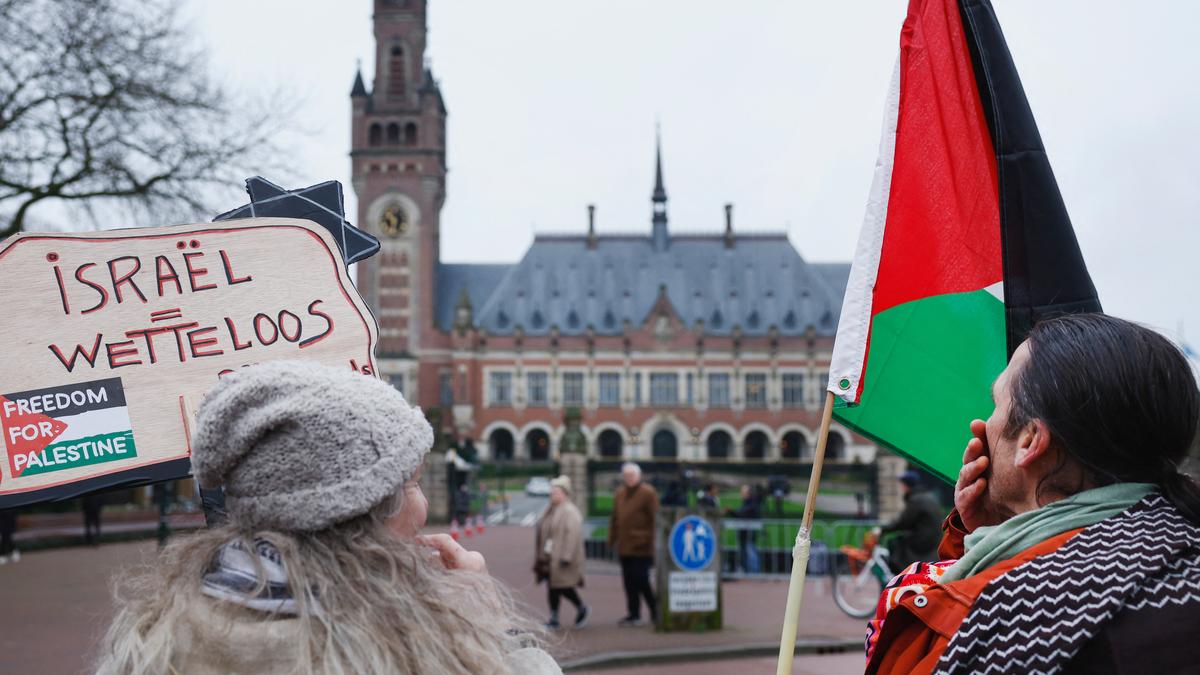
People protest on the day of a public hearing held by The International Court of Justice (ICJ) to allow parties to give their views on the legal consequences of Israel’s occupation of the Palestinian territories before eventually issuing a non-binding legal opinion, in The Hague, Netherlands, on February 21, 2024.
| Photo Credit: Reuters
The International Court of Justice (ICJ) on July 19 ruled that Israel’s decades-long occupation of Palestinian territory was “illegal” and should come to an end “as rapidly as possible”. In a historic but non-binding advisory opinion rendered by the 15-judge panel, the U.N.’s top court found multiple breaches of international law by Israel including activities that amounted to apartheid.
Notably, the court underscored that other states are under an obligation to neither recognise the occupation as lawful nor aid or assist it — a directive with profound implications for Israel’s allies. The opinion was issued in response to a request from the U.N. General Assembly (UNGA) in 2022. While it predates the Israel-Hamas conflict, it is likely to amplify pressure on Israel to bring an end to its ongoing military offensive which has killed more than 38,000 Palestinians, according to the Gaza Ministry of Health.
In a separate case instituted by South Africa, the ICJ is already considering allegations that Israel is committing genocide in its military campaign in Gaza. A preliminary ruling has already been issued, instructing Israel to prevent and punish any incitement to genocide and to enhance provisions for humanitarian aid. In May, the world court ordered Israel to halt its offensive on Rafah, a city in southern Gaza, citing “immense risk” to hundreds of thousands of Palestinians taking shelter there. However, Israel has continued its attack in defiance of the court order.

Advisory jurisdiction
The ICJ wields dual jurisdictional powers — resolving legal disputes between member states and rendering legal opinions on matters referred to by U.N. organs and specialized agencies. While advisory opinions issued through the latter are non-binding, they carry significant legal weight and moral authority, capable of influencing diplomatic relations. In December 2022, the UNGA adopted a resolution seeking the court’s advisory opinion on the “legal consequences arising from the policies and practices of Israel in the Occupied Palestinian Territory, including East Jerusalem.” Introduced by Nicaragua, the resolution was passed with 87 votes in favour, 26 against, and 53 abstentions.
Following the 1967 Arab-Israeli War, Israel captured the West Bank, Gaza Strip and East Jerusalem – territories historically sought by Palestinians for their statehood aspirations. It has since built settlements in the West Bank and East Jerusalem and steadily expanded them. While Israeli troops and settlements were withdrawn from Gaza in 2005, the expansion of settlements in the West Bank continued unabated. In recent months, Prime Minister Benjamin Netanyahu’s far-right government has used its war on Gaza as a pretext to expand these settlements at a rate faster than seen in the previous decades.
Although Israel abstained from participating in the proceedings, it filed a written statement contending that an advisory opinion would be “harmful” to attempts made to resolve the conflict since the questions posed by the UNGA were prejudiced. The last time the UNGA asked the ICJ for an advisory opinion on Palestine was in 2004 when the court ruled that Israel’s construction of a wall predominantly within the occupied West Bank and East Jerusalem violated international law. Israel was ordered to halt the construction of the wall and dismantle parts of it, while the U.N. was asked to consider additional measures to end the illegal construction. Despite the ruling, Israel unilaterally altered the wall’s route. Nearly two decades later, the situation has only worsened, with the separation wall extending over 700km, and 85% of its route located inside the occupied West Bank.
‘Occupation’ under international law
Under international law, “occupation” refers to a situation when during an international armed conflict, a territory, or parts thereof, comes under the effective provisional control of a foreign power, even if it is not met with armed resistance. The most widely accepted definition of an occupation has been codified in Article 42 of the 1907 Hague Regulations. The provision stipulates that a “ territory is considered occupied when it is actually placed under the authority of the hostile army. The occupation extends only to the territory where such authority has been established and can be exercised”. However, an occupation must be temporary and cannot entail any transfer of sovereignty to the occupying power.
Once a territory is seized, the occupying power assumes specific obligations toward individuals within the occupied territory, as outlined in the 1907 Hague Regulations and the Fourth Geneva Convention of 1949 alongside norms of customary international humanitarian law. These obligations include ensuring that provisions of food and medical care are extended to the population of an occupied territory and prohibition on the use or threat of force against civilians.
Court’s findings
Acknowledging that international law does not specify any temporal limit for an occupation, the ICJ observed that the prolonged duration of an occupation does not inherently change its legal status under international humanitarian law. Instead, the court said, that the legality of such an occupation is determined by the occupying power’s “policies and practices and the manner in which they are implemented and applied on the ground”.
“This advisory opinion holds immense importance as it declares the continued Israeli occupation of Palestinian territories unlawful under international law”, Dr. Başak Çalı, professor of international law and director of the Centre for Fundamental Rights at the Hertie School, Berlin told The Hindu. “The court reached this conclusion by finding that Israel abused its position as an occupying power by annexing Palestinian territories, asserting permanent control over them and consistently denying the Palestinian people their right to self-determination”.
It was highlighted that a wide array of Israel’s military measures such as the building and expansion of Israeli settlements in the West Bank and East Jerusalem, the use of the area’s natural resources, the annexation and imposition of permanent control over lands violate “the prohibition of the use of force in international relations,” rendering Israel’s ongoing occupation illegal.

“The court also found that Israeli laws and policies constitute systemic discrimination, based amongst others on race, religion and ethnic origin in violation of three human rights treaties ratified by Israel — the International Covenant on Economic, Social and Cultural Rights, 1954 (ICESCR), the International Covenant on Civil and Political Rights, 1954 (ICCPR), and the International Convention on the Elimination of All Forms of Racial Discrimination, 1965 (ICERD)“, Dr. Çalı added.
In recent years, international human rights groups have asserted that the Israeli military’s administration of the West Bank and East Jerusalem has transitioned into apartheid. They have cited the presence of separate courts for Israelis and Palestinians, as well as the implementation of a residence permit system and segregated roads exclusively for Palestinians, to substantiate their claims. Concurring with this, the judges underscored that such policies maintain “near-complete separation” between the settler and Palestinian communities in clear violation of Article 3 of the ICERD which prohibits racial segregation and apartheid.
Accordingly, the ICJ called upon Israel to bring an end to this unlawful occupation “as rapidly as possible”, cease new settlement activities and make reparations to all affected people for the damage caused. It also outlined that the U.N. and its principal organs such as the UNGA should consider additional modalities to ensure Israel’s compliance with this directive. Other member states were also ordered to not “render aid or assistance in maintaining” Israel’s presence in the occupied territories.
What lies ahead?
According to Dr. Prabhash Ranjan, professor at the Jindal Global Law School, the opinion is bound to intensify international pressure on Israel. “This decision vindicates the right to self-determination of the Palestinian people and rebukes Israel’s continued occupation and its policies and practices in the Occupied Palestinian Territory. While it might not immediately halt the military offensive in Gaza, it significantly dents Israel’s credibility”, he said.
However, Dr. Ranjan pointed out that since Israel has already refuted the court’s findings, it is unlikely to reconsider its stance without increased diplomatic pressure from the Western powers.
Highlighting the potential impact of the opinion on other cases before the ICJ and the International Criminal Court (ICC), Dr. Çalı noted, “While the temporal context, subject matter, and factual analysis of this advisory opinion differ from other ongoing proceedings related to the conflict, the court’s findings are so significant that all parties involved in those proceedings will undoubtedly take careful note of them.”