




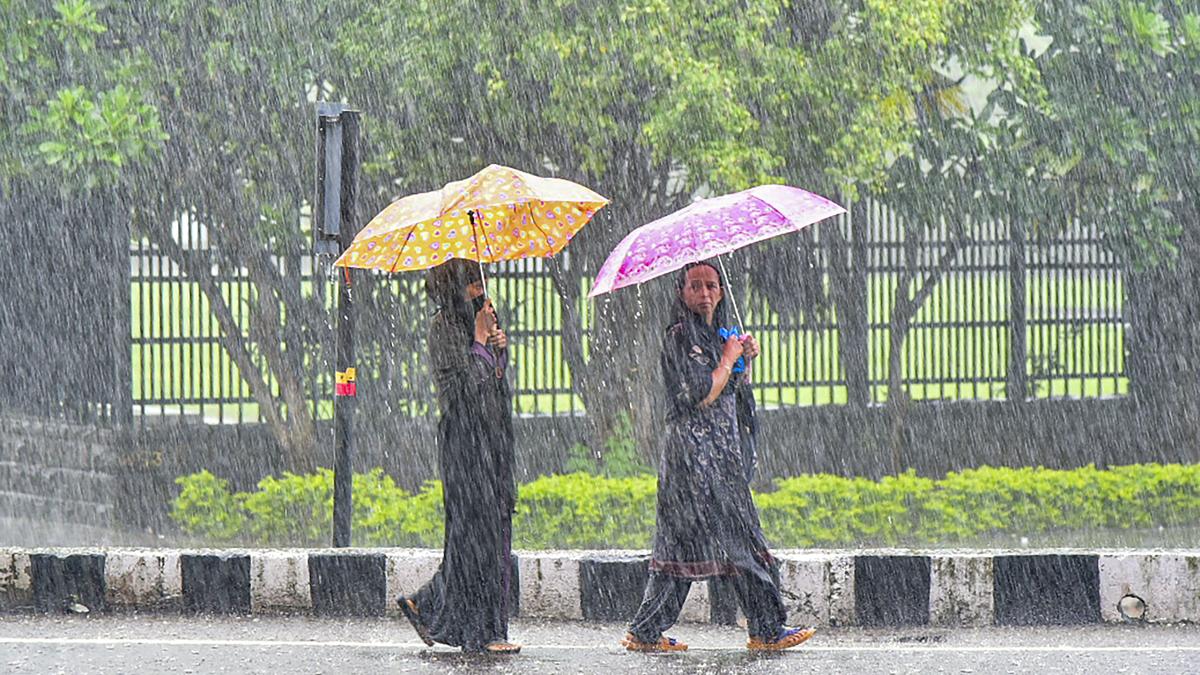
Pedestrians walk on a road amid heavy monsoon rains in Navi Mumbai, July 13, 2024.
| Photo Credit: PTI
We are in the middle of the monsoon season of 2024. The monsoon onset happened on time on May 30 but its evolution thus far has sprung some surprises. The distribution of rainfall looks as patchy as ever, albeit with some unexpected patterns. The seasonal outlook by the India Meteorological Department (IMD) has predicted a normal to above-normal amount of rainfall based on the expectation that a La Niña appears to be likely. But this La Niña appears to be playing truant so far.
After the on-time onset, the northward movement of the monsoon trough seemed to be quite rapid. But then the trough stalled and produced a fairly dry June for large swaths of the country. Even the entire stretch of the Western Ghats received below-normal rainfall levels into July. An unusual pattern of excess rain stretching from south to north persists to this day, with dry patches over large parts of Uttar Pradesh, Bihar, Jharkhand, and Odisha, as well as northwestern India into Jammu & Kashmir.

A useful index with disclaimers
I have used this analogy before and it still works well. As the Sun crosses into the Northern Hemisphere and starts warming the Indian subcontinent like a popcorn kettle, monsoon systems pop like kernels of corn in the kettle. The temperature inside the kettle will be essentially uniform but kernels will still pop randomly, here and there.
These kernels are like the rainfall: its patchy pattern is visible on day-to-day data as well as data averaged over the whole season and even over a whole decade.
However, the convenience of using the ‘all India monsoon rainfall’ index for providing seasonal outlooks — as the IMD does — is undermined by the uncertainty India’s farmers face at the local levels. Our forecasts of rain days or weeks ahead of a given date are getting better but they concomitantly increase the demand for and value of even more accurate and hyperlocal forecasts.
This demand is not only from farmers but also water managers and energy companies, among others. We need a broader perspective of the monsoon circulation to help understand where the limitations exist and how they can be resolved.
The circulation beyond India
People know the summer monsoon as the “southwest monsoon” because the winds sweep in from the southwest over the Arabian Sea into mainland India, across the Western Ghats. The western edge of the winds graze the African highlands, and some experts have often argued that they are critical for steering the southwesterly winds. The active Bay of Bengal, which is full of convective events, can be expected to ‘pull’ the winds towards India as well.
Convection in the atmosphere refers to rain events that release condensation heat.
The heating over West Asia and even the dust from the deserts there contribute to the monsoon circulation and its variability, as well as the changes it is experiencing due to global warming. Pakistan is very much a part of the monsoon circulation and it experiences high rainfall variability. This is because the edges of the monsoon circulation tend to be highly variable.
The land encompassed by the Himalayan foothills, and thus Nepal and Bhutan as well as the eastern edge of the Bay of Bengal (including Myanmar), is also involved in regulating the monsoon and the transfer of its heat to the Indian subcontinent. Bangladesh is of course ensconced between Northeast India and mainland India. We don’t pay attention to the role of heating over Bangladesh or the ocean-land-atmosphere dynamics that creates the beautiful monsoon and its heartbreaking vagaries every year.
The heating centres over the subcontinent are very strong and they maintain a sustained demand for moisture to sustain the convection centers. Indeed, the circulation that sweeps the oceans and the subcontinent can’t be represented accurately in rainfall models unless we capture all the heating centres from Pakistan and West Asia in the west to Myanmar in the east, and the Indian Ocean from about 10º south to its northern edge against the subcontinent.
Detail gaps beyond India’s borders
As hard as the IMD and its labs are working to improve their monsoon forecasting abilities at all timescales, their efforts are also undermined by a lack of rainfall and other weather data over parts of the subcontinent beyond India. Satellites can help to some extent but the amount of data available in near real-time to initiate forecasts is often quite inadequate.
These rainfall models are global for most subcontinent-scale forecasts even though the IMD also develops regional model forecasts, at the levels of cities, and at the national scale. The global models ingest data about the oceans and the planetary atmosphere to initiate forecasts and the volume of data can appear to be large and adequate — but this is often not the case.

Monitoring the whole subcontinent
India has been fortunate enough to have a rainfall monitoring network since the 19th century, and the advantages are now bearing fruit with investments in forecasting infrastructure. At this point, we need a few important steps to reach the next level in forecast accuracy. This is also essential to sustain continuous economic growth for India, especially in terms of food, water, and energy security.
In fact, even our national security depends heavily on weather and climate forecasts — for India as well as for the country’s more climate-vulnerable neighbors. Debilitating natural disasters can quickly turn into national security concerns, especially with some neighbors having to seek aid from non-allies.
India does share its forecasts with some countries but it may benefit more by extending this strategy to also establish a broad network to monitor weather and climate across the subcontinent. Improved forecasts for the subcontinent will make everybody safe and less vulnerable. This can only mean better opportunities for safety for all, including food, water, and energy, as well as better health.
Raghu Murtugudde is a professor, IIT Bombay, and emeritus professor, University of Maryland.