



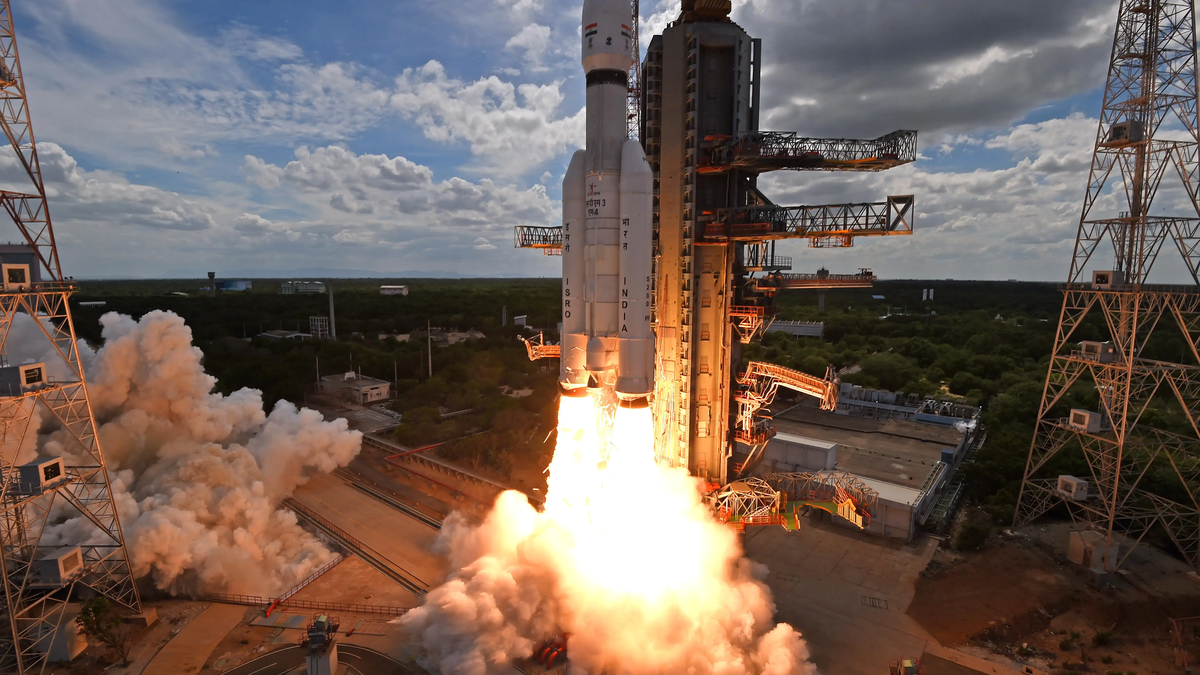
In June, S. Somanath, Chairman of the Indian Space Research Organisation (ISRO) and Secretary of the Department of Space, said ISRO’s launch vehicle capability was three-times the demand. Many experts in the spaceflight sector and beyond interpreted this to mean the space launch market was grim. Mr. Somanath also suggested strong demand was needed for launch vehicles from the domestic Indian market.
India currently has four launch vehicles: the Small Satellite Launch Vehicle (SSLV), the Polar Satellite Launch Vehicle (PSLV), the Geosynchronous Satellite Launch Vehicle (GSLV), and the Launch Vehicle Mark-III (LVM-3). These rockets can launch satellites weighing up to four tonnes to the geosynchronous orbit. India also relies on foreign launch vehicles, like Europe’s Ariane V and SpaceX’s Falcon 9, when a satellite weighs more than four tonnes.
At present, the country operates a fleet of satellites with applications in communications, remote sensing, positioning, navigation and timing (PNT), meteorology, disaster management, space-based internet, scientific missions, and experimental missions. It also needs launch vehicles for space missions like Chandrayaan 3 and Aditya L1.
All this makes it look like there are more applications and satellites than there are launch vehicles — which is the opposite of what Somanath mentioned. Where then is the issue?
Supply-driven to demand-driven model
The Indian space programme used to follow a supply-driven model: ISRO would build and launch satellites and then look for customers who needed the services provided by the satellites. When the Indian government reformed the space sector in 2019-2020, it changed this to a demand-driven model. Here, a satellite needs to be built and launched only if there is already demand for it. This may have led to the situation Mr. Somanath mentioned.
There is now a chicken and egg problem. The customer of the services provided by the satellite needs to be educated about the need for the service. The customer will then create a demand for a service that will need a satellite to be launched. This will provide the demand Mr. Somanath is asking for.
Consider the example of the internet. There needs to be a demand for space-based internet in a country already filled with affordable fibre and mobile-based internet services, so a company will launch a constellation of satellites into orbit to provide that service.
The question arises: Who will educate the customer, ISRO or the industry?
Without such educated customers, demand at the scale ISRO expects will not be created. The customers here are not only consumers of space-based internet. These are other companies, government institutions, defence enterprises, and ordinary people including farmers, bankers, etc. So the ‘amount’ of education required is very great.
The other area from which demand is likely to arise is human spaceflight. This includes human-rated launch vehicles that carry humans and supplies into orbit and to destinations like an orbiting space station or the moon. There could in future be demand for space tourism as well.
Launch capability limitations
India’s launch vehicles are also not powerful enough to undertake certain missions like Chandrayaan 4. China used its Long March 5 launch vehicle to launch its Chang’e 4 and Chang’e 5 missions in a single launch. India’s LVM-3 has less than one-third of Long March 5’s capability (28% to be more precise) and will need two LVM-3 launches to launch all the components of Chandrayaan 4.

ISRO will be upgrading the LVM-3 with a semi-cryogenic engine to boost its payload capacity to six tonnes to the geostationary transfer orbit (GTO). The organisation will also need a new launch vehicle — already dubbed the Next Generation Launch Vehicle (NGLV), a.k.a. Project Soorya — to carry 10 tonnes to GTO. But it has only submitted a funding proposal thus far for this project. Other variants of this launch vehicle are expected to raise this vehicle’s lift capacity.
India will also need one more successful flight of the SSLV to be confident about its ability to launch smaller satellites. Smaller satellites are usually experimental and university-built. More success in this domain will encourage space companies to build larger satellites, eventually leading to a demand for launch vehicles.
Launch vehicle economics
All these launch vehicles will need satellites to launch. The heavier vehicles can fulfil some national goals like lunar exploration and a space station while ISRO can use the smaller satellites for technology and capability demonstration. However, the latter will constitute only a small number of launches.
Satellites have a defined mission life. As they get old, they will need to be replaced with newer satellites. This will also create a demand for launch vehicles. However, mission operators like their satellites to live longer and have been improving their lifetimes with software and hardware upgrades. This complicates estimates of the number and frequency of launch vehicles that will be needed.
Launch vehicles are improving as well. In a single launch, the PSLV can deliver multiple satellites in multiple orbits. Rocket stages are becoming reusable, which reduces the cost of building the rocket and increases profitability. ISRO has been building its Reusable Launch Vehicle and vertical landing technologies to make reusable landing stages. It is also making an effort to replace toxic fuels for rocket engines with green alternatives.
Launch vehicle perspectives
Mr. Somanath himself provided a solution for the problem he highlighted. He suggested we need an ecosystem that creates demand for various services, leading to a demand for data, leading to more sources of data (like satellites), culminating in a demand for launch vehicles. The richer the ecosystem, the greater the demand.
The Indian government wants the private sector to create demand among customers and to build and launch satellites. It wants them to look for services to offer customers in India and abroad. It also wants revenue by providing launch services of its own. Finally, the government wants to upskill workers and give them jobs.
However, private companies don’t want the government to be in the launch business. Instead, they want the government to be their customer and to provide rule of law and reliable regulations.
This is because private players desire a reliable source of revenue, which the Indian government can be over a long period of time. There is thus talk of the government being an ‘anchor customer’ helping companies in their early days.

The roadmap here is for the government to exit the launch vehicle business at some point, leaving the companies with sufficient demand for launch vehicles. This is similar to the situation in the U.S., where arms of the U.S. government award contracts to SpaceX, Blue Origin, etc. to execute launches with their payloads.
Thus, the Indian government will absorb the cost of the transition from supply-driven to demand-driven building of satellites and launch vehicles. But it isn’t yet educating its own Ministries and creating some of the anchor demand for satellites and launch vehicles.
Pradeep Mohandas is a technical writer and space enthusiast in Pune.