




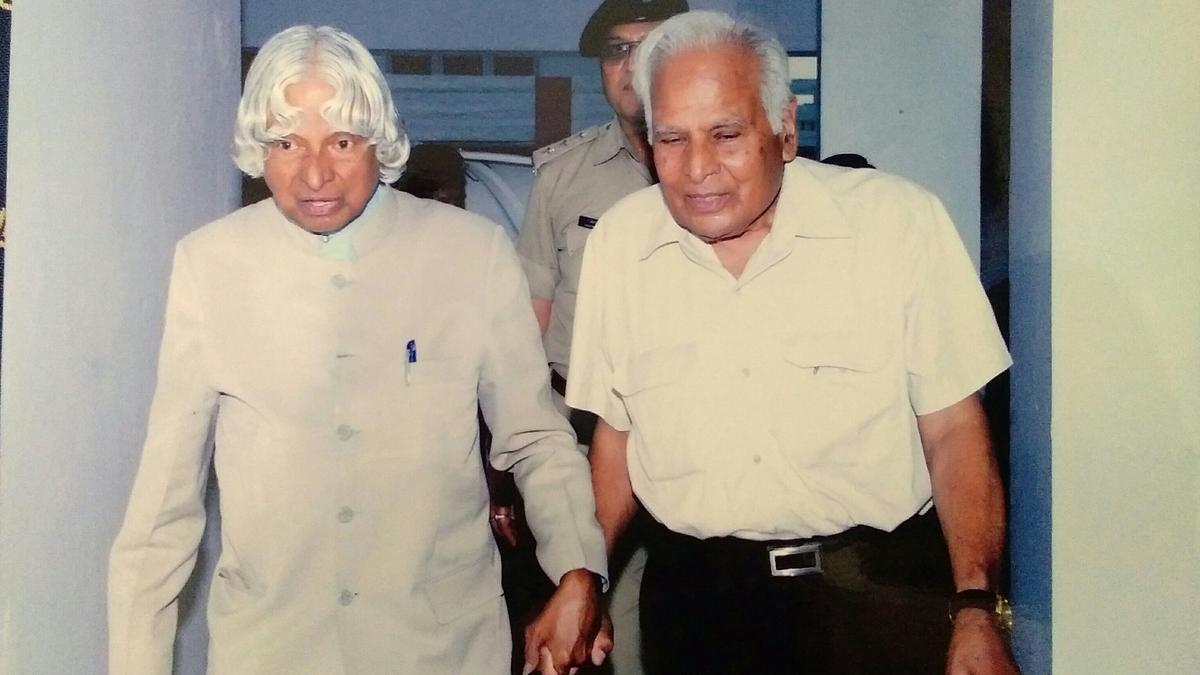
A photograph of Dhirendra Sharma (right) holding hands with A.P.J. Abdul Kalam.
| Photo Credit: Special arrangement
With the passing away of Professor Dhirendra Sharma (1932-2024) in Dehradun this week, a highly contested and sensational chapter in the history of nuclear technology development in India has ended. Prof. Sharma was the first intellectual to publicly criticise the nuclear programme in India and lead a campaign against nuclear power. Though the government did not roll back its nuclear energy development efforts, Prof. Sharma’s relentless campaign on the safety and techno-economic issues forced long-term systemic changes in the field. He did all this as a public policy expert working in a public university – Jawaharlal Nehru University (JNU) in Delhi – and ended up paying a price for raising uncomfortable questions.
Armed with a doctorate in philosophy from the University College London and a decade-long teaching experience in American universities, Prof. Sharma was appointed an associate professor in the newly established JNU in 1974. He was a member of the founding faculty of the Centre for Studies in Science Policy at the School of Social Sciences. The centre was headed by B.V. Rangarao — a pharmaceutical industry expert — and Prof. Sharma succeeded him.
Inside view of the nuclear establishment
The period coincided with several political and technological changes in India and worldwide: the oil shock, the ‘Peaceful Nuclear Explosion’ (PNE) at Pokhran, the emergency, and the emergence of the Janata Party regime. The nuclear power programme, by this point, was more than two decades old and the Department of Atomic Energy (DAE) was drawing up ambitious plans for generating commercial nuclear power. Against this backdrop, Prof. Sharma decided to focus on the study of nuclear and energy policies in India but within the ambit of the academy. He began by studying the sociology of science and organised lectures on energy policy and writing research papers and monographs on energy policies with a focus on nuclear energy.
In one such paper, Prof. Sharma warned of “a great danger of our energy policy becoming the captive of the nuclear technological elite”. He argued: “Our national energy planning and our military and defence interests would be better served by developing solar technology” and not nuclear energy and the bomb. To achieve the target to produce 10,000 MW of nuclear electricity by 1990, he estimated India would require 2,000 tonnes of heavy water every year to run 44 reactors with 230 MW capacity each, an army of trained personnel, and massive investments. It was the first-ever critical evaluation of nuclear power in India.
With his experience of participating in antiwar, anti-nuclear, and civil rights movements in the U.K. and the U.S. while being in academia, Prof. Sharma took the next step: he organised the Committee for a Sane Nuclear Policy (COSNUP) in June 1981, the first such civil society body in India. The committee issued a statement signed by eminent citizens, including former diplomat and Mr. Nehru’s sister Vijayalakshmi Pandit, expressing concerns over the emergence of a nuclear bomb lobby in India and calling for a rethink.
All this did not go well with the establishment. JNU formed a nine-member panel headed by none other than Raja Ramanna, the ‘father’ of the PNE and soon to be the head of the DAE, to review the working of the science policy centre chaired by Prof. Sharma. As expected, the panel recommended the centre’s closure and said science policy research should focus on topics like the law of the seas, science education, etc. and that this did not warrant a dedicated centre. The centre was not shut but Prof. Sharma remained the target of the university establishment.
In a landmark book, ‘India’s Nuclear Estate’, released in May 1983, Prof. Sharma gave an inside view of the nuclear establishment and pointed to several holes, like the lack of an independent regulatory authority and any plan for safe disposal of nuclear waste. The book was based on information he collected during the Janata Party regime (1977-1979), when he was allowed to visit nuclear installations, meet scientists and access internal records.
The access was facilitated by Atma Ram, former director general of the Council of Scientific and Industrial Research and scientific advisor to Prime Minister Morarji Desai. When the book came out, some people wanted Prof. Sharma arrested for flouting the secrecy clauses of the DAE Act. He was not arrested but transferred to the School of Languages in December 1983, and the science policy centre became dormant. His transfer became international news when Noam Chomsky and British labour politician Tony Benn wrote to Indira Gandhi about Prof. Sharma’s harassment.

Friendship with Abdul Kalam
Prof. Sharma became interested in science communication when he realised the difficulties of explaining scientific terms like radiation and nuclear safety to villagers in local dialects during his campaign. He joined the Indian Science Writers Association (ISWA) and was elected its president in 1988 and again in 1992 and 1993. After a few years of his retirement, he settled down in Dehradun and remained an active member of the social and scientific community there.
He was a great advocate of South Asian solidarity and wrote extensively about the need to develop the ‘third pole’ – the Himalaya – as a zone of peace and scientific research. All his life, Prof. Sharma stood for the core values of peace, harmony, democracy, transparency, academic freedom, and openness in public life. Once he wrote: “If I had my time again, I would confront the challenges with even greater vigour.”
His friendship with A.P.J. Abdul Kalam, dating back to the 1980s, continued despite their differences of opinion on nuclear and missile development. Prof. Sharma used to describe Dr. Kalam as a “scientist-sage” and prodded him to promote spinoffs from missile development for social good. Prof. Sharma was a keen adventurer and went on regular hiking expeditions in the Himalaya and the Alps until he was in his early 80s. He was in the contingent that went to Kailash Mansarovar in 2005 and swam in the freezing waters of the lake.
Prof. Sharma’s body was donated to the Himalayan Institute of Medical Sciences (popularly called Jolly Grant Hospital) as he had willed. His wife Nirmala passed away two months ago and her body was also donated to the same teaching hospital.
Dinesh C. Sharma is a columnist and author based in New Delhi. He was associated with Vigyan Prasar as the founding Managing Editor of India Science Wire (ISW) from 2017 to 2019.