





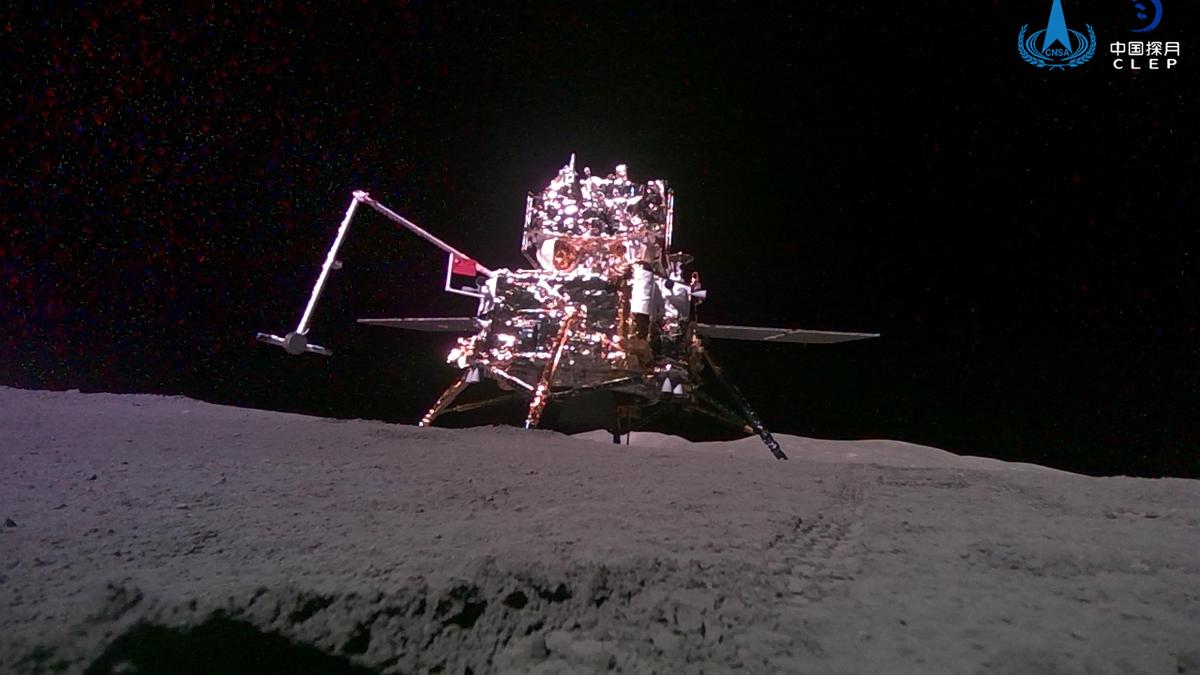
The story so far: In the pre-dawn hours (IST) of June 4, a small spacecraft bearing lunar samples took off from the moon’s far side, headed for an orbit that would bring it in contact with an orbiter waiting for it. There, the spacecraft will ‘hand over’ the samples to a capsule on the returner, which will eventually bring the samples back to the earth in a two-week journey. Thus, scientists will finally have access to the first pieces of moon soil and rocks from its far side. All the spacecraft in this mission are part of China’s ambitious and ongoing Chang’e 6 mission.
What are the Chang’e missions?
China’s moon missions are called Chang’e, named for the goddess of the moon in Chinese mythology.
The China National Space Administration (CNSA) launched the Chinese Lunar Exploration Programme (CLEP) in 2003, and the first Chang’e mission happened in 2007. Chang’e 1 created a map of the moon’s surface.
With Chang’e 2, CLEP launched phase I of its moon missions, and equipped the orbiter with a better camera. The images taken by this camera were used to prepare the Chang’e 3 mission’s lander and rover for their descent on the moon, which they successfully achieved on December 14, 2013, and started CLEP’s phase II missions.
Chang’e 4 was a precursor to Chang’e 6: in 2019, it carried the first lander and the rover to descend on the moon’s far side and explore this relatively more mysterious region. Achieving this first required another spacecraft around the moon that could ‘talk’ between ground stations on the earth and the moon’s far side. In the same year, CLEP said China would land an astronaut on the moon in a decade.
Phase III began with the Chang’e 5 mission. In late 2020, it deployed a lander on the moon’s near side. It included a mission component called an ascender, which, after collecting and stowing soil samples (specifically, the youngest volcanic lunar soil samples yet), launched itself into orbit. There, an orbiter collected the samples, transferred them to a returner, and the returner brought them to the earth.
As CLEP’s second phase III mission, Chang’e 6 is attempting to replicate its predecessor’s feat — except from the moon’s far side. This time, the scientific goal is to understand why the far side is so different from the near side.
What is the far side?
The moon is tidally locked to the earth: the lunar hemisphere facing the earth will always face the earth, and the hemisphere facing away will always face away. The far side has rockier terrain and fewer smooth plains than the near side. Scientists believe this is because of heat released by the earth when the moon was forming and thermochemical characteristics of the moon’s near-side surface.
In effect, it’s harder to land a spacecraft on the far side — and more so since it’s impossible to communicate directly from the earth with a spacecraft here: there’s no line of sight. A typical workaround is to have a second spacecraft in space that relays signals between ground stations on the earth and the surface spacecraft, making the mission more complex.
The earth screens the moon’s far side from the solar wind, which is expected to have allowed the far side to retain more helium-3. There has been some excitement in the past about using this isotope in advanced fusion reactors — not least when former Indian Space Research Organisation (ISRO) chairman K. Sivan said as much in a 2018 statement. But the technology for this fusion doesn’t yet exist.
The far side is also expected to be a good place to install large telescopes, which would have a view of the universe unobstructed by the earth. ISRO and scientists at the Raman Research Institute, Bengaluru, are currently working on such a telescope, called PRATUSH.

What is the status of Chang’e 6?
CNSA launched the 8.3-tonne Chang’e 6 orbiter-lander assembly on May 3, and it entered a lunar orbit on May 8. On May 30, the lander complex split from the orbiter and descended over a large crater called the Apollo Basin on June 1. Apollo itself lies within the much larger South Pole-Aitken Basin.
CLEP scientists coordinated this part of the mission with help from the Queqiao 2 relay satellite, which the CNSA launched in February this year into an elliptical orbit around the moon. Its other relay satellite, Queqiao 1, is in a halo orbit around the second earth-moon Lagrange point. (Note: Aditya-L1 is in a halo orbit around the second earth-Sun Lagrange point.)
Once down and operational in the Apollo Basin, a drill plunged into the soil, and with help from a scoop extracted about 2 kg of far-side material, and transferred it to the ascender. On June 4, the ascender took off for moon orbit, where it’s expected to rendezvous with the orbiter, transfer the samples to a capsule in the returner, which is finally expected to return to the earth, crashing somewhere in Inner Mongolia on June 25.
What might the samples reveal?
Since Chang’e 6 is a Chinese mission, the ‘what’ depends on the samples as much as ‘by whom’ and ‘when’. CNSA hasn’t been sharing periodic and detailed updates, as has been expected from other space programmes.
Once CNSA retrieves the sample-bearing capsule, Chinese scientists will have first crack at it before sharing access with foreign research groups based on their proposals. It’s unknown whether any Indian research groups have applied for access.
Scientifically, the far-side samples are expected to inform insights about why the moon is the way it is and the formation of planets.
When it completed the Chang’e 5 mission, China became the first country to successfully execute a robotic lunar sample-return mission since the Soviet Union did in 1976. China was also the first country to execute an autonomous soft-landing on the moon’s far side with its Chang’e 4 mission and — if the returner brings the samples safely back to the earth — will become the first and only country to do so from the moon’s far side as well.

CNSA is expected to launch asteroid and Mars sample-return missions in 2025 and 2030, respectively.
India currently has no plans to explore the moon’s far side. ISRO’s Chandrayaan programme is expected to launch a lunar sample-return mission in 2028, but that is likely to be delayed. India is a signatory of the U.S.-led Artemis Accords, an arrangement that’s expected to have India and other accord members share knowhow to more cooperatively explore the moon next decade.
China is not a part of the accords.
(The details in this article are as of 4 pm on June 6, 2024.)