




Skip to content
  • Facebook
  • X
  • Linkedin
  • WhatsApp
  • YouTube
  • Associate Journalism
  • About Us
  • Privacy Policy
  • 033-46046046
  • editor@artifex.news
Artifex.News

Artifex.News

Stay Connected. Stay Informed.

  • Breaking News
  • World
  • Nation
  • Sports
  • Business
  • Science
  • Entertainment
  • Lifestyle
  • Toggle search form
  • U.S. to start social media vetting for H-1B and H4 visa seekers
    U.S. to start social media vetting for H-1B and H4 visa seekers World
  • Oppose land distribution to workers, lose incentives: Assam CM to tea planters
    Oppose land distribution to workers, lose incentives: Assam CM to tea planters Business
  • Red-Hot Iga Swiatek Demolishes Ex-US Open Champion In Australian Open 2025
    Red-Hot Iga Swiatek Demolishes Ex-US Open Champion In Australian Open 2025 Sports
  • Indian-American entrepreneur releases song to mobilise South Asians to vote for Kamala Harris
    Indian-American entrepreneur releases song to mobilise South Asians to vote for Kamala Harris World
  • Access Denied Sports
  • Complex PTSD: When trauma persists…
    Complex PTSD: When trauma persists… Science
  • Access Denied World
  • Access Denied
    Access Denied Sports
Does inequality lead to growth? | Explained

Does inequality lead to growth? | Explained

Posted on June 2, 2024 By admin


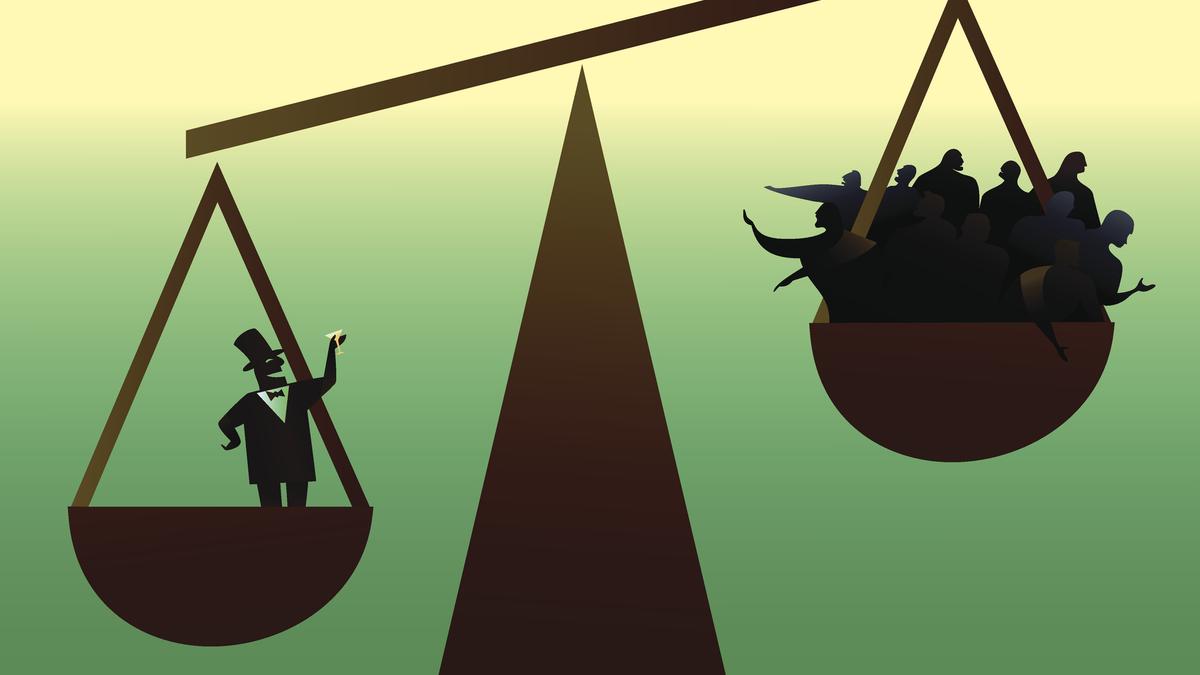
For representative purposes.
| Photo Credit: iStockphoto

Rahul Gandhi’s statements regarding redistribution — and the polarising rebuttal of Prime Minister Narendra Modi — have brought the topic of inequality to the forefront. Researchers from the Paris School of Economics have shown inequality in modern India to be greater than colonial times.

Several argue that inequality harms democratic processes. Some inequality, others argue, is actually beneficial, since it acts as an incentive to entrepreneurs to start businesses, thereby increasing employment and welfare for others.

This view is mistaken, for inequality can have deleterious economic effects as well. Consider one form of inequality, that of concentration of monopoly power amongst capital relative to labour. This can have negative effects on consumption, welfare, and growth. If done properly, wealth taxes and distribution can have positive effects.

Monopoly power and consumption

Billionaires draw their wealth from monopoly. Their business groups are dominant players in their specific market. This allows them to set prices instead of being determined by the market. The extent of mark-ups above the cost of production is determined by their monopoly power. Thus, for any given level of money wages, real wages — which determine purchasing power — are lower in economies with strong monopolies.

These monopoly effects are currently being experienced as the cost-of-living crises affecting the developed economies. The phenomenon of “greedflation”, or companies raising prices to increase profit margins in the wake of multiple demand-and-supply shocks due to the pandemic, has been pointed to as contributing to high rates of inflation in the West. Textbook economics shows us that the profit-maximising level of output under a monopoly is less than under a competitive economy, implying a welfare loss. Thus, the presence of monopolies can lead to lower real wages and lower levels of output and investment.

Inequality and growth

Assume that a company decides to set up a new factory. Before the new capital stock is created, wages are paid out to workers to build it. The income of the workers is spent on purchasing goods, which increases the income of goods-sellers, whose increased income results in purchases of other goods, and so on. The total increase in the income of workers and goods-sellers is greater than the initial investment. This process is called the ‘multiplier’ effect, wherein investment raises incomes by a greater proportion than the initial investment.

When companies exercise market power, mark-ups and prices will be higher. Real wages of workers are lower, and they can only purchase lesser items. However companies, because of higher margins, will enjoy the same amount of profits from the sale of a lesser amount of goods. The increase in income from a given amount of investment will be lesser under monopoly because of reduced consumption power. Thus, investment will have a weaker effect on growth under monopoly while not affecting profits.

One can argue that consumption of the rich can help boost growth. While the absolute amount of consumption of the rich is more, they consume a smaller proportion of their incomes. The multiplier process depends on the proportion of consumption from incomes. An unequal economy will put lesser incomes in the hands of those with a greater propensity to consume, leading to weaker expansion in the economy.

Redistribution and growth

Some argue that the ‘cure’ of redistribution can prove more harmful than the disease of inequality by affecting job creation. Entrepreneurs would see reduced incentives for amassing wealth under a high-tax regime, resulting in a scale-back of investment and jobs.

One must make a distinction between wealth and profits. Investment occurs under the influence of future profit expectations, while wealth is accumulated past profits. As the Polish economist Michal Kalecki argued, taxes on wealth would not affect investment since it leaves expectations of future profits unchanged. For example, taxing Gautam Adani’s wealth will not affect investment since expected profits from airports depends on the demand for air-travel which is independent of the value of his wealth.

No doubt, the difficulty in converting profits into wealth may deter some business-owners from undertaking investment. But an economy with high expectations of profit would ensure businesses invest even if wealth is taxed. Redistribution can generate forces to spur growth even if some billionaires pull back on investment. For one, if wealth is redistributed and increases income, the multiplier process would become stronger. Businesses would be more willing to invest where purchasing power is strong. If monopolies are curtailed, then prices would be lower and real wages higher, leading to greater demand.

Consider Thomas Piketty’s proposal of taxing billionaire wealth and providing basic income. This might cause some to exit the economy, but can create a new class of entrepreneurs who can create start-ups, freed from the necessity of working for wages. Redistribution is not a silver bullet, and too high a rate of taxation can become a net drain on an economy. Used in conjunction with other policy measures, curtailing inequality can lead to a healthier economy.

Source link

Business Tags:Inequality, inequality monopoly power, inequality report Paris School of Economics, redistribution rahul gandhi

Post navigation

Previous Post: On Camera, Two Planes Collide At Portugal Beja Air Show, Pilot Dead: Report
Next Post: Tonga volcano could cause unusual weather for rest of decade: study

Related Posts

  • Real estate sector pins hope on reforms, incentives
    Real estate sector pins hope on reforms, incentives Business
  • MEA ‘monitoring developments’ of Russia sanctions bill in U.S. Congress
    MEA ‘monitoring developments’ of Russia sanctions bill in U.S. Congress Business
  • Access Denied Business
  • Rupee falls 12 paise to close at 86.82 against U.S. dollar
    Rupee falls 12 paise to close at 86.82 against U.S. dollar Business
  • Budget 2023 | On the right course: A growth-oriented Budget: Keki Mistry
    Budget 2023 | On the right course: A growth-oriented Budget: Keki Mistry Business
  • Maruti Suzuki sees traction in subscription model
    Maruti Suzuki sees traction in subscription model Business

More Related Articles

Access Denied Business
Stock markets rebound in early trade Stock markets rebound in early trade Business
Access Denied Business
The changing contours of Delhi The changing contours of Delhi Business
Punjab Minister meets Nirmala Sitharaman, seeks special incentive for Punjab’s border districts Punjab Minister meets Nirmala Sitharaman, seeks special incentive for Punjab’s border districts Business
SiteLock

Archives

  • September 2026
  • August 2026
  • July 2026
  • June 2026
  • May 2026
  • April 2026
  • March 2026
  • February 2026
  • January 2026
  • December 2025
  • November 2025
  • October 2025
  • September 2025
  • August 2025
  • July 2025
  • June 2025
  • May 2025
  • April 2025
  • March 2025
  • February 2025
  • January 2025
  • December 2024
  • November 2024
  • October 2024
  • September 2024
  • August 2024
  • July 2024
  • June 2024
  • May 2024
  • April 2024
  • March 2024
  • February 2024
  • January 2024
  • December 2023
  • November 2023
  • October 2023
  • September 2023
  • August 2023
  • July 2023
  • June 2023
  • May 2023
  • April 2023
  • March 2023
  • February 2023
  • January 2023
  • December 2022
  • November 2022
  • October 2022
  • September 2022
  • August 2022
  • July 2022
  • June 2022
  • May 2022

Categories

  • Business
  • Nation
  • Science
  • Sports
  • World

Recent Posts

  • Israeli settler killed in West Bank, suspect arrested
  • Number of drought-hit taluks in Karnataka may cross 200
  • OFC menace persists in Bengaluru as new GBA regulations remain pending
  • Manal bounces back after failing to make it to u-19 WC team
  • Old era of jingoism, equating Nepali nationalism with anti-Indianism, is over: Nepal Finance Minister

Recent Comments

  1. Frankenrib on UP Teacher Who Asked Students To Slap Muslim Classmate
  2. Frankenrib on UP Teacher Who Asked Students To Slap Muslim Classmate
  3. Anthonylop on UP Teacher Who Asked Students To Slap Muslim Classmate
  4. Anthonylop on UP Teacher Who Asked Students To Slap Muslim Classmate
  5. TimmyMEs on UP Teacher Who Asked Students To Slap Muslim Classmate
  • MS Dhoni Out For Golden Duck, Punjab Kings Pacer’s Celebration Wins Internet – Watch
    MS Dhoni Out For Golden Duck, Punjab Kings Pacer’s Celebration Wins Internet – Watch Sports
  • Q3 Results Updates: Bajaj Finance Profit Falls 6%, Mankind Pharma Revenue Rises 12% Business
  • Rohit Bal, One Of India’s Top Fashion Designers, Dies Of Cardiac Arrest At 63
    Rohit Bal, One Of India’s Top Fashion Designers, Dies Of Cardiac Arrest At 63 Nation
  • Rupee rises 3 paise to close at 83.56 against U.S. dollar
    Rupee rises 3 paise to close at 83.56 against U.S. dollar Business
  • Access Denied
    Access Denied Nation
  • Economic survey flags syncing skilling with learning to boost job prospects
    Economic survey flags syncing skilling with learning to boost job prospects Business
  • Bonnie Tyler, who topped the charts with epic ‘Total Eclipse of the Heart’, has died at 75
    Bonnie Tyler, who topped the charts with epic ‘Total Eclipse of the Heart’, has died at 75 World
  • ISL 2025-26 | Bengaluru and Mumbai fail to break the deadlock
    ISL 2025-26 | Bengaluru and Mumbai fail to break the deadlock Sports

Editor-in-Chief:
Mohammad Ariff,
MSW, MAJMC, BSW, DTL, CTS, CNM, CCR, CAL, RSL, ASOC.
editor@artifex.news

Associate Editors:
1. Zenellis R. Tuba,
zenelis@artifex.news
2. Haris Daniyel
daniyel@artifex.news

Photograher:
Rohan Das
rohan@artifex.news

Artifex.News offers Online Paid Internships to college students from India and Abroad. Interns will get a PRESS CARD and other online offers.
Send your CV (Subjectline: Paid Internship) to internship@artifex.news

Links:
Associate Journalism
About Us
Privacy Policy

News Links:
Breaking News
World
Nation
Sports
Business
Entertainment
Lifestyle

Registered Office:
72/A, Elliot Road, Kolkata - 700016
Tel: 033-22277777, 033-22172217
Email: office@artifex.news

Editorial Office / News Desk:
No. 13, Mezzanine Floor, Esplanade Metro Rail Station,
12 J. L. Nehru Road, Kolkata - 700069.
(Entry from Gate No. 5)
Tel: 033-46011099, 033-46046046
Email: editor@artifex.news

Copyright © 2023 Artifex.News Newsportal designed by Artifex Infotech.