




Skip to content
  • Facebook
  • X
  • Linkedin
  • WhatsApp
  • Associate Journalism
  • About Us
  • Privacy Policy
  • 033-46046046
  • editor@artifex.news
Artifex.News

Artifex.News

Stay Connected. Stay Informed.

  • Breaking News
  • World
  • Nation
  • Sports
  • Business
  • Science
  • Entertainment
  • Lifestyle
  • Toggle search form
  • Electoral Bonds Data Out With Numbers, Donors Can Be Matched With Parties Nation
  • How a wandering white shark’s epic journey could provide clues for protecting them Science
  • Daily quiz | On asteroid names Science
  • Jeffrey Epstein’s “Black Book” With 221 More High-Profile Names Up For Auction World
  • ICC Names Sachin Tendulkar As ‘Global Ambassador’ For ODI World Cup 2023 Sports
  • “Look At Your Own Game”: England Great Shreds ‘Bazball’ To Pieces Sports
  • “Only Thing I Want To Say”: Smriti Mandhana Sums Up On RCB’s WPL Triumph Sports
  • PBKS vs GT, IPL 2024: Rahul Tewatia, Sai Kishore Guide Gujarat Titans To Win Over Punjab Kings Sports

Earliest-known galaxy, spotted by Webb telescope, is a beacon to cosmic dawn

Posted on June 1, 2024 By admin


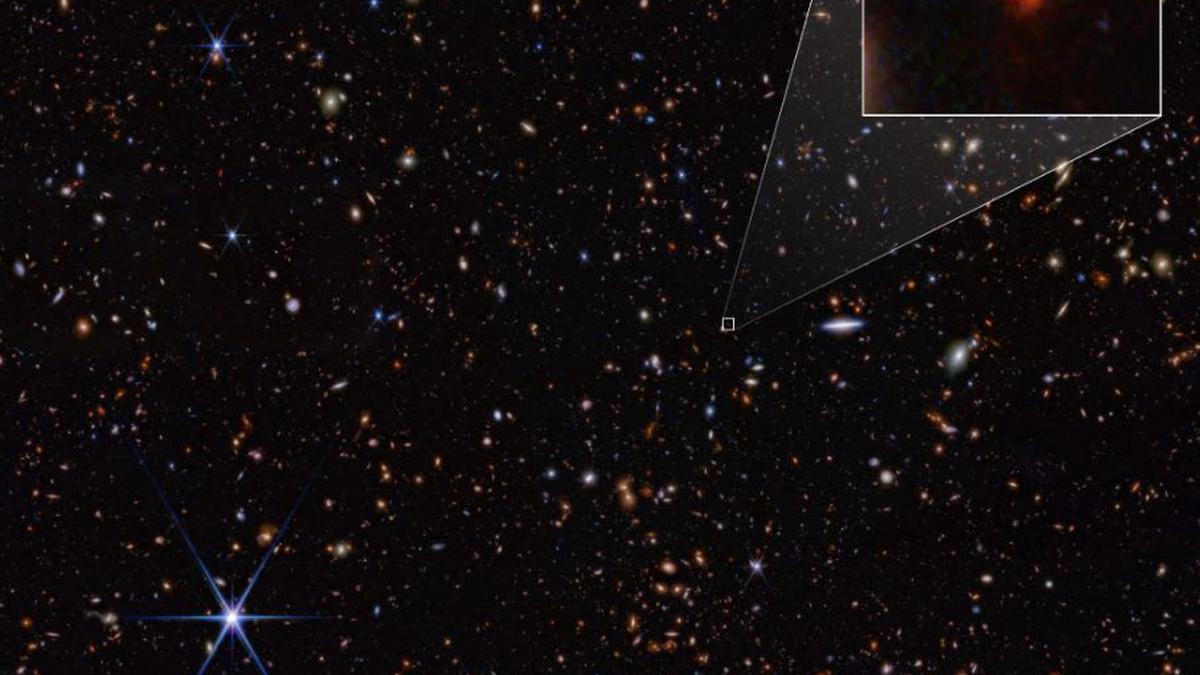
This handout image obtained on May 30, 2024 courtesy of NASA/ESA/CSA STScI shows an infrared image from NASA’s James Webb Space Telescope. A galaxy, JADES-GS-z14-0 (shown in the pullout), was determined to be at a redshift of 14.32 (+0.08/-0.20), making it the current record-holder for the earliest known galaxy.
| Photo Credit: AFP

NASA’s James Webb Space Telescope has spotted the earliest-known galaxy, one that is surprisingly bright and big considering it formed during the universe’s infancy— at only 2% its current age.

Webb, which by peering across vast cosmic distances is looking way back in time, observed the galaxy as it existed about 290 million years after the Big Bang event that initiated the universe roughly 13.8 billion years ago, the researchers said. This period spanning the universe’s first few hundred million years is called cosmic dawn.

The telescope, also called JWST, has revolutionized the understanding of the early universe since becoming operational in 2022. The new discovery was made by the JWST Advanced Deep Extragalactic Survey (JADES) research team.

This galaxy, called JADES-GS-z14-0, measures about 1,700-light years across. A light year is the distance light travels in a year, 5.9 trillion miles (9.5 trillion km). It has a mass equivalent to 500 million stars the size of our sun and was rapidly forming new stars, about 20 every year.

Before Webb’s observations, scientists did not know galaxies could exist so early, and certainly not luminous ones like this.

“The early universe has surprise after surprise for us,” said astrophysicist Kevin Hainline of Steward Observatory at the University of Arizona, one of the leaders of the study published online this week ahead of formal peer review.

“I think everyone’s jaws dropped,” added astrophysicist and study co-author Francesco D’Eugenio of the Kavli Institute for Cosmology at the University of Cambridge. “Webb is showing that galaxies in the early universe were much more luminous than we had anticipated.”

Until now, the earliest-known galaxy dated to about 320 million years after the Big Bang, as announced by the JADES team last year.

“It makes sense to call the galaxy big, because it’s significantly larger than other galaxies that the JADES team has measured at these distances, and it’s going to be challenging to understand just how something this large could form in only a few hundred million years,” Mr. Hainline said.

“The fact that it’s so bright is also fascinating, given that galaxies tend to grow larger as the universe evolves, implying that it would potentially get significantly brighter in the next many hundred million years,” Mr. Hainline said.

While it is quite big for such an early galaxy, it is dwarfed by some present-day galaxies. Our Milky Way is about 100,000 light years across, with the mass equivalent to about 10 billion sun-sized star.

The JADES team in the same study disclosed the discovery of the second oldest-known galaxy, from about 303 million years post-Big Bang. That one, JADES-GS-z14-1, is smaller – with a mass equal to about 100 million sun-sized stars, measuring roughly 1,000 light years across and forming about two new stars per year.

“These galaxies formed in an environment that was much more dense and gas-rich than today. In addition, the chemical composition of the gas was very different, much closer to the pristine composition inherited from the Big Bang – hydrogen, helium and traces of lithium,” Mr. D’Eugenio said.

Star formation in the early universe was much more violent than today, with massive hot stars forming and dying quickly, and releasing tremendous amount of energy through ultraviolet light, stellar winds and supernova explosions, Mr. D’Eugenio said.

Three main hypotheses have been advanced to explain the luminosity of early galaxies. The first attributed it to supermassive black holes in these galaxies gobbling up material. That appears to have been ruled out by the new findings because the light observed is spread over an area wider than would be expected from black hole gluttony.

It remains to be seen whether the other hypotheses – that these galaxies are populated by more stars than expected or by stars that are brighter than those around today – will hold up, Mr. D’Eugenio said.




Source link

Science Tags:cosmic dawn, James Webb Space Telescope, James Webb Space Telescope nasa, Milky Way, nasa James Webb Space Telescope

Post navigation

Previous Post: Borussia Dortmund Dream Of Shocking Real Madrid In Champions League Final
Next Post: Israel maintains a shadowy hospital in the desert for Gaza detainees. Critics allege mistreatment

Related Posts

  • The Science Quiz | Condensed matter physics Science
  • NASA names chief of UFO research; panel sees no alien evidence Science
  • Naturally occurring bile acid can blunt statin-induced diabetes Science
  • Australia’s enigmatic pink sand was born in Antarctic mountains: new research Science
  • A trial to test a new path for preventing Alzheimer’s Science
  • Risk of type 2 diabetes linked to air pollution in Chennai, Delhi Science

More Related Articles

Scientists move forward with plans for giant new atom-smasher to begin operating by 2040 Science
Sex differences don’t disappear as a country’s equality develops: study Science
Breast cancer diagnosis result within 24 hours at Hyderabad hospital Science
Science Quiz | What computers need to compute: Logic gates Science
How can a quantum computer prove that it is superior? Science
Gaganyaan test flight mission successful, crew escape module splashes down Science
SiteLock

Archives

  • July 2024
  • June 2024
  • May 2024
  • April 2024
  • March 2024
  • February 2024
  • January 2024
  • December 2023
  • November 2023
  • October 2023
  • September 2023
  • August 2023
  • July 2023
  • June 2023
  • May 2023
  • April 2023
  • March 2023
  • February 2023
  • January 2023
  • December 2022
  • November 2022
  • October 2022
  • September 2022
  • August 2022
  • July 2022
  • June 2022
  • May 2022

Categories

  • Business
  • Nation
  • Science
  • Sports
  • World

Recent Posts

  • Israeli strikes kill six in Gaza, including kids and U.N. worker, as truce talks show signs of progress
  • AIADMK, BJP, PMK condole the murder of BSP leader Armstrong
  • Biden Firefights Shaky Debate Performance
  • Delhi Court Directs Removal Of Post Alleging Centipede In Amul Ice Cream
  • Bhole Baba: The godman who failed his devotees

Recent Comments

  1. GkJwRWEAbS on UP Teacher Who Asked Students To Slap Muslim Classmate
  2. xreDavBVnbGqQA on UP Teacher Who Asked Students To Slap Muslim Classmate
  3. aANVRzfUdmyb on UP Teacher Who Asked Students To Slap Muslim Classmate
  4. YQCyszVBmIP on UP Teacher Who Asked Students To Slap Muslim Classmate
  5. aiXothgwe on UP Teacher Who Asked Students To Slap Muslim Classmate
  • “How Will You Manage Studies?”: Mumbai Indians Teen Gets Tricky Question From Mom, His Reply Viral Sports
  • Ireland wants to further deepen its strong economic, cultural ties with India World
  • Sri Lanka T20I Skipper Wanindu Hasaranga Gets Two-Match Ban By ICC Sports
  • 4-Year-Old Girl Kidnapped, Slammed On Floor Several Times, Dies On Spot: UP Cops Nation
  • Zambia find shows humans have built with wood for 476,000 years Science
  • Election Commissioner Arun Goel Quits. What Happens Now Nation
  • Paytm Payments Bank MD and CEO Surinder Chawla quits Business
  • Any Act Of Terrorism Regardless Of Motivation “Unjustifiable”: Ajit Doval Nation

Editor-in-Chief:
Mohammad Ariff,
MSW, MAJMC, BSW, DTL, CTS, CNM, CCR, CAL, RSL, ASOC.
editor@artifex.news

Associate Editors:
1. Zenellis R. Tuba,
zenelis@artifex.news
2. Haris Daniyel
daniyel@artifex.news

Photograher:
Rohan Das
rohan@artifex.news

Artifex.News offers Online Paid Internships to college students from India and Abroad. Interns will get a PRESS CARD and other online offers.
Send your CV (Subjectline: Paid Internship) to internship@artifex.news

Links:
Associate Journalism
About Us
Privacy Policy

News Links:
Breaking News
World
Nation
Sports
Business
Entertainment
Lifestyle

Registered Office:
72/A, Elliot Road, Kolkata - 700016
Tel: 033-22277777, 033-22172217
Email: office@artifex.news

Editorial Office / News Desk:
No. 13, Mezzanine Floor, Esplanade Metro Rail Station,
12 J. L. Nehru Road, Kolkata - 700069.
(Entry from Gate No. 5)
Tel: 033-46011099, 033-46046046
Email: editor@artifex.news

Copyright © 2023 Artifex.News Newsportal designed by Artifex Infotech.