





Skip to content
  • Facebook
  • X
  • Linkedin
  • WhatsApp
  • Associate Journalism
  • About Us
  • Privacy Policy
  • 033-46046046
  • editor@artifex.news
Artifex.News

Artifex.News

Stay Connected. Stay Informed.

  • Breaking News
  • World
  • Nation
  • Sports
  • Business
  • Science
  • Entertainment
  • Lifestyle
  • Toggle search form
  • Aiden Markram Fuels ‘Pitch Talk’ Amid Afghanistan Coach’s Explosive Press Conference Remarks Sports
  • Australian Woman Suspended Over Racist Email To Indian Tennant: Report World
  • Who Is Bhartruhari Mahtab, The Pro-Tem Speaker For 18th Lok Sabha Nation
  • Race to rush aid to Gaza as EU warns hunger ‘a weapon of war’ World
  • Elon Musk’s Neuralink to start human trial of brain implant for paralysis patients World
  • Asia Cup 2023, SL vs PAK | Sri Lanka’s Mendis and Asalanka script a thrilling win over Pakistan Sports
  • Deadly Russian Attack In Ukraine Kills 16 Amid Top US Official Antony Blinken’s Visit World
  • Adultery A Ground For Divorce, Not For Granting Child Custody: Bombay High Court Nation

Sea otters get more prey and reduce tooth damage using tools

Posted on May 17, 2024 By admin


An undated handout image shows a southern sea otter using a rock anvil to break open shells of prey, in the Pacific Ocean off the coast of California, U.S.
| Photo Credit: Reuters

Humans are not alone in the use of tools. Chimpanzees, for instance, crack nuts with stones and use sticks to get at tasty termites. Dolphins are known to employ sponges to protect their beaks while foraging. And a Galapagos Islands finch uses cactus spines to dig grubs out of holes.

Sea otters also are members of the animal kingdom’s tool-wielding club. And a new study offers a fuller understanding of the tool use – utilizing rocks and other objects to break open hard prey – by these marine mammals. It lets the otters eat certain larger prey and reduces their tooth damage by cutting down on their chomping down on hard shells, with females using tools more than males, perhaps to compensate for their smaller body size and weaker bite force, researchers found.

The researchers observed 196 southern sea otters along the central California coastline – Big Sur, Monterey, San Luis Obispo, Piedras Blancas and Elkhorn Slough.

When not crushing prey with their teeth, the otters float on their backs when feeding and use rocks, shells and discarded bottles as hammers or anvils to smash open hard-shelled prey, also sometimes bashing prey onto the surfaces of docks and boats.
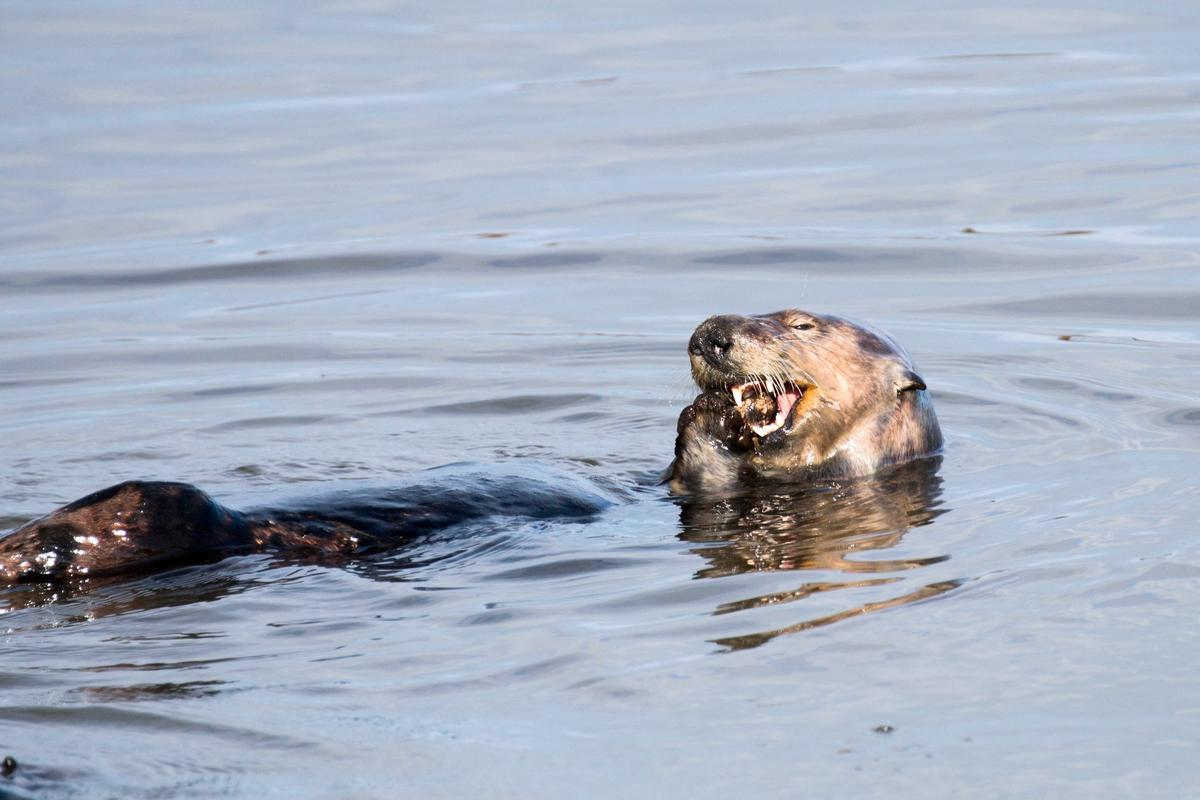
An undated handout image shows a southern sea otter preying on a marine animal, in the Pacific Ocean off the coast of California, U.S.

An undated handout image shows a southern sea otter preying on a marine animal, in the Pacific Ocean off the coast of California, U.S.
| Photo Credit:
Reuters

Among the prey were sea urchins, abalone, crabs, mussels, clams, snails and fat innkeeper worms. The shells of certain larger prey would be too tough, without tools, to break to gain access to the edible soft parts inside. For instance, mussels, clams and snails would otherwise be unavailable.

“Tool use allows individuals to maintain energetic requirements through the processing of alternative hard prey that are typically inaccessible with biting alone, suggesting that this behavior is a necessity for the survival of some otters in environments with limited resources,” said evolutionary biologist Chris Law of the University of Texas and University of Washington, lead author of the study published on Thursday in the journal Science.

The frequency of tool-use behavior varies, with some otters doing it more than 90% of the time when feeding and others rarely or never, according to study co-author Rita Mehta, a University of California, Santa Cruz functional and comparative biologist.

Tool use was particularly important for the female otters.

“Females need the calories. They are smaller than males, and pregnant or nursing females have elevated caloric demands. Tool-using females were shown to consume a greater proportion of very large prey to help them meet their caloric needs,” Mehta said.
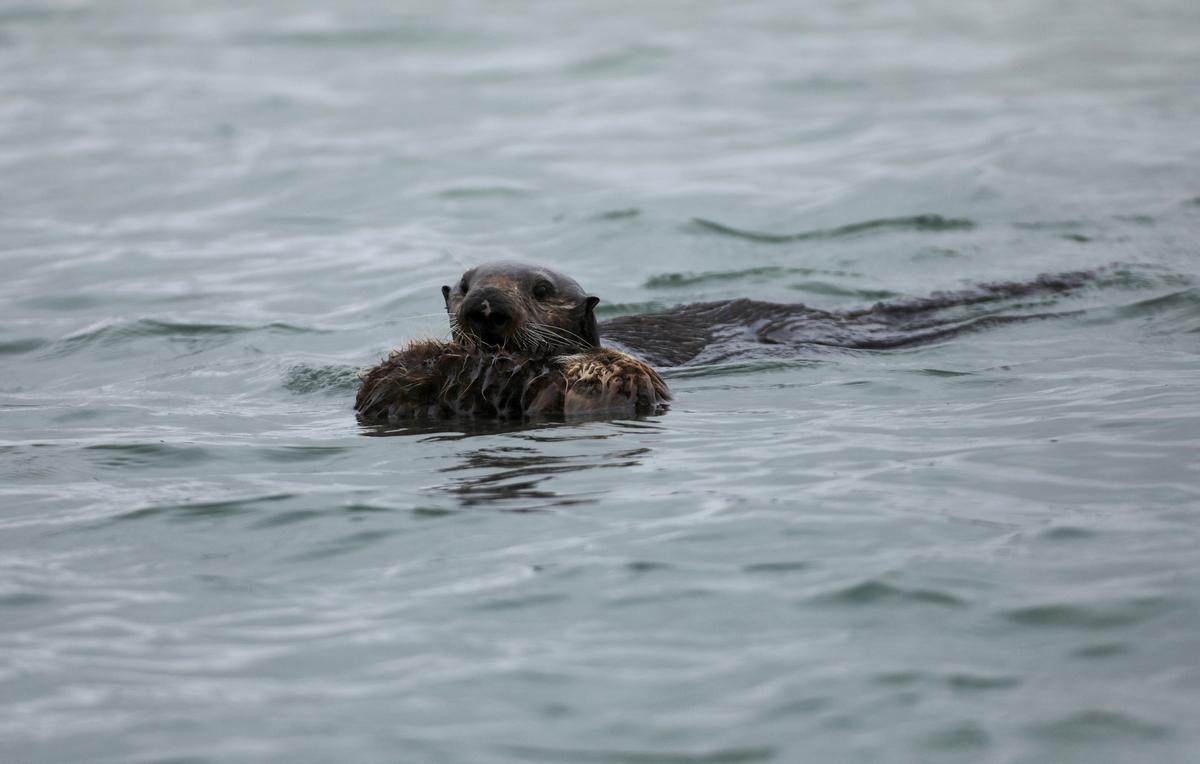
An adult sea otter pushes a sea otter pup on the surface of the Elkhorn Slough in Moss Landing, California, U.S. May 14, 2021. Picture taken May 14, 2021.

An adult sea otter pushes a sea otter pup on the surface of the Elkhorn Slough in Moss Landing, California, U.S. May 14, 2021. Picture taken May 14, 2021.
| Photo Credit:
Reuters

The southern sea otters, a subspecies also called the California sea otter, can reach up to four feet (1.2 meters) long. Males weigh up to about 70 pounds (32 kg) and females up to about 50 pounds (23 kg).

Eating hard-shelled prey, as the otters do, can lead to broken teeth.

“Without their teeth, otters can’t eat and will die. Females show slightly less damage to their teeth overall, probably because of their increased tool use,” Law said.

Sea otters, the largest member of the weasel family, generally eat food equal to about a quarter of their body weight daily as they prowl kelp forests and seagrass beds. The population of southern sea otters along California’s coastline numbers only about 3,000.

The otters were opportunistic in terms of their tools.

“Otters are intelligent mammals, and they are very strong. People who live along the bay commonly observe otters using a variety of human-discarded material as tools, from glass bottles to pieces of plastic, so otters seem flexible in what they may try to use to break open prey,” Mehta said.




Source link

Science Tags:animal news, science news, Sea otters, sea otters use tools get prey

Post navigation

Previous Post: All About The Parasite That Has Cause Diarrhoea Outbreak In UK Town
Next Post: Prithvi Shaw Given Big IPL Warning? “Without Him, We Won Games,” Delhi Capitals Assistant Coach

Related Posts

  • Right against climate change a distinct fundamental and human right, SC judgment Science
  • ISRO hand-holding start-ups to foster space ecosystem Science
  • Spaceflight is reckoning anew with new generation of ‘space planes’” Science
  • Team including Indian scientists designs potent antidote to cobra, krait venom toxins Science
  • A strange intermittent radio signal from space has astronomers puzzled Science
  • Putin aims to have Russian space station by 2027 Science

More Related Articles

Muscle, wood, coal, oil: what earlier energy transitions tell us about renewables Science
Why Nipah virus outbreaks are occurring only in Kerala Science
Something changed about cyclone formation in the 1990s | Explained Science
Japanese scientists find microplastics are present in clouds Science
Chemistry Nobel Prize for trio that made ‘artificial atoms’ Science
What is magnetic resonance imaging? | Explained Science
SiteLock

Archives

  • July 2024
  • June 2024
  • May 2024
  • April 2024
  • March 2024
  • February 2024
  • January 2024
  • December 2023
  • November 2023
  • October 2023
  • September 2023
  • August 2023
  • July 2023
  • June 2023
  • May 2023
  • April 2023
  • March 2023
  • February 2023
  • January 2023
  • December 2022
  • November 2022
  • October 2022
  • September 2022
  • August 2022
  • July 2022
  • June 2022
  • May 2022

Categories

  • Business
  • Nation
  • Science
  • Sports
  • World

Recent Posts

  • Sunil Gavaskar Delivers Brutal Reply To Australian Paper On Suryakumar Yadav’s T20 World Cup Final Catch Row
  • UK Elections 2024: Keir Starmer becomes new U.K. Prime Minister after Labour’s landslide election victory
  • Did A Robot Really Die By ‘Suicide’ In South Korea? Experts Probe
  • Bengal Governor CV Ananda Bose Slams Speaker Over New MLAs’ Oaths
  • Petition Seeks Survey of Agra Jama Masjid, High Court Asks ASI To Reply

Recent Comments

  1. GkJwRWEAbS on UP Teacher Who Asked Students To Slap Muslim Classmate
  2. xreDavBVnbGqQA on UP Teacher Who Asked Students To Slap Muslim Classmate
  3. aANVRzfUdmyb on UP Teacher Who Asked Students To Slap Muslim Classmate
  4. YQCyszVBmIP on UP Teacher Who Asked Students To Slap Muslim Classmate
  5. aiXothgwe on UP Teacher Who Asked Students To Slap Muslim Classmate
  • Pakistan Pace Trio “Far More Potent On…”: Dinesh Karthik’s Honest Admission Sports
  • Joe Biden Jokes About Turbulent Boeing World
  • Seat-Sharing To Be On Agenda At INDIA’s First Coordination Panel Meet Today Nation
  • Highway Agencies Should Not Charge Toll If Roads Not Good: Nitin Gadkari Nation
  • In Bail Appeal, Manish Sisodia Says Investigation Against Him Complete Nation
  • Lebanon’s Hezbollah chief Hassan Nasrallah meets Hamas, Islamic Jihad officials World
  • John Lee Ka-chiu: The Beijing loyalist World
  • 6 Assam, Manipur Rivers Experience Severe Flooding, Many Districts At High Risk Nation

Editor-in-Chief:
Mohammad Ariff,
MSW, MAJMC, BSW, DTL, CTS, CNM, CCR, CAL, RSL, ASOC.
editor@artifex.news

Associate Editors:
1. Zenellis R. Tuba,
zenelis@artifex.news
2. Haris Daniyel
daniyel@artifex.news

Photograher:
Rohan Das
rohan@artifex.news

Artifex.News offers Online Paid Internships to college students from India and Abroad. Interns will get a PRESS CARD and other online offers.
Send your CV (Subjectline: Paid Internship) to internship@artifex.news

Links:
Associate Journalism
About Us
Privacy Policy

News Links:
Breaking News
World
Nation
Sports
Business
Entertainment
Lifestyle

Registered Office:
72/A, Elliot Road, Kolkata - 700016
Tel: 033-22277777, 033-22172217
Email: office@artifex.news

Editorial Office / News Desk:
No. 13, Mezzanine Floor, Esplanade Metro Rail Station,
12 J. L. Nehru Road, Kolkata - 700069.
(Entry from Gate No. 5)
Tel: 033-46011099, 033-46046046
Email: editor@artifex.news

Copyright © 2023 Artifex.News Newsportal designed by Artifex Infotech.