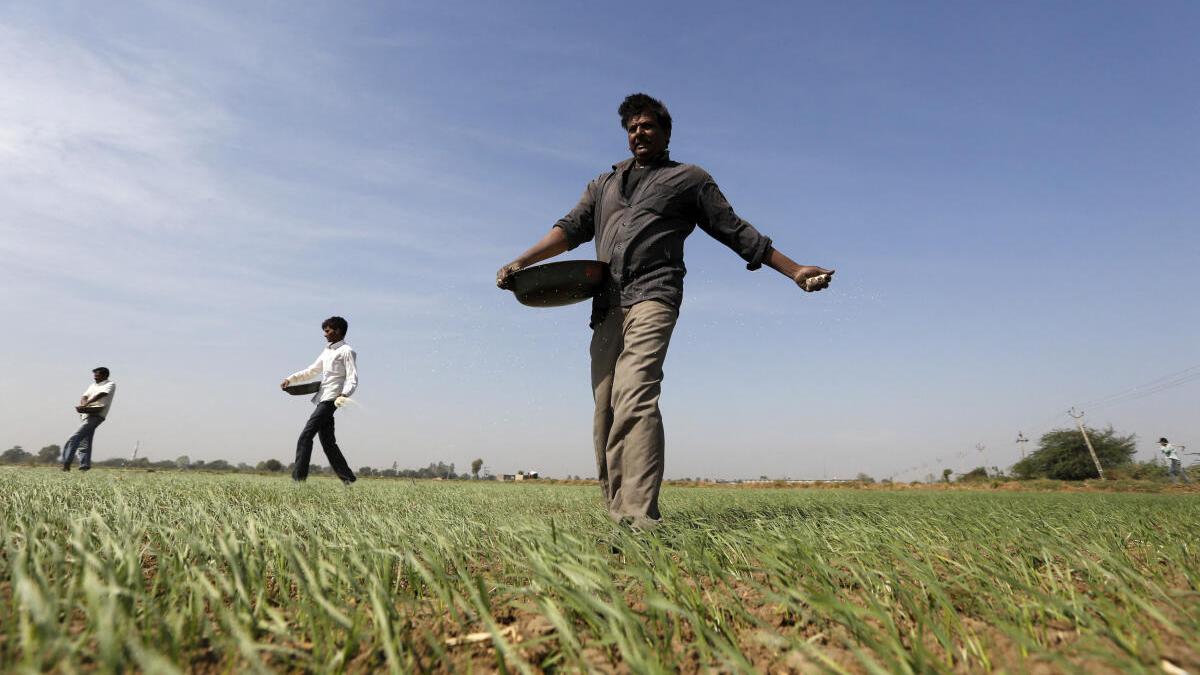




A man covers his head with cloth to protect himself during a heat wave in Bhubaneswar, April 24, 2024.
| Photo Credit: Biswaranjan Rout/The Hindu
The complexities of the ways in which global warming manifests in local weather continue to underscore the need to model globally but predict locally.
The waning phase of the strong El Niño of 2023 brings the expected warm temperatures across the globe — while cooler temperatures spread from Pakistan across India to West Bengal during March. This band remained cool throughout 2023 even as record temperatures made relentless headlines.
What do the heat waves have to do with global warming?
Global warming also creates unique features locally that modulate heat waves on top of cool background temperatures. Heat waves over India have been of special concern this season because of the general elections. Some persistent circulation patterns have been creating heat waves and this pattern should serve as another focal point for improving predictions.

It was apparent in March that the anticyclonic circulations over the North Indian Ocean were the drivers of unusual rainfall over Odisha. An anticyclone has winds moving in a clockwise direction, with air sinking down in the middle of it. As this air hits the ground, it is compressed and warmed and can create a high pressure heat dome. An anticyclonic circulation could also explain the historic Dubai floods of April 17.
And these anticyclones exist over the North Indian Ocean and the Indian subcontinent even now.
What links anticyclones to heat?
The persistence of the anticyclones is not unusual in and of itself. During the pre-monsoon season, the upper-level Indian Easterly Jet (IEJ) begins to take shape in the upper atmosphere, at around the 10 degrees N latitude, across the Arabian Sea, peninsular India, and the Bay of Bengal. A strong westerly jet exists to the north around 30 degrees N, and the two together can generate an anticyclonic pattern over the Indian Ocean and the Indian subcontinent.
An easterly jet refers to strong winds coming from the east while westerly jets come from the west. These are natural seasonal features. The westerly jet is pushed north during the monsoon season and the IEJ dominates the Indian subcontinent. During the pre-monsoon season, a strong anticyclone can bring dry and hot weather over many parts of India while a weak anticyclone produces milder weather.
The key question then is whether the anticyclone is strong this year and if that is related to global warming and, thus, the heat waves.
How are heat waves amplified?
The pre-monsoon season is India’s summer and heat waves are to be expected. The focus is always on predicting them accurately and providing early warnings to save lives. The background drivers of the duration, intensity, and frequency of heat waves are helpful to identify the hotspots of heat waves at the timescales relevant to the evolution of the weather and the climate.

The record warming of 2023 has so far not been fully explained since it was much warmer than what we expected just from the superposition of El Niño on global warming. But the impact of the El Niño during its pre-monsoon demise on the IEJ tends to produce a stronger and more persistent anticyclone and thus longer lasting and more intense heat waves.
So, the heat wave season this year is consistent with the warmer temperatures due to the El Niño itself as well as the ‘steroids’ being added by the unexplained warming of 2023.
This background state of cool seasonal temperatures but a strong and persistent anticyclone is important. It can help the India Meteorological Department ensure predictions are done with accurate background conditions and build the early warnings accordingly.
What are the stages of early warnings?
Returning to the local manifestation of global warming: accurate early-warning systems take a three-step approach called the ‘ready-set-go’ system, under the so-called ‘Subseasonal-to-Seasonal Predictions’ project of the World Climate Research Program under the World Meteorological Organisation. India is part of this project, has invested heavily in S2S predictions, and has made impressive progress in improving the accuracy of predictions.
Preparing the system and guiding the National Disaster Management Agency (NDMA) requires this three-step approach to function efficiently and effectively. Considering there are more than 1.2 million polling stations for the general elections this year, the optimal use of resources to prepare for, mitigate, and recover from extreme events requires location-specific information at each step.
The ‘ready’ step provides a seasonal outlook — where the background state, or the external factors (such as global warming and the El Niño), are used to maximise the accuracy of longer-lead forecasts. The ‘ready’ step allows the NDMA, its local agencies, and all local governments to ready their disaster response systems.
The subseasonal predictions refer to the extended range of weeks two to four, which contribute to the ‘set’ step. Resource allocations and identifying potential hotspots to move resources including personnel ensure disaster-preparedness is set to go.
The ‘go’ step is based on short- (days 1-3) and medium- (days 3-10) range forecasts. At this step, everything hits the road to manage a disaster, including rescue efforts, hydration centres, heat shelters, etc.
How’re preparedness and recovery faring?
All evidence suggests India’s prediction system and early warning systems continue to improve and the NDMA has worked these details well into its ‘ready-set-go’ system.
The remaining challenges are to build resilience for the future by better predicting the trajectory of the weather at every location over India. This is a significant challenge but budding efforts for predictions at 10-year timescales have shown promise.
The coordination from national to neighbourhood levels and early-warnings from days to a decade are taking shape. Governments, their departments, and the people at large need to be trained and engaged with to make this a sustained success. India’s dream of sustained economic development depends on this.
Raghu Murtugudde is a visiting professor at IIT Bombay and an emeritus professor at the University of Maryland.