





Skip to content
  • Facebook
  • X
  • Linkedin
  • WhatsApp
  • Associate Journalism
  • About Us
  • Privacy Policy
  • 033-46046046
  • editor@artifex.news
Artifex.News

Artifex.News

Stay Connected. Stay Informed.

  • Breaking News
  • World
  • Nation
  • Sports
  • Business
  • Science
  • Entertainment
  • Lifestyle
  • Toggle search form
  • Ukraine Orders Civilian Evacuation In Russia-Controlled Kherson Region World
  • Max Verstappen Matches Ayrton Senna Pole Record At Imola Sports
  • Plea filed in SC seeks to review Adani-Hindenburg verdict Business
  • Ready To Discuss Hostage Deal Without “Permanent” Ceasefire: Top Hamas Official World
  • Rupee gains 9 paise against dollar in early session Business
  • Man Charged For Stabbing Employer To Death Over Wages Of Rs 1,250 In Mumbai: Cops Nation
  • Veteran South African politician Mangosuthu Buthelezi dies at 95 World
  • First Time In History – SunRisers Hyderabad Go On Rampage vs DC, Score World Record 125 In 6 Overs Sports

Scientists are grasping at straws while trying to protect infant corals from hungry fish

Posted on April 11, 2024 By admin


This July 26, 2023 image shows a ‘Coral Fort’ researchers are using to prevent laboratory-grown coral from being eaten by parrot fish.
| Photo Credit: AP

South Florida researchers trying to prevent predatory fish from devouring laboratory-grown coral are grasping at biodegradable straws in an effort to restore what some call the rainforest of the sea.

Scientists around the world have been working for years to address the decline of coral reef populations. Just last summer, reef rescue groups in South Florida and the Florida Keys were trying to save coral from rising ocean temperatures. Besides working to keep existing coral alive, researchers have also been growing new coral in labs and then placing them in the ocean.

But protecting the underwater ecosystem that maintains upwards of 25% of all marine species is not easy. Even more challenging is making sure that coral grown in a laboratory and placed into the ocean doesn’t become expensive fish food.

Marine researcher Kyle Pisano said one problem is that predators like parrot fish attempt to bite and destroy the newly transplanted coral in areas like South Florida, leaving them with less than a 40% survival rate. With projects calling for thousands of coral to be planted over the next year and tens of thousands of coral to be planted over the next decade, the losses add up when coral pieces can cost more than $100 each.

Pisano and his partner, Kirk Dotson, have developed the Coral Fort, claiming the small biodegradable cage that’s made in part with drinking straws boosts the survival rate of transplanted coral to over 90%.
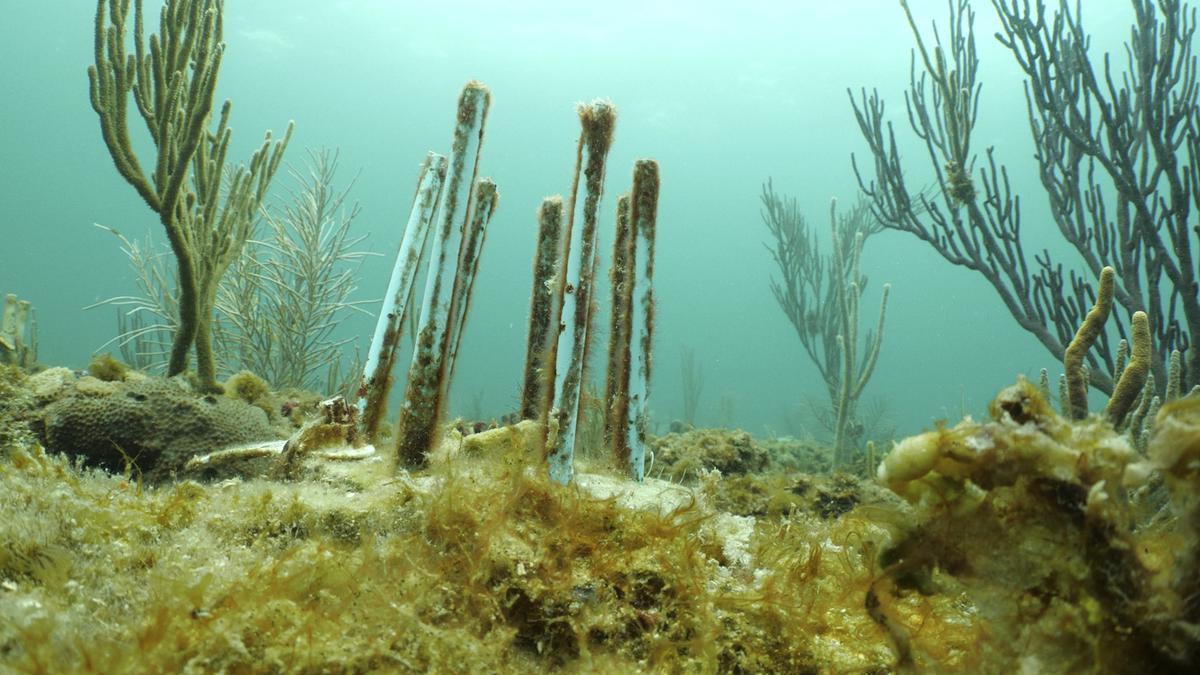
This July 26, 2023 image provided by phade® by WinCup, Inc., shows a “Coral Fort,” made of biodegradable drinking straws that researchers are using to prevent laboratory-grown coral from becoming really expensive fish food, off the coast of Fort Lauderdale, Fla. Scientists around the world have been working for years to address the decline of coral reef populations. Last summer, reef rescue groups in South Florida and the Florida Keys were trying to save coral from rising ocean temperatures.

This July 26, 2023 image provided by phade® by WinCup, Inc., shows a “Coral Fort,” made of biodegradable drinking straws that researchers are using to prevent laboratory-grown coral from becoming really expensive fish food, off the coast of Fort Lauderdale, Fla. Scientists around the world have been working for years to address the decline of coral reef populations. Last summer, reef rescue groups in South Florida and the Florida Keys were trying to save coral from rising ocean temperatures.
| Photo Credit:
AP

“Parrot fish on the reef really, really enjoy biting a newly transplanted coral,” Pisano said. “They treat it kind of like popcorn.”

Fortunately the fish eventually lose interest in the coral as it matures, but scientists need to protect the coral in the meantime. Stainless steel and PVC pipe barriers have been set up around transplanted coral in the past, but those barriers needed to be cleaned of algae growth and eventually removed.

Pisano had the idea of creating a protective barrier that would eventually dissolve, eliminating the need to maintain or remove it. He began conducting offshore experiments with biodegradable coral cages as part of a master’s degree program at Nova Southeastern University. He used a substance called polyhydroxyalkanoate, a biopolymer derived from the fermentation of canola oil. PHA biodegrades in ocean, leaving only water and carbon dioxide. His findings were published last year.

The coral cage consists of a limestone disc surrounded by eight vertical phade brand drinking straws, made by Atlanta-based WinCup Inc. The device doesn’t have a top, Pisano said, because the juvenile coral needs sunlight and the parrot fish don’t generally want to position themselves facing downward to eat.

Dotson, a retired aerospace engineer, met Pisano through his professor at Nova Southeastern, and the two formed Reef Fortify Inc. to further develop and market the patent-pending Coral Fort. The first batch of cages were priced at $12 each, but Pisano and Dotson believe that could change as production scales up.

Early prototypes of the cage made from phade’s standard drinking straws were able to protect the coral for about two months before dissolving in the ocean, but that wasn’t quite long enough to outlast the interest of parrot fish. When Pisano and Dotson reached out to phade for help, the company assured them that it could make virtually any custom shape from its biodegradable PHA material.

“But it’s turning out that the boba straws, straight out of the box, work just fine,” Dotson said.

Boba straws are wider and thicker than normal drinking straws. They’re used for a tea-based drink that includes tapioca balls at the bottom of the cup. For Pisano and Dotson, that extra thickness means the straws last just long enough to protect the growing coral before harmlessly disappearing.

Reef Fortify is hoping to work with reef restoration projects all over the world. The Coral Forts already already being used by researchers at Nova Southeastern and the University of Miami, as well as Hawaii’s Division of Aquatic Resources.

Rich Karp, a coral researcher at the University of Miami, said they’ve been using the Coral Forts for about a month. He pointed out that doing any work underwater takes a great deal of time and effort, so having a protective cage that dissolves when it’s no longer needed basically cuts their work in half.

“Simply caging corals and then removing the cages later, that’s two times the amount of work, two times the amount of bottom time,” Karp said. “And it’s not really scalable.”

Experts say coral reefs are a significant part of the oceanic ecosystem. They occupy less than 1% of the ocean worldwide but provide food and shelter to nearly 25 percent of sea life. Coral reefs also help to protect humans and their homes along the coastline from storm surges during hurricanes.



Source link

Science Tags:animal news, animal science, biodegradable straws, coral, Coral bleaching, Environment news, fish food

Post navigation

Previous Post: Anil Ambani suffers another setback as SC sets aside arbitral award of ₹8,000 crore in favour of Reliance firm
Next Post: Vistara Airlines CEO says ‘worst is behind us’; operations have stabilised

Related Posts

  • Tropical birds show signs of mercury contamination, due to artisanal gold mining operations: Study Science
  • The physics of why Shami’s ‘bolt upright’ seam works magic Science
  • Katalin Kariko, scientific maverick who paved way for mRNA vaccines Science
  • Goa scientists find 50,000-year-old magnetic fossils in Bay of Bengal Science
  • Send robots into space rather than people, says Britain’s Astronomer Royal Science
  • Genomic clues suggest humans’ ancestors nearly went extinct 9L years ago Science

More Related Articles

 Global project ‘paints’ evidence of air pollution in India Science
How many trees do we have? Science
Sci-Five | The Hindu Science Quiz: On Solar Eclipse Photographers Science
ISRO’s POEM-3 mission accomplishes zero orbital debris mission Science
The Hindu Daily Quiz | On balancing rocks- Feb 29, 2024 Science
Risk of type 2 diabetes linked to air pollution in Chennai, Delhi Science
SiteLock

Archives

  • July 2024
  • June 2024
  • May 2024
  • April 2024
  • March 2024
  • February 2024
  • January 2024
  • December 2023
  • November 2023
  • October 2023
  • September 2023
  • August 2023
  • July 2023
  • June 2023
  • May 2023
  • April 2023
  • March 2023
  • February 2023
  • January 2023
  • December 2022
  • November 2022
  • October 2022
  • September 2022
  • August 2022
  • July 2022
  • June 2022
  • May 2022

Categories

  • Business
  • Nation
  • Science
  • Sports
  • World

Recent Posts

  • French left to name PM candidate this week
  • MLA Becomes Minister, Twice in 15 Minutes, In Bizarre Oath-Taking Ceremony
  • Japan, Philippines sign defence pact in the face of shared alarm over China
  • Boeing Agrees To Plead Guilty To Fraud In Probe Into 737 MAX Crashes
  • India Women On Mercy Of Weather Gods, Hope To Draw South Africa T20I Series

Recent Comments

  1. GkJwRWEAbS on UP Teacher Who Asked Students To Slap Muslim Classmate
  2. xreDavBVnbGqQA on UP Teacher Who Asked Students To Slap Muslim Classmate
  3. aANVRzfUdmyb on UP Teacher Who Asked Students To Slap Muslim Classmate
  4. YQCyszVBmIP on UP Teacher Who Asked Students To Slap Muslim Classmate
  5. aiXothgwe on UP Teacher Who Asked Students To Slap Muslim Classmate
  • India Signs 10-Year Contract To Operate Iran’s Key Chabahar Port World
  • PM Justin Trudeau, delegation’s earliest possible departure from Delhi is Tuesday late afternoon: Canada World
  • Coco Gauff Marches Into US Open Women’s Singles Final With Straight Sets Win Over Karolina Muchova Sports
  • Hamas ‘only thing standing between the people of Gaza and a ceasefire’: U.S.’s Blinken World
  • Rupee rebounds 14 paise to 83.37 against US dollar Business
  • Rupee rises 9 paise to 82.99 against U.S. dollar Business
  • History in the making in Russia as Putin set to begin another term in office World
  • Markets snap 2-day winning run; Sensex slumps nearly 390 points on weak global cues Business

Editor-in-Chief:
Mohammad Ariff,
MSW, MAJMC, BSW, DTL, CTS, CNM, CCR, CAL, RSL, ASOC.
editor@artifex.news

Associate Editors:
1. Zenellis R. Tuba,
zenelis@artifex.news
2. Haris Daniyel
daniyel@artifex.news

Photograher:
Rohan Das
rohan@artifex.news

Artifex.News offers Online Paid Internships to college students from India and Abroad. Interns will get a PRESS CARD and other online offers.
Send your CV (Subjectline: Paid Internship) to internship@artifex.news

Links:
Associate Journalism
About Us
Privacy Policy

News Links:
Breaking News
World
Nation
Sports
Business
Entertainment
Lifestyle

Registered Office:
72/A, Elliot Road, Kolkata - 700016
Tel: 033-22277777, 033-22172217
Email: office@artifex.news

Editorial Office / News Desk:
No. 13, Mezzanine Floor, Esplanade Metro Rail Station,
12 J. L. Nehru Road, Kolkata - 700069.
(Entry from Gate No. 5)
Tel: 033-46011099, 033-46046046
Email: editor@artifex.news

Copyright © 2023 Artifex.News Newsportal designed by Artifex Infotech.