




Skip to content
  • Facebook
  • X
  • Linkedin
  • WhatsApp
  • Associate Journalism
  • About Us
  • Privacy Policy
  • 033-46046046
  • editor@artifex.news
Artifex.News

Artifex.News

Stay Connected. Stay Informed.

  • Breaking News
  • World
  • Nation
  • Sports
  • Business
  • Science
  • Entertainment
  • Lifestyle
  • Toggle search form
  • Several Rajasthan Congress Leaders, Including Former MLAs, Join BJP Nation
  • U. S new visa rule could boost local hiring, warns Nasscom Business
  • JP Morgan CEO praises Modi, says he ‘took 400 million people out of poverty’ Business
  • UN Chief Calls For Ceasefire To End Gaza’s “Godawful Nightmare” World
  • “PhD For Professor Jasprit Bumrah”: Ian Bishop’s Worldly Praise For Mumbai Indians Star Sports
  • BMW To Each Player, 1 Crore Cash: Hyderabad Team Promised Big Reward If They Win Ranji Trophy Sports
  • Cricketer Shikhar Dhawan Gets Divorce On Grounds Of Cruelty By Wife Sports
  • Criticised As Captain, Hardik Pandya Goes On Record To Pinpoint His Brilliant Decisions vs SRH Sports

50,000-year-old magnetic fossils found in the Bay of Bengal

Posted on March 26, 2024 By admin


Needle, spindle, bullet and spearhead shape-magnetofossils.
| Photo Credit: Kadam, N et al/Nature

In the depths of the Bay of Bengal, scientists have discovered a 50,000-year-old sediment — a giant magnetofossil and one of the youngest to be found yet. 

What are magentofossils?

Magnetofossils are the fossilised remains of magnetic particles created by magnetotactic bacteria, also known as magnetobacteria, and found preserved within the geological records.

Magnetotactic bacteria are mostly prokaryotic organisms that arrange themselves along the earth’s magnetic field. These unique creatures were first described fairly recently, in 1963, by Salvatore Bellini, an Italian doctor and then again in 1975 by Richard Blakemore of the Woods Hole Oceanographic Institution, Woods Hole, Massachusetts.

These organisms were believed to follow the magnetic field to reach places that had optimal oxygen concentration. Using an electron microscope, Blakemore found the bacteria contained “novel structured particles, rich in iron” in small sacs that essentially worked as a compass.

These magnetotactic bacteria create tiny crystals made of the iron-rich minerals magnetite or greigite. The crystals help them navigate the changing oxygen levels in the water body they reside in.

The fossils left behind by the crystal-creating bacteria help scientists glean conditions that prevailed millions of years ago and which contributed to “the sediment magnetic signal”.

What makes the Bay of Bengal sediment special?

In previous studies on magnetofossils often ascertained their origins to be hyperthermal vents, comet impacts, changes in oceanic ventilation, weathering or the presence of oxygen-poor regions.
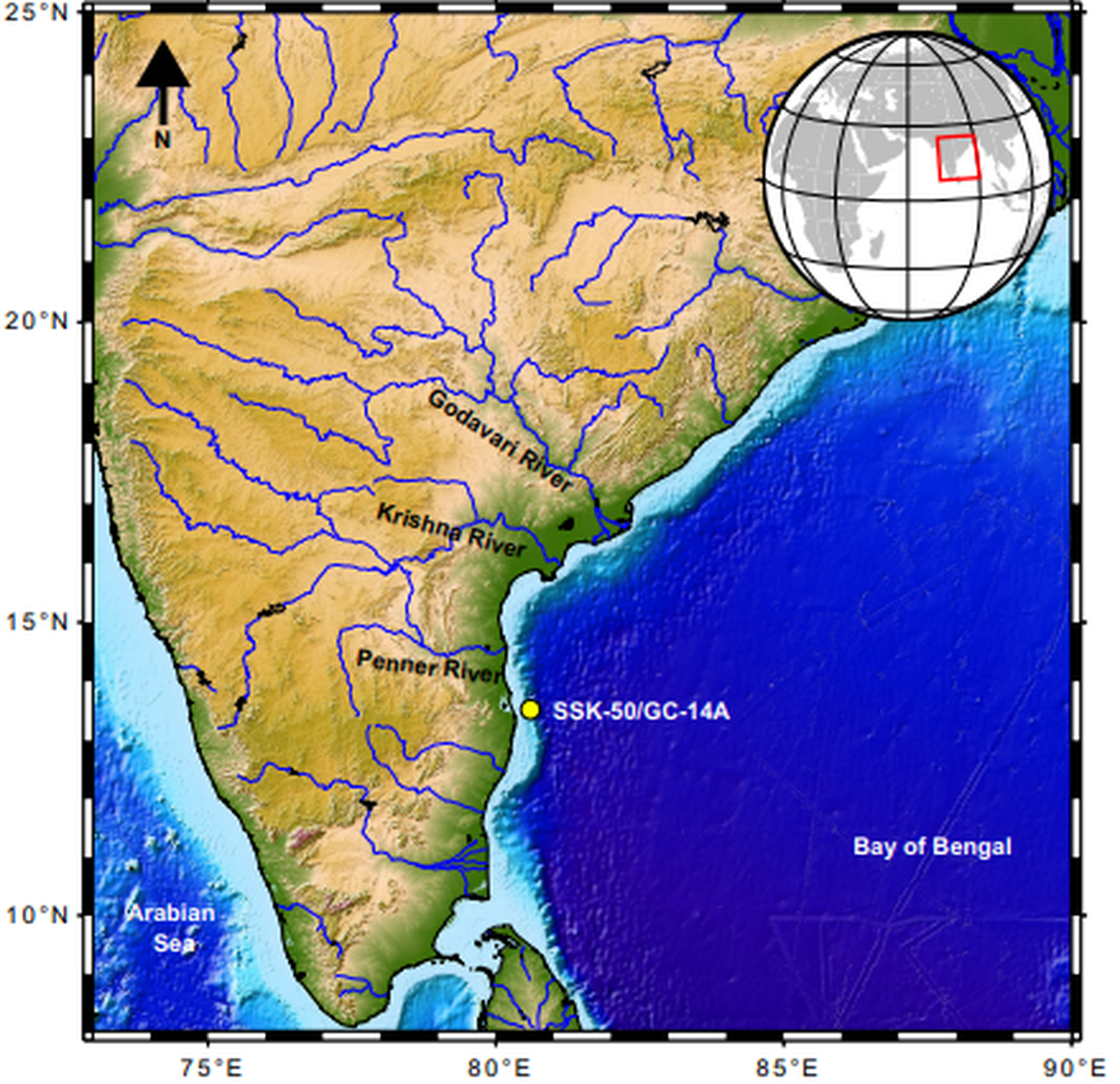
Sediments deposited at the core site originate predominantly from the Godavari, Krishna, and Penner Rivers, highlighted on the map.

Sediments deposited at the core site originate predominantly from the Godavari, Krishna, and Penner Rivers, highlighted on the map.
| Photo Credit:
Kadam, N et al/Nature

In fact, the origin of giant magnetofossils has stayed a mystery. Most giant magnetofossils have been found in sediments dating to the late Palaeocene period, some 56 million years ago, suggesting they formed only during periods of extreme warming.

But in the new study, published in the journal Nature in February, the scientists found the sediment in the Bay of Bengal to be from the late Quaternary period, or about 50,000 years ago, making it the youngest giant magnetofossil to have been found found yet.

What did the study find?

In the study, scientists at the CSIR-National Institute of Oceanography, Goa, combined magnetic analyses and electron microscopy to study the sediment sample.

The three-metre-long sediment core from the southwestern Bay of Bengal consisted mainly of “pale green silty clays,” they wrote in their paper. They also reported finding abundant benthic and planktic foraminifera — single-celled organisms with shells found near the sea bed and free-floating in water.

High-resolution transmission electron microscopy revealed the fossil to be in the shape of needles, spindles, bullets, and spearheads. The microscopy also confirmed the presence of ‘conventional’ magnetofossils along with giant ones. 

At a depth of around 1,000-1,500 m, the Bay of Bengal has a distinctively low oxygen concentration.

Earlier, studies of sediments suggested that nearly 29,000 to 11,700 years ago, during the last Glacial Maximum-Halocene period, the northeast and southwest monsoon strengthened and resulted in significant weathering and sedimentation.

Analysis of the sediment sample confirmed fluctuations in the monsoon took place as the scientists found particles of magnetic minerals from the two distinct geological periods.

The scientists also suggested the rivers Godavari, Mahanadi, Ganga-Brahmaputra, Cauvery, and Penner, which empty into the Bay of Bengal, played a crucial role in the formation of the magnetofossils.

The nutrient-rich sediment carried in by these rivers provided a sufficient supply of reactive iron, which combined with the available organic carbon in the suboxic conditions of the Bay of Bengal to create a favourable environment for the growth of magnetotatic bacteria.

The freshwater discharge from these rivers along with the other oceanographic processes, like eddy formation, rendered the oxygen content in these waters that isn’t usually found in other low-oxygen zones.

The scientists also said the presence of the magnetofossils showed that the suboxic conditions of the Bay of Bengal persisted for a long time, allowing the bacteria to thrive.



Source link

Science Tags:Bay of Bengal, history of monsoons, India summer monsoons, magnetic bacteria, Magnetofossils, Magnetofossils in the Bay of Bengal, science news

Post navigation

Previous Post: Kangana Ranaut On Congress Leaders Supriya Shrinate, HS Ahir’ Derogatory Remarks
Next Post: As Birth Rates Drop, Japanese Diaper Makers Move To Adult Market

Related Posts

  • Balancing two forms of SNCA protein could help manage Parkinson’s, study finds Science
  • The birth and growth of music Science
  • A comprehensive immunisation schedule for adult women is now ready Science
  • Fourth Earth-bound manoeuvre of the Aditya-L1 mission performed successfully Science
  • PM congratulates ISRO on successful launch of Aditya-L1 Science
  • The value of attributing extreme events to climate change | Explained Science

More Related Articles

IISc scientists develop design to control temperature for transition from electrical insulator to conductor Science
What is ‘Net Zero’, anyway? A short history of a monumental concept Science
Agni-Prime Missile: New generation ballistic missile Agni-Prime successfully flight-tested Science
Vymaanika Shastra, Pushpakavimana in reading module on Chandrayaan-3 Science
The Science Quiz | The quiet awesomeness of tungsten Science
Glycemic index of diets: importance beyond diabetes control Science
SiteLock

Archives

  • July 2024
  • June 2024
  • May 2024
  • April 2024
  • March 2024
  • February 2024
  • January 2024
  • December 2023
  • November 2023
  • October 2023
  • September 2023
  • August 2023
  • July 2023
  • June 2023
  • May 2023
  • April 2023
  • March 2023
  • February 2023
  • January 2023
  • December 2022
  • November 2022
  • October 2022
  • September 2022
  • August 2022
  • July 2022
  • June 2022
  • May 2022

Categories

  • Business
  • Nation
  • Science
  • Sports
  • World

Recent Posts

  • Finance Minister wraps up consultation ahead of FY25 budget
  • Will Kuldeep Yadav Marry A Bollywood Actress? T20 World Cup Winner Breaks Silence
  • Centre Acts Against 2 Kolkata Senior Cops For Tarnishing Governor’s Office
  • Israeli protesters block highways, call for cease-fire to bring back hostages as war marks nine months
  • Chinese Premier Congratulates New UK PM, Says “Willing To Work”: Report

Recent Comments

  1. GkJwRWEAbS on UP Teacher Who Asked Students To Slap Muslim Classmate
  2. xreDavBVnbGqQA on UP Teacher Who Asked Students To Slap Muslim Classmate
  3. aANVRzfUdmyb on UP Teacher Who Asked Students To Slap Muslim Classmate
  4. YQCyszVBmIP on UP Teacher Who Asked Students To Slap Muslim Classmate
  5. aiXothgwe on UP Teacher Who Asked Students To Slap Muslim Classmate
  • Amazon To Invest $3 Million In Nature-Based Projects In India Business
  • “Hope Rahul Dravid Can…”: Brian Lara’s Big ‘T20 World Cup’ Advice For Outgoing India Coach Sports
  • Mehidy relishing batting at the top of the order Sports
  • Taiwan Actively Considering Visa-On-Arrival For Indians World
  • Markets fall for third day on weak global equities, spike in Brent crude oil prices Business
  • Delhi Police Sub-Inspector Shoots Self In Apartment Nation
  • Tribunal lifts ban on Zee’s Goenka on holding key positions Business
  • “Aapse Behtar…”: Anchor Reminds Misbah-Ul-Haq Of MS Dhoni’s Brilliance. Ex-Pakistan’s Star Reaction Goes Viral Sports

Editor-in-Chief:
Mohammad Ariff,
MSW, MAJMC, BSW, DTL, CTS, CNM, CCR, CAL, RSL, ASOC.
editor@artifex.news

Associate Editors:
1. Zenellis R. Tuba,
zenelis@artifex.news
2. Haris Daniyel
daniyel@artifex.news

Photograher:
Rohan Das
rohan@artifex.news

Artifex.News offers Online Paid Internships to college students from India and Abroad. Interns will get a PRESS CARD and other online offers.
Send your CV (Subjectline: Paid Internship) to internship@artifex.news

Links:
Associate Journalism
About Us
Privacy Policy

News Links:
Breaking News
World
Nation
Sports
Business
Entertainment
Lifestyle

Registered Office:
72/A, Elliot Road, Kolkata - 700016
Tel: 033-22277777, 033-22172217
Email: office@artifex.news

Editorial Office / News Desk:
No. 13, Mezzanine Floor, Esplanade Metro Rail Station,
12 J. L. Nehru Road, Kolkata - 700069.
(Entry from Gate No. 5)
Tel: 033-46011099, 033-46046046
Email: editor@artifex.news

Copyright © 2023 Artifex.News Newsportal designed by Artifex Infotech.