

The story so far:
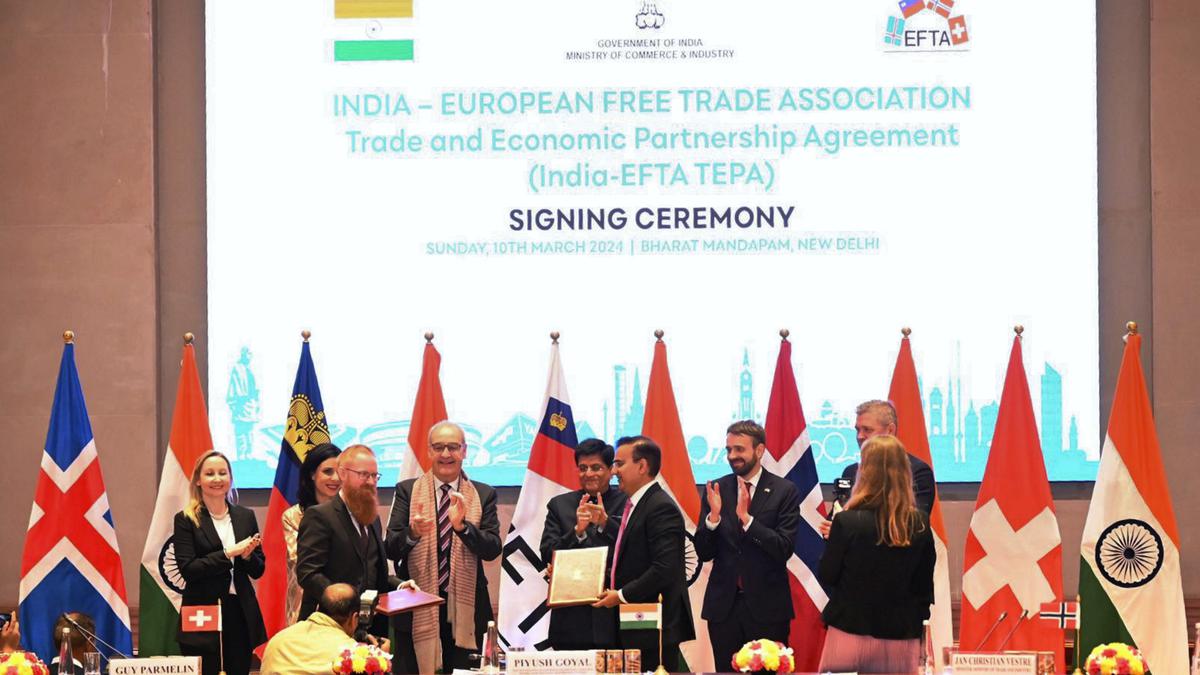
The India-EFTA Trade and Economic Partnership Agreement (TEPA) is the latest in India’s recent Free Trade Agreements (FTAs). As its name suggests, the thrust of the FTA is deeper economic engagement with the EFTA ( European Free Trade Association) countries — Switzerland, Norway, Iceland and Liechtenstein. It heralds the westward tilt of India’s FTAs, being the first with any European country and the western world.
What does this mean?
The successful conclusion of an FTA with developed countries including Switzerland and Norway is a significant positive signal to the world, showcasing India’s firm commitment to trade liberalisation at a time of rising protectionism across both developed and developing countries. For trading partners, an FTA with India is very attractive since it represents surpassing India’s high tariff walls to access a large market. The TEPA negotiations started almost 15 years back; however, these were rapidly concluded in the last few months, close on the heels of the swift conclusion of FTAs with Australia and the UAE. The FTAs with the U.K. and the EU are also reportedly at an advanced stage.
What are the key features of TEPA?
Investment: TEPA sets out a target of a $100 billion investment into India from EFTA countries, and consequent one million jobs over a 15-year period. It also provides India the ability to withdraw its tariff concessions if such expected investment is not achieved. A closer look at the legal text reveals that for the promised investments and jobs to materialise, two conditions need to be met: India growing at a fast rate of 9.5%, and the return on EFTA investments in India exceeding 16% annually over the 15-year timeline. If not, both sides may lower their level of ambitions. If India is not satisfied, it can pull back its tariff concessions in a proportionate manner after 18 years. The investment chapter is not subject to dispute resolution and is overall, a statement of positive intent, and its benefits will be dependent on the private sector’s responsiveness to the TEPA.
Trade in goods: the chief gain here is for EFTA’s market, which can have more access to India due to tariff concessions. India is mandated to eliminate tariff on most products within seven to 10 years. This will benefit EFTA exports of seafood like tuna and salmon, fruits like olives and avocados, coffee capsules, oils like cod liver and olive oil, and a variety of sweets and processed foods including chocolate and biscuits. Also covered are smartphones, bicycle parts, medical equipment, clocks, and watches, many medicines, dyes, textiles, apparels, iron and steel products, and most machinery. Additionally, tariffs on cut and polished diamonds will be reduced from 5% to 2.5% in five years. For wines, India has extended tariff cuts as follows: wines priced between $5 and less than $15 will see a duty reduction from 150% to 100% in the first year, which will then decrease gradually to 50% over 10 years. For wines costing $15 or more, the initial duty cut is from 150% to 75%, eventually reducing to 25% after 10 years.
Gold, which accounts for 80% of the merchandise imports from EFTA countries, as well as dairy, soya, coal and some sensitive agricultural products have been excluded from India’s tariff concession list.
With regard to India’s exports to EFTA, there will be no material impact since most products face very low or zero tariff for nations which have the Most Favoured Nation (MFN) status in EFTA countries. For example, value wise, 98% of India’s $1.3 billion merchandise exports to Switzerland are industrial products where tariff is already zero. The remaining 2% of India’s exports are agricultural products, where gains would be negligible due to low trade values.
Trade in services: on services, both India and the EFTA members have committed to liberalisation across a wide range of sectors. Some key benefits for India include commitments by Norway for access to yoga instructors and practitioners of traditional medicine from India, subject to compliance with its legal framework. Both Norway and Switzerland have committed four and three years respectively for highly skilled Indian professionals moving as intra-corporate transferees, subject to obtaining work permits.
The nitty-gritties of actual service delivery are often impacted by regulatory requirements in each country. A separate annex in the TEPA lays the framework for easing the recognition of qualifications of service suppliers through streamlining the various requirements, including the possibility of achieving equivalence by topping up academic or training requirements, rather than having to repeat the entire professional degree. Separate annexes on financial services and telecom services similarly lay down disciplines that aim to enable ease of providing such services.
In a departure from previous FTAs of India, benefits of the trade in services chapter would extend to any juridical person (i.e., corporate entity) by merely being incorporated in an EFTA member, while having its actual operations in any other WTO member, including those with which India does not have FTAs. This will allow free riders benefiting from the TEPA. The investment chapter stems that risk by requiring benefits to be confined only to entities having substantial business activities within the EFTA; however, services related to commercial presence will be governed by the services chapter.
Sustainable development: the TEPA’s chapter on Trade and Sustainable Development (TSD), comprising commitments on environment and labour aspects, represents a first for India in any FTA. India has so far been sceptical of linking environmental and labour related issues within a FTA, given the concern that these may simply become proxies for protectionist measures. The TSD chapter refers to a range of multilateral environmental agreements and labour conventions, whose implementation is based on a balance of rights and obligations. For example, the UN Framework Convention on Climate Change and Paris Agreement recognises differential obligations for developed and developing countries. Labour conventions under the International Labour Organization (ILO) are based on a tripartite framework involving the government, as well as organisations representing employers and employees. Even though the TSD chapter is not subject to dispute resolution, India will need to be careful that any scrutiny of its implementation of environment and labour obligations, which is inevitable under the TSD chapter, is respectful of the balance inherent in multilateral environment and labour conventions.
Intellectual property rights: the EFTA countries are home to several pharmaceutical and high technology MNCs, whose ask has been commitments on protection of intellectual property rights that exceed the WTO’s Trade-Related Aspects of Intellectual Property Rights (TRIPS) Agreement. The TEPA represents a nod to some of these. For example, India’s Patents Act provides for pre-grant opposition of a patent application. The TEPA’s IPR Annex requires swift rejection of “prima facie unfounded” oppositions. This potentially opens up India’s internal regulatory process to external scrutiny on whether this standard was met. Similarly, a statutory requirement under Indian law is filing of an annual statement on working of a patent. The TEPA mandates that this periodicity be increased to three years, with annual statements to be required only in specified cases, which potentially raises the concern that the statutory requirement as it exists under Indian law, may need reconsideration to make it case specific. While amendments to India’s patent rules have been notified on March 15, five days after the signing of the TEPA, FTA commitments should ideally have followed such amendments.
Overall, in a nutshell, the TEPA ventures into some uncharted territory. It’s implementation over time will determine its impact.
R.V. Anuradha is Partner, Clarus Law Associates; Ajay Srivastava is Founder, Global Trade Research Initiative. Views are personal.