






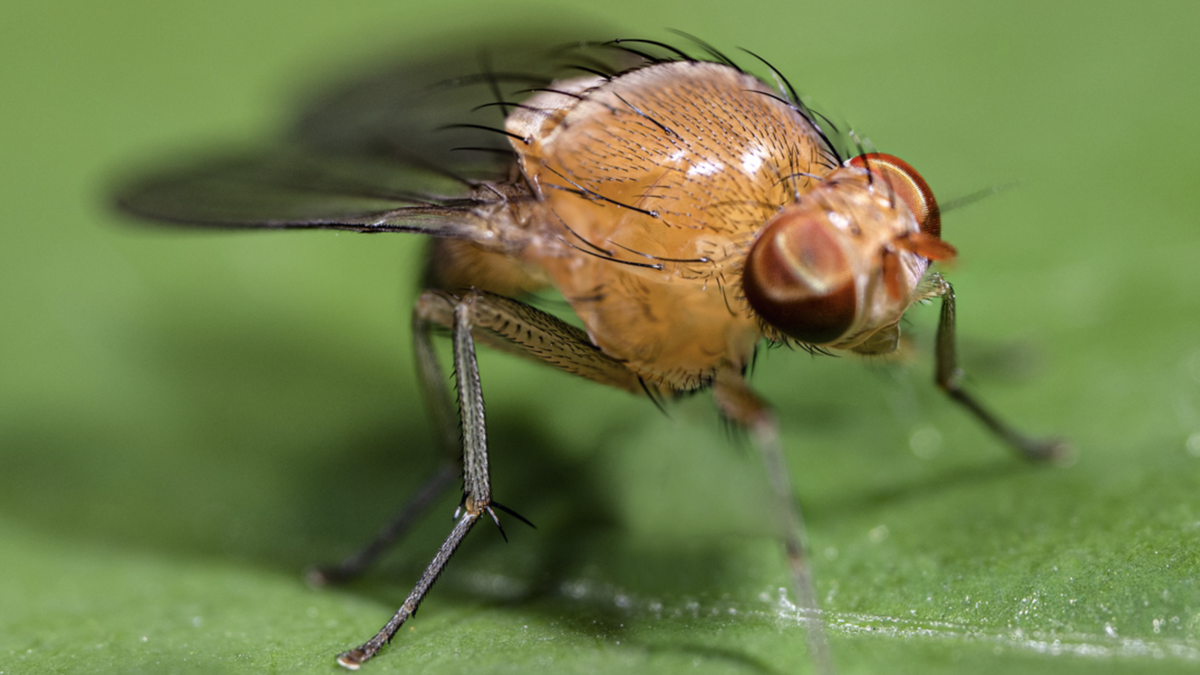
The fruit fly (Drosophila melanogaster) has been among the favourite organisms of genetics researchers for more than a hundred years. Many years of intense research with these diminutive creatures have led to many breakthroughs in our understanding of biology and evolution.
Recently, researchers from Cambridge University and the California Institute of Technology reported yet another such breakthrough. They were able to ‘engineer’ a sexually reproducing fruit-fly species to reproduce asexually, demonstrating the profound biological consequences of relatively minor genetic manipulation.
The first study that reported this significant feat was published in July 2023; a follow-up study to it was published in the February 2024 issue of Heredity.
The Drosophila family
How was an organism that usually reproduces sexually turned into one that could reproduce asexually?
Fatherless reproduction is known as parthenogenesis. Earlier, other researchers had collected fruit-fly-like specimens from diverse geographies and compared them in different ways with the canonical specimen and with each other, to gauge the extent of their natural diversity. The collection represented more than 1,600 Drosophila species.
Of these, one species, Drosophila mangebeirai, was found to consist only of females. The eggs produced by isolated females developed directly into female progeny without having to be fertilised by sperm from a male.
Many species (about 76%) that ordinarily reproduce sexually were found to also hatch a small fraction of eggs laid by isolated virgin females into larvae, a smaller fraction of which went on to develop into adults. The name for such species – i.e. which are arbitrarily parthenogenetic a small fraction of the time – is facultatively parthenogenetic. One of them was Drosophila mercatorum.
The canonical species used in research, Drosophila melanogaster, is however strictly sexual.
The genes for parthenogenesis
The researchers set themselves two goals. First, to identify the genes that allow unfertilised Drosophila mercatorum eggsto complete parthenogenetic development. Second, to modify the Drosophila melanogaster genome to express the corresponding genes in a way that would trigger parthenogenesis.
RNA sequencing is a technique that can quantitatively estimate the level to which a gene is expressed. Using this technique, the researchers identified 44 genes in D. mercatorum eggs that were expressed differently when they were parthenogenetic versus when they weren’t.
The DNA is a ladder-like molecule. Its two rails, or strands, are made of a long series of alternating units of phosphate molecules and the sugar deoxyribose molecules. Each sugar unit is attached to one of the four chemical bases: adenine (A), cytosine (C), guanine (G), and thymine (T). The As and Cs on one strand link with the Ts and Gs on the other to form the rungs, or base-pairs, that hold the strands together.
The Drosophila melanogaster genome has 200,000,000 base-pairs distributed across four DNA molecules. Each molecule is the core of a chromosome. The four chromosomes together make up the genome. In all, this genome encodes about 13,600 genes.
On the other hand, the RNA molecule is comb-like. Its spine (strand) is made of alternating units of phosphate and sugar ribose molecules. Each sugar unit is attached to one of the four bases: A, C, G, and uridine (U), which make up the comb’s tines.
A gene is a segment of a few thousand base-pairs of the DNA molecule. The sequence of bases on one of its strands tells every cell the sequence of amino acids it needs to string together to make a protein. To do this, the cell copies the sequence of As, Ts, Cs, and Gs in the DNA’s protein-coding strand to a sequence of Us, As, Gs, and Cs, respectively, to form the RNA. The RNA is then sent to structures called ribosomes, which assemble the encoded protein.
Engineering asexual reproduction
The 44 genes whose expression differed between eggs of parthenogenetic and sexually-reproducing D. mercatorum strains had counterparts in the D. melanogaster genome. The researchers over- or under-expressed the counterparts to the levels in the D. mercatorum parthenogenetic eggs.
In particular, they found that if the genome of a D. melanogaster specimen was modified to have two extra copies of the polo gene, an extra copy of the Myc gene, and a lower expression of the Desat2 gene, 1.4% of the specimen’s eggs were parthenogenetic and whose offspring survived to adulthood.
The researchers also found that these parthenogenetically produced adult flies could also mate with male flies and produce progeny. So a strictly sexually reproducing fly was made facultatively parthenogenetic.
The polar bodies
A fly receives two sets of chromosomes, one from each parent. It transmits only one chromosome of each pair to its egg or sperm. Say a sperm has fertilised an egg. This egg will now have five sets of the genome: one in the egg’s nucleus (maternal pronucleus), another in the nucleus from the sperm (paternal pronucleus), and three more nuclei called polar bodies that are sequestered in the egg’s periphery.
The polar bodies are a by-product of the mechanism by which the fly transmits only one chromosome of each pair to the egg nucleus. Normally, the male and female pronuclei fuse to form the progeny nucleus, and the polar bodies are lost. If an egg is unfertilised, however, it lacks the male pronucleus and the female pronucleus is unable to initiate embryonic development on its own.
Altering the protein levels of polo, Myc and Desat2 likely rendered polar-body sequestration and disposal inefficient. This makes one or more polar bodies available to substitute for the missing male pronucleus and start embryonic development.
These findings have implications to approaches to control insect pests by releasing large numbers of males sterilised by irradiation or males bearing genomes edited to derail progeny development, and thus reduce progeny numbers. Unwittingly, this approach will also select for facultatively parthenogenetic individuals, thus limiting its long-term effectiveness.
(D.P. Kasbekar is a retired scientist.)