


The story so far: On February 5, an unlikely visitor landed in Delhi from Sri Lanka on an official invitation. Anura Kumara Dissanayake, the leader of the National People’s Power (NPP) alliance, received a red carpet welcome, following which two top officials spent time with him in the capital. The main constituent of the NPP is the Janatha Vimukthi Peramuna (JVP), and Mr. Dissanayake is its leader. The Indian outreach to the JVP has set off much speculation in Sri Lanka. The country is to go through a presidential election this year followed by parliamentary elections this year or the next. A survey conducted by the Health Policy Institute showed that 50% of respondents favoured Mr. Dissanayake as the next President. Since its inception, the party has had a bad history with India. But Mr. Dissanayake’s meetings with National Security Adviser A. K. Doval and External Affairs Minister S. Jaishankar have created new optics in the run-up to the election.
Who are the JVP?
Over its five decade-existence, the JVP, which calls itself Marxist, but has been mostly a Sinhala nationalist party, has viewed India as an expansionist power seeking to colonise Sri Lanka.
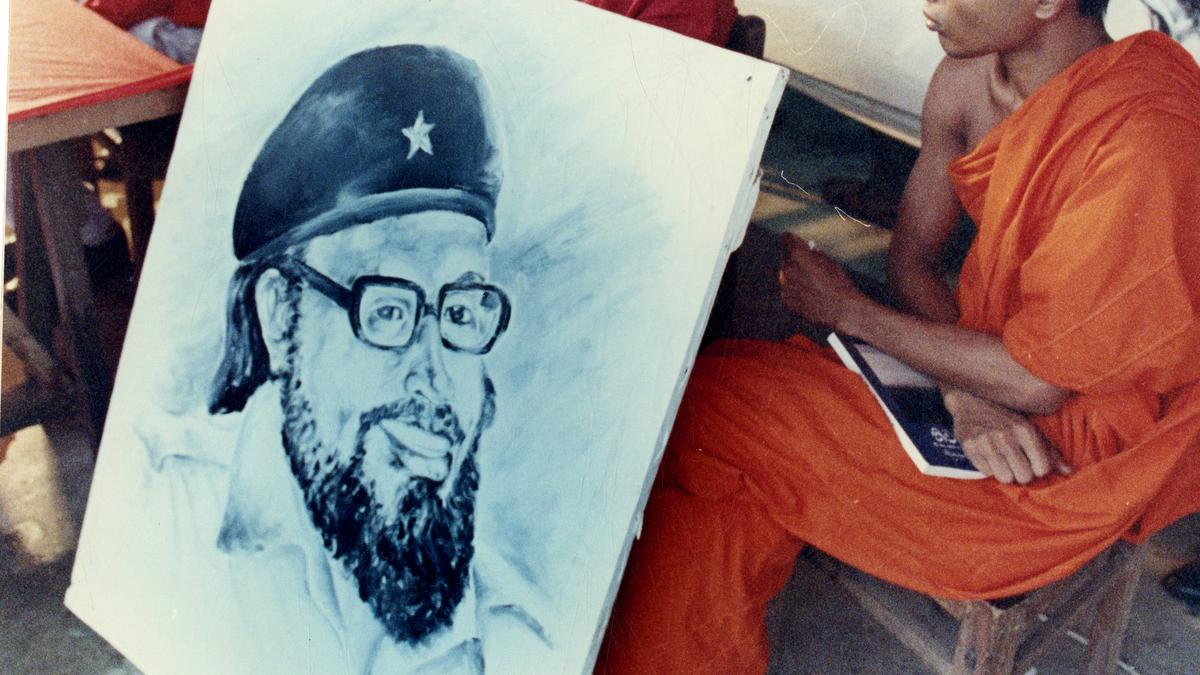
The JVP was formed in 1965. Its founder Rohana Wijeweera, who came from a family of modest means in coastal southern Sri Lanka, already had exposure to leftist ideologies through the Communist Party of Sri Lanka, before he went as a student to Moscow’s Patrice Lumumba International University, where he mingled with leftists from all over the world. On his return, he aligned himself with the Ceylon Communist Party (Maoist), before breaking away to form the JVP, with the intention of creating a revolution to turn Sri Lanka into a socialist state. Its members were mostly the youth who were unable to find jobs in the Sri Lankan economy, comprising British-era trading houses manned by Colombo’s English-speaking elites.
The cadres of JVP imbibed the party ideology from lectures known as the Five Classes — on the crisis of the capitalist system in Sri Lanka; history of Sri Lanka’s left movement; history of socialist revolutions; Indian expansionism; and the path of revolution in Sri Lanka. However, within no time, JVP found it more expedient to push class struggle to the back-burner, and became a vehicle for majoritarian Sinhala-Buddhist sentiments.
What happened in 1971?
In the 1970 election, the JVP campaigned for Sirima Bandaranaike’s leftist United Front coalition comprising of the Sri Lanka Freedom Party (SLFP), the Lanka Sama Samaja Party and the Communist Party. But the JVP’s support for Sri Lanka’s ‘bourgeois’ left was short-lived. In April 1971, it carried out an armed insurrection. The plan was to take over police stations first. The government, despite receiving prior intelligence, was caught unprepared. A state of Emergency was declared and Wijeweera was jailed. But the Sri Lankan tri-services were a ceremonial force and the government had to appeal to foreign nations for help. The Indian Army, Navy and Air Force played a part in thwarting the rebellion. The insurrection was overcome after a few weeks and some 15,000 JVP cadres were arrested. The death toll was over a 1,000, including civilians, police personnel and Sri Lankan armed forces personnel.
In 1977, with the election of J. R. Jayewardene, who went on to politically dominate the country for a decade, the Sri Lankan economy changed full tilt from the Bandarnaike era of socialist nationalisation, to liberalisation and the entry of free market forces. Jayewardene also released all JVP prisoners including Wijeweera, who went on to contest the 1982 presidential election, polling 4% of the vote. Some make the case that Jayewardene used the JVP to weaken the SLFP and the “old left”. Indeed, the JVP made SLFP’s Sinhala Buddhist plank its own from about the time of the 1983 anti-Tamil riots and the flaring up of the Sinhala-Tamil ethnic conflict.
What was the context for the JVP’s second insurrection?
Delhi’s growing involvement in the conflict led to anti-India sentiment among the Sinhalese majority. In June 1987, the Indian Air Force carried out Operation Poomalai to airdrop food to the north of Sri Lanka, which was Tamil-dominated, at a time when Sri Lankan forces had laid siege to the province, believing that they had cornered the Liberation Tigers of Tamil Eelam (LTTE) and its leader Velupillai Prabhakaran. The next month came the India-Sri Lanka Accord under which Sri Lanka introduced an amendment in its Constitution to devolve political power to the Tamil north and east. However, the LTTE rejected the Accord, and the soldiers that India sent under the banner of the Indian Peace Keeping Force to disarm the LTTE, soon found themselves in a war against the group.
JVP launched protests against the presence of Indian troops on Sri Lankan soil. Among the Sinhalese, the protests found widespread support. The Indian Prime Minister Rajiv Gandhi narrowly escaped an assassination attempt when he was attacked by a sailor at a guard of honour at the airport after the signing of the Accord in Colombo. Even SLFP workers joined hands with the JVP on the ground. However, the JVP did not take on the Indian Army or even the Tamils, directing its violence on fellow Sinhalese in southern Sri Lanka. Government officials, police personnel, teachers, students of rival unions and political activists — with its lists of “traitors”, the JVP went after all of them. Lampost hangings, tyre pyres and bodies on roads were a common sight. Chandrika Bandaranaike Kumaratunga’s husband, Vijaya Kumaratunga, a charismatic film star-turned-politician, was shot dead. The government’s brutality in putting down the insurgency was no less. The bloodbath lasted until 1989. The number of people killed is cited as 60,000. Wijeweera was also among the dead.
What happened to the JVP after that?
In the 1990s, the JVP tried to put its past behind and entered the political mainstream under a new leadership. It won one seat in the parliamentary elections of 1994. It even contested elections for provincial councils, which it had opposed as an Indian imposition under the 13th Amendment.
In the 2001 parliamentary election, the JVP won 16 seats, indicating that it had gained the trust of sections of voters. Its high point came when it contested in coalition with the SLFP-led People’s Alliance in 2004. The election was fought on an anti-ceasefire plank. The previous United National Party (UNP) government had entered into a Norway-brokered truce with the LTTE in 2002, on terms that were seen as favouring the LTTE. In 2004, President Kumaratunga called for fresh elections, naming Mahinda Rajapaksa as the prime ministerial face of the People’s Alliance-JVP coalition, called the United People’s Freedom Alliance (UPFA). Of the 105 seats UPFA won in the 225-seat parliament, the JVP’s share was 39, its highest ever tally. Months later it pulled out of the cabinet over the mechanics of sharing tsunami relief aid with the LTTE. It continued to support the government from the outside, and also supported Rajapaksa’s campaign in the 2005 presidential election.
However, in the post-war period, JVP’s fortunes waned. Not only did President Mahinda Rajapaksa dominate the political landscape as the architect of the May 2009 military victory over the LTTE, a host of Buddhist nationalist parties that had come up by then were competing for the same space as JVP. In 2008, the JVP also suffered a vertical split.
In 2015, Mr. Dissanayake formed a coalition with 25 other organisations, including civil society groups, women’s organisations and others called the NPP. The JVP now contests elections under the banner of the NPP, seen by some as a “rebranding” exercise to shake off its violent past that continues to haunt it. Mr. Dissanayake has described the NPP as a national liberation movement.
How does the NPP function now?
When the mass uprising against the Gotabaya Rajapaksa regime began in March 2022 over worsening economic circumstances, the protests were at first neighbourhood candle light vigils that grew to large gatherings in the city’s Galle Face sea front. Later, opposition parties including the NPP and JVP, breakaway organisations like the Frontline Socialist Party and Inter University Students’ Federation also converged at Galle Face. The involvement of these organisations, and some incidents of violence became the justification for a crackdown on the protests by the government under the new leadership of President Ranil Wickremesinghe.
Subsequently, the JVP/NPP position against the International Monetary Fund deal, whose conditions included sale of public sector enterprises, higher utility bills, higher taxes and other “anti-people” measures, earned it praise and a huge following. It has also taken popular positions against the “sale of national assets” to foreigners. In 2020-21, it had been steadfast in its opposition to the plan to offer 49% stake in the East Container Terminal at Colombo Port to the Adani group, which led the Gotabaya Rajapaksa government to cancel a tripartite agreement with India and Japan to develop the terminal. It also questioned the wind farm deal with Adani, and the deal with India to develop the oil tank farm in Trincomalee. It has been an opponent of the Indian Oil Corporation’s presence and expansion in Sri Lanka since 2002, when IOC first began operations in Sri Lanka. In 2017, despite its reported proximity to China, it had also protested the sale of the Hambantota Port to China.
However, of late, the JVP is of the view that the reality of India as Sri Lanka’s closest neighbour and “major political and economic centre” cannot be ignored. While India and JVP have had some contact previously, this is the first time that its leaders were invited to Delhi as an opposition party. In politically charged Sri Lanka, various signals are being read from this new friendship. But perhaps India is learning from its experience in the Maldives, where a new President that India failed to get to know better before his election, has junked his predecessor’s “India First” foreign policy, and given a distinct pro-China tilt to his foreign policy.
The writer is an independent journalist.