





For nearly seven decades since their discovery in 1898, viruses were the only organisms at the boundary between the living and the non-living. Their obligate host dependence, parasitism, and small genome sizes collectively made sure they weren’t classified as ‘life’per se.
Each virion is composed of a nucleic acid (DNA or RNA) core that serves as the genetic material, surrounded by a protein coat, and, in some cases, a lipid (fat) layer outside that coat. Viruses’ life cycle is simple: they infect a host cell, use the cell’s machinery to make more copies of themselves, then infect a new cell to repeat the cycle.
The simplest life
Biologically, scientists couldn’t imagine anything simpler. That changed in 1971 when Theodor Diener, a plant pathologist at the U.S. Department of Agriculture’s Research Center in Maryland tried to isolate the pathogen that caused potato spindle tuber disease. With his colleague William Raymer, Deiner realised the organism responsible – if he could call it that – didn’t contain the lipid layer or the protein coat found in viruses. It appeared to be just plain, naked RNA.
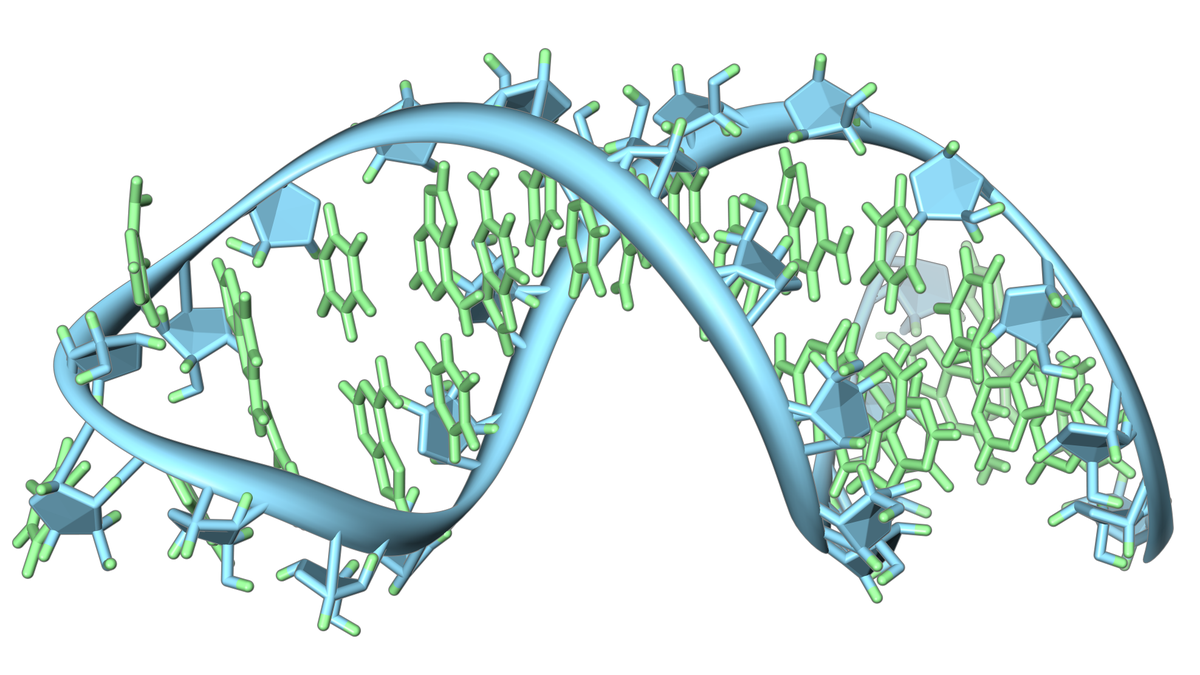
This RNA would enter a cell as RNA, force the cell to make more copies of itself, and the new RNAs would then infect other cells. Diener called these life-forms ‘viroids’ since they resembled viruses. There was, however, one important distinction. Usually, genetic material contains a code that tells cells how to make various proteins. This is true of all known organisms, including viruses. But the RNA of viroids didn’t code for any protein. For the most part, they were just small pieces of RNA that served no function apart from propagating themselves.
Deiner also noticed that the viroid RNA was tiny (250-400 base pairs versus a few thousand in RNA viruses). Deiner’s discovery added a new dimension to plant pathology, and, as a result, viruses were no longer the sole creatures at the edge of life.
Viruses, viroids, now obelisks
Now, however, it appears viruses and viroids may have company. According to a preprint paper uploaded recently, scientists at Stanford University have reported another extremely simple, and unusual, form of life.
When analysing genetic material from bacteria present in the human gut, the scientists identified a new form of life lying between viruses and viroids on the scale of simplicity. They called them ‘obelisks’.
The discovery was made possible using data obtained using a powerful technique called next-generation sequencing (NGS), which allows researchers to parallelly determine genome sequences, in bits and pieces from different organisms.
Understanding NGS
Imagine you walk into a library full of books. You see that a mischievous student has removed the binding and cut out the page numbers from all the books, and scattered the pages all over the room. The only way you can assemble the pieces is if you read each page and figure out what comes next by searching all the scattered pages and determining what makes sense logically. This process would be a lot simpler if you have already read a given book, since you will know what the subsequent page is expected to contain.
In the example above, each book represents the DNA sequence of a particular organism. NGS yields the sequence information in bits and pieces, generating large amounts of data. Researchers then feed this data to computers, which piece together the complete sequence information. If the genome sequence of an organism is already known, then – like in the example above – assembly becomes very easy.
Looking for a circular genome
The Stanford team discovered obelisks when they were analysing RNA from all the bacteria present in the human gut using NGS, while specifically looking for viroid-like elements. The team wrote a software script that would look through the RNA fragments, searching for those pieces whose sequential assembly starting from a given point would lead back to the same point – i.e. a sign of a circular RNA genome.
The team analysed 5.4 million publicly available sequence datasets of RNA from bacteria in the human gut using this method. In 220,000 of them, it identified 29,959 distinct obelisks. The team proceeded to search for obelisks in the RNA datasets of bacteria found in the human mouth as well, and found them in approximately half of the sets. Further searches revealed obelisks were present in human-gut and -oral bacteria from all seven continents as well, demonstrating their ubiquity.
Finally, the team set about ascertaining the degree of similarity of obelisks to viroids. They observed that while both organisms do have circular RNA for genomes, the similarity ended there. The obelisk RNA was much longer – around a thousand base pairs – and appeared to code for two proteins, neither of which bore any similarity to any known protein from any other life form!
A link to S. sanguini
Despite its ingenuity, the new study suffers from one minor limitation: since the team was analysing RNA data from all the gut or oral bacteria put together, it was impossible to determine which bacteria hosted a given obelisk.
This issue notwithstanding, the team, to demonstrate proof of the notion that obelisk sequences are indeed a part of data from the bacterial hosts, managed to analyse all the RNA from a few bacteria individually grown in the laboratory. This way, they managed to link one particular obelisk to the bacterial species Streptococcus sanguini, commonly found in the human mouth.
The discovery of obelisks raises multiple questions. For example, how do they make copies of their genome? How do they transmit? Are they pathogenic to bacteria? How did they evolve? Do they have roles to play in human health and disease?
Further research will no doubt answer these questions. For now, all we know is that at the far reaches of life, the distinction between the living and the non-living is becoming increasingly murky.
Arun Panchapakesan is an assistant professor at the Y.R. Gaithonde Centre for AIDS Research and Education, Chennai.