
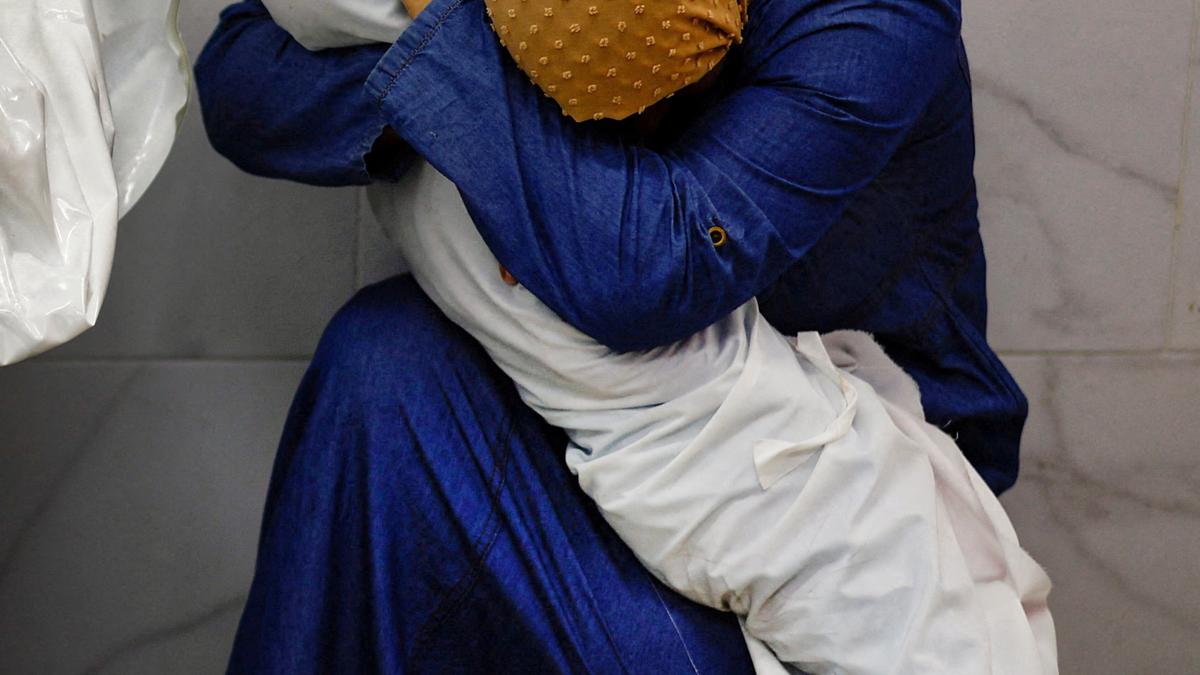
Ever since Hamas attacked Israel on October 7, the Israeli Defense Forces have been relentlessly bombing civilian locations across the Gaza Strip. Meanwhile, the Russia-Ukraine conflict is still ongoing. These two conflicts have in recent times led to more questions about the inability of the United Nations in bringing about peace. Has the UN become toothless in ending wars? Rakesh Sood and Vivek Katju discuss the question in a conversation moderated by Kallol Bhattacherjee. Edited excerpts:
Why is the UN ineffective in bringing in a ceasefire in the Israel-Hamas conflict?
Rakesh Sood: The UN was brought into existence (after World War 2) by those who played an important role in the aftermath of the war; they became the permanent members of the Security Council (UNSC). A global order must reflect two criteria: one, convergence of views among the major powers of the day and two, it must also seek to provide a global public good. In short, it must have saleability for the rest of the world. Over the years, the UN gained universal membership; nearly all the countries in the world became party to it. These criteria were seen also in the coming into being of the World Trade Organization. However, the equations of power are not permanent; they change. Eventually, that is how legitimacy gets eroded.
Post the Cold War, we saw a gradual decline in the ability of the UN to undertake any kind of meaningful roles (in resolving conflicts). The Israel crisis is just one of them. Over the last two-three decades, the UN has been like a bystander. With the major powers developing severe differences, they have made it impossible for the UN with its frozen membership of decision-making bodies, such as the UNSC, to be able to undertake any meaningful action.
Vivek Katju: The end of the Cold War saw the demise of the Soviet Union and chaos. And that continued through the 1990s. China was rising, but it was still hiding its fire, so to speak. So, that was when the Americans and their allies were able to proceed within the UN or outside the UN as they wanted. The UNSC, in its present shape, as long as the vetoes are there, does not provide any hope for addressing any international issue, where the national interests of the permanent five are in conflict.
Watch: What does the Hamas attack mean for Israel, Palestine and West Asia?
If the UN is failing, are we seeing the end of the liberal international order that was started with the League of Nations?
RS: First of all, the liberal international rules-based order is a myth. During the Cold War, we had a liberal Western order led by the U.S., not an international order. The end of the Cold War saw the demise of the Soviet Union and chaos. We had a unipolar moment, which lasted for about a decade or 15 years. That disappeared by 2008. This is because two-three things happened. We saw the U.S. enter Afghanistan with the full support of the international community, then we saw the U.S.’s misadventure in Iraq, and then the global financial crisis in the Western economies.
Through the wars that took place after the end of the Cold War, the UN had no role. The U.S. did what it wanted. You look at Iraq, you look at Afghanistan. Look at smaller conflicts too: Mali where France got involved, and Libya, where the Europeans and the Americans got involved. There was no UN sanction to any of these conflicts. This is because after 2008 we have seen a multipolar world. However, the new order that should serve a multipolar world hasn’t yet come into existence. So, multipolarity without multilateralism only leads to an exercise of force and chaos.
UNGA vote on Gaza | India defends abstention, says resolution should have referred to October 7 terror attacks on Israel
If the UN is not providing a solution, where do we look for one?
VK: Last Friday, 128 countries voted for a UN resolution calling for a ‘humanitarian pause’ (in Gaza), but the problem is that major powers are not willing to see eye to eye on the most important issue of ceasefire.
Israeli Prime Minister Benjamin Netanyahu’s political future is toast. I think the sentiment within Israel and among the Jewish people outside Israel, except for a few who believe in peace, is that Hamas must pay a price for the terrible atrocities that it inflicted on Israel (on October 7). These people do not have any sympathy for the innocent people of Gaza who are suffering such a terrible punishment. Israel had reached an understanding with certain Arab states on the assumption that the Palestinian issue will be confined to the backwaters, but Hamas’ attack brought the issue to the front and centre. The Netanyahu government is under under tremendous pressure. What happened on October 7 goes far beyond the national security of Israel. It goes to the very soul of of Israel. The Israelis are determined that Hamas must be eliminated. And that Gaza be ‘sanitised’. And for that they are willing to pay a price.
India has strong ties with both sides, just like in the Russia-Ukraine conflict. Yet, why is there such little diplomatic willingness on display to control the violence in this conflict, especially by Israel?
RS: India’s interests in the West Asian region have grown. We have strong ties with the Gulf Arab states and with Israel. We have a large diaspora. In addition, we get energy supplies from the Gulf Arab states.
There are multiple factors involved here that need to be considered. Netanyahu has proven to be a divisive Prime Minister. His current coalition consists of extreme right-wing parties which do not leave him with any kind of leeway. He has been trying to undertake a slew of controversial judicial reforms which would enable him to escape the judicial net. That is why for the last six-seven months, every weekend, we have seen sustained protests in Israel. This is the domestic political backdrop. It may sound cynical, but the continuation of the conflict serves a limited political end.
There is support from the Arab and Islamic world for the Palestinian cause, but the fact is that within the Gulf Arab states, there is little sympathy. Even in Egypt and Jordan, there is little sympathy. In the Russia-Ukraine conflict, the Ukrainians left the country and other European countries such as Poland accepted them as refugees. But Egypt has kept its borders closed for the Palestinians. It does not want any more refugees, because it feels that once they come in, they will not go back.
Third, the U.S. is also caught up with an election. So, I’m afraid you don’t have an endgame because the solution that the West had visualised through the Abraham Accords has exploded. And the attack by Hamas demonstrated that the Palestinian problem is not going away because the fact is that precious little or nothing at all was really done to resolve the Palestinian problem, despite the various commitments, the UN Security Council resolutions, etc.
Is India, which is the current chair of the G20, in a position to play a mediatory role?
VK: Traditionally, if you look at the 1950s, India was aligned with the “progressive states”. And at that stage, the conservative states, led by Saudi Arabia, took a back seat. But starting from the 1970s, especially after 1973, the transformation of the Arab Gulf States began. In 1992, India recognised Israel, but that did not detract from our essential policy of a direct bilateral inter-state relationship with each of these countries. On October 7, Prime Minister Narendra Modi tweeted in a pro-Israel manner at a time when little information was available. Then, on October 10 came his next tweet based on a conversation with Netanyahu. It’s only on October 12 that the official spokesperson balanced it out by reiterating India’s traditional position on the Israel-Palestinian issue, stressing the two-state solution. Thereafter, we have sent aid to Palestinians as the Prime Minister has talked to various Arab leaders. But I don’t think we are really in a position to play a mediatory role, even though India is the head of the G20. Because this is a game that is now being played at a much more superior level. And while we are a confident country, we have interests and we serve these interests. And while our diplomacy is active, I always believe that one should be aware of the limitations of our position and the limitations of what we can do diplomatically.
Listen to The Hindu Parley podcast