









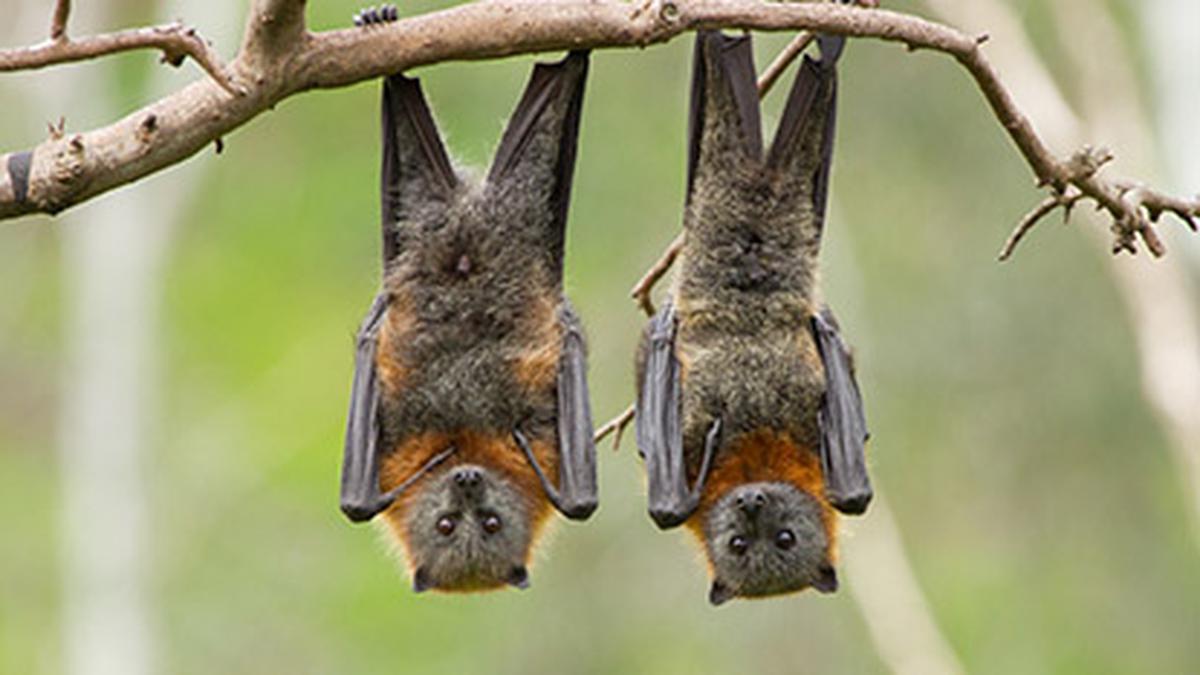
Bats are extraordinary organisms in many ways. They are the only mammals on the earth that can maintain sustained flight. They also have relatively long life-spans and are relatively more protected from a variety of diseases, including cancer. They also have a unique ability in echolocation, whereby they use sound to navigate and locate objects, freeing them from being constrained by the availability of light like humans are.
By population, bats make up 20% of all mammals. There are more than 1,400 species of bats today around the world; more than 60 are endangered and 170-odd are classified as vulnerable. The bumblebee bat weighs only 2 grams whereas the flying foxes, which have a wingspan of 1.5 metres, weigh up to 1.6 kg.
In all bats play crucial roles in maintaining the ecological balance, and are essential for pollination, insect control, etc.
However, bats have grabbed the headlines of late for the wrong reasons. Their notoriety stems from the fact that many deadly viruses use bats as a reservoir host, including coronaviruses, Nipah, Ebola, Marburg virus, and Hendra virus, among others. The COVID-19 pandemic also cast a bright spotlight on the habits of bats.
Bats do host a wide variety of pathogens, including ones deadly to other mammals, but they themselves don’t get infected. Scientists have been curious about the source of this protection.
The bat genomes
Scientists’ first object of study is the bat genome. Over the years, researchers have unearthed significant insights by sequencing the genomes of many bat species. Bats are also unique because they have a relatively small genome, around 2 billion bases.
One watershed moment came in 2013. In a paper published in the journal Science, scientists compared the genomes of a fruit-eating and an insect-eating species and found that genes involved in metabolism and immune response had been positively selected. That is, these bats had evolved by improving these two biological domains.
In the following decade, scientists sequenced a large number of bat genomes. The ambitious Bat1K global genome consortium – to sequence all the 1,400 or so species’ genomes – is also currently underway.
A number of studies have also shed insights into the peculiar biological features of bats. For example, by analysing bat genomes, scientists have found the natural selection of a protein called prestin, which is involved in echolocation (dolphins have the same protein).
Immune insights
Of course, immunity-related genes have been one of the more well-studied gene classes in bats. The fraction of these genes is also unique in bats: some 2.7-3.5% of the bat genome versus roughly 7% of the human genome. Emerging evidence also suggests that a set of immune-related genes have been undergoing positive selection in bats, adapting them to control the spread of viruses while mitigating the antiviral inflammatory response. As a result, the bats are shielded from the effects of the clinical response of their bodies to these viruses.
The heightened pro-inflammatory activity is what makes these viruses deadly in humans.
One of the first Bat1K genome consortium papers described six high-quality bat species genomes in the journal Nature. It suggested that echolocation, loss of pro-inflammatory genes, and expansion of antiviral genes are ancestral traits of bats. This suggests that bats have molecular mechanisms that allow them to host a range of deadly viruses but evade clinical disease.
It is not surprising, therefore, that genome sequencing – but especially metagenomic sequencing, adept at providing an unbiased view of the diversity of viruses – has been the mainstay of investigations of the viruses that bats carry, also known as the bat virome. Aside from knowing that bats can harbour all types of viruses, we have also found that bats can harbour multiple viruses at the same time, i.e. in a state of co-infection, without themselves falling ill.
Long reads, deeper insights
Long-read sequencing technologies are those that can ‘read’ thousands to tens of thousands of bases of a genome at a time. With their advent, it has become possible today for scientists to quickly assemble the nearly complete whole-genomes of organisms. Another benefit to them is that they no longer had to use more complex, time-consuming, and expensive molecular technologies in the pursuit of building complete genomes.
A recent report by researchers from the Cold Spring Harbor Laboratory, New York, used a long-read technology to sequence two bat genomes as well as compared the genomes of 15 species that were already available. Their results were published in the recent edition of the journal Genome Biology and Evolution.
The researchers reported that subsets of genes involved in mounting an immune response – which encode proteins called interferons (IFN) – had contracted significantly. This in turn changed the relative proportions of two subsets, interferon-alpha (IFN-α) and interferon-omega (IFN-ω), relative to each other. The researchers attributed bats’ immune properties to these changes. By shedding the genes for IFN-α, bats can dampen the pro-inflammatory response against a number of viruses, thus protecting themselves from clinical disease.
The researchers also reported that a number of genes involved in suppressing tumours and in repairing DNA contained signs of positive selection. According to them, this could contribute to the bats’ longer life span and a significantly lower risk of developing cancer.
With rapid deforestation, ecological degradation, and more and more unfavourable human-animal interactions, we should expect significantly enhanced outbreaks of zoonotic diseases in future. The Nipah outbreaks in Kerala over the last few years is a good example, as are outbreaks of Marburg disease and the Ebola virus in some African countries. In this milieu, genome-sequencing – especially its more advanced avatars – could help us cope without violating the balances of nature.
The authors are senior consultants at Vishwanath Cancer Care Foundation. All opinions expressed here are personal.