



The story so far: Over the past few days, thousands have fled south of the Gaza Strip after Israel ordered the evacuation of over one million civilians in the north — nearly half of the total population of the Palestinian enclave — ahead of an anticipated ground invasion by the Israeli military. The planned invasion was in response to the multi-front attack by Hamas on October 7 that killed more than 1,000 Israelis.
Even as civilians queue up at the border with hopes of escaping the conflict zone, the status of the sole remaining exit out of Gaza and the gateway for crucial supplies that the besieged area desperately needs — the Rafah crossing on the Egyptian border — remains unclear. With food, water, electricity, fuel and other critical supplies running dangerously low, uncertainty now looms large over the fate of displaced Palestinians and trapped foreign nationals.
The U.S. on October 18, without giving a timeline, claimed that Egypt has agreed to reopen the crossing after Cairo said that the arterial crossing was not sealed but rendered inoperable by continuous airstrikes by the Israeli military.
Check out furthercoverage by The Hindu on the Israel-Palestine conflict here.
Where is the Rafah crossing and who controls it?
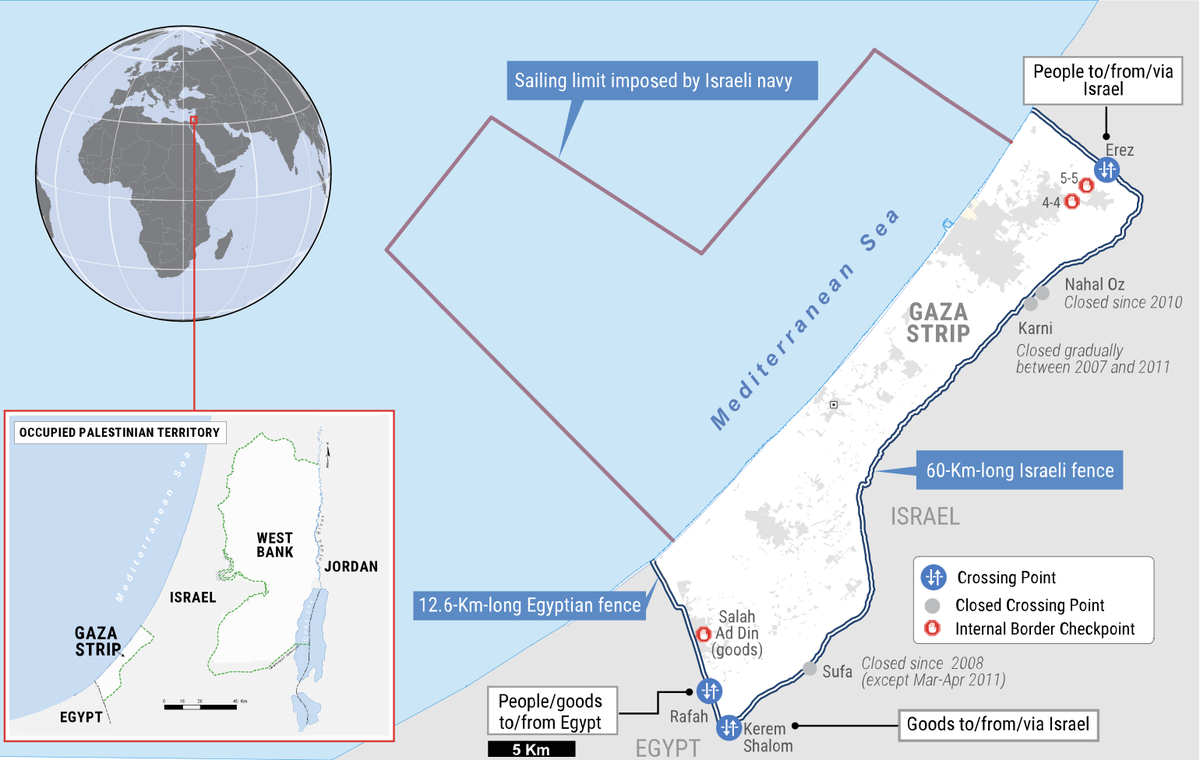
The Gaza Strip is a narrow 41-km designated Palestinian territory along the eastern coast of the Mediterranean Sea, bound to the north and east by Israel, and to the south by Egypt. Israel controls Gaza’s airspace and territorial waters, which makes it extremely hard for Palestinians to pass through.
Source: United Nations Office for the Coordination of Humanitarian Affairs (OCHA), 2018
The enclave, home to more than two million people, currently has three functional entry and exit points — the Erez or the Beit Hanoun crossing in the north, and the Karem Abu Salem and Rafah crossings in the south. The Erez crossing, managed by Israel in the north, controls the movement of people between Gaza and the West Bank via Israel. The checkpoint is limited to “exceptional humanitarian cases” and prominent traders. Only a few individuals can exit Gaza because the mandatory Israeli-issued exit permit is not easy to obtain. The Israeli authorities allowed 58,606 exits from Gaza in August this year, according to the United Nations. The Karem Abu Salem point is also under Israel’s control but is exclusively for the movement of commercial goods. Both are presently shut.
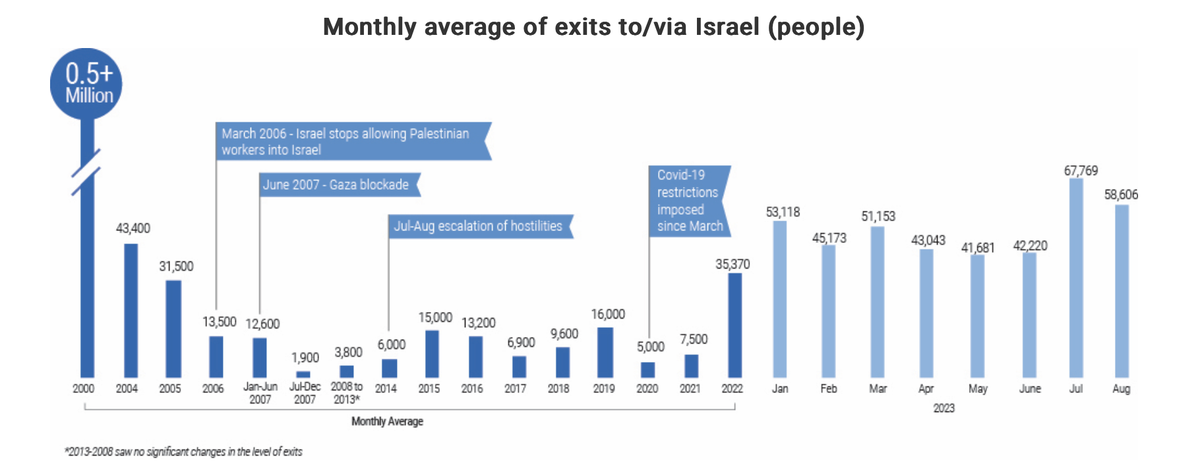
(Source:OCHA)
Opposite the Erez crossing in the north is the Rafah point on the border with the Sinai Peninsula of Egypt — a vast, volatile Egyptian territory of mountains and desert which has been a centre of conflict for decades, starting with the first Arab-Israeli war in 1948.
This crossing is the primary exit point from Gaza due to longstanding restrictions associated with the blockade at the Erez crossing. Since it serves as a vital link between the ‘world’s biggest open-air prison’ and the outside world, the Rafah crossing is widely referred to as the lifeline of the Gaza Strip. It is under the management of Egypt as per a 2007 agreement with Israel. It is the only border not directly controlled by Israel, but the approval of Israeli authorities is still required for supplies to enter Gaza from Egypt. Egyptian authorities allowed 19,608 exits of people from Gaza in August, which was also the highest number of exits recorded since July 2012.
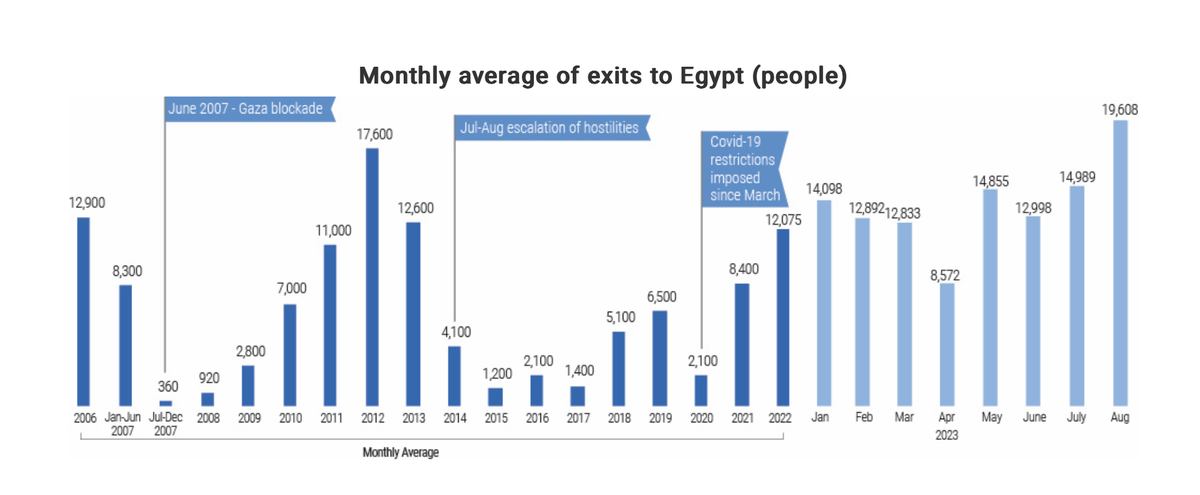
(Source:OCHA)
How did Rafah emerge as the lifeline of Gaza?
The present Egyptian-Israeli border is a reflection of multiple wars fought between Israel and Egypt, and others involving the colonial powers which formerly ruled Egypt and historical Palestine.
The first form of the present boundary emerged around the beginning of the 20th century, following an agreement between the Turkish authorities and the British Empire regarding an “administrative separating line” from Rafah to Taba on the Gulf of Aqaba. The Rafah-Aqaba line became a boundary between the two territories administered by Britain after the First World War, as per a historical account of the evolution of Egyptian-Israeli boundaries. The line to Taba remained a border until the establishment of Israel in 1948.
The first Arab-Israeli war that followed resulted in Egypt taking control over the Gaza Strip, which meant that the Israel-Egypt border no longer existed. In 1956, Israel, France and Britain invaded the Sinai Peninsula of Egypt and occupied Gaza after Egyptians announced the nationalisation of the Suez Canal Company. The Israeli forces eventually withdrew from the Gaza Strip after the intervention of the United Nations. A U.N. Emergency Force was dispatched to the troubled area for a peacekeeping operation.
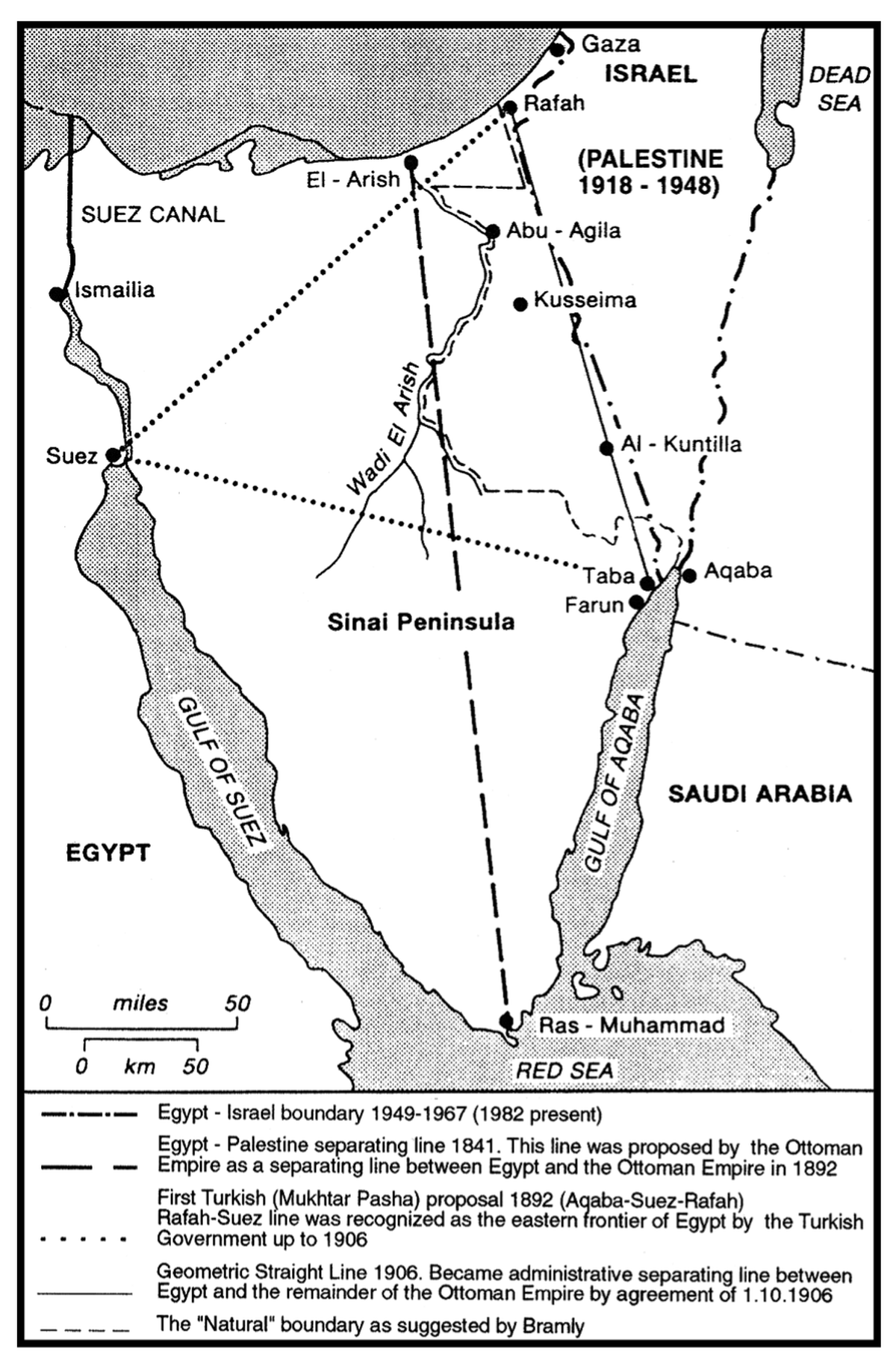
Israeli-Egyptian Boundaries
The third Arab-Israeli War, also called the Six-Day War, broke out in 1967 following heightened tensions in the region after Egypt re-militarised the Sinai peninsula, expelled the U.N. forces from Sinai and the West Bank, and closed the Straits of Tiran. Israel secured a decisive victory against Arab forces and captured the Sinai peninsula, the West Bank, the Gaza Strip, East Jerusalem and the Syrian territory of Golan Heights by the end of the war. The West Bank and the Gaza Strip were declared “closed military areas”, which meant restrictions on the movement of Palestinians.
The Israel-Egypt peace process took place between 1973 and 1982 after the Yom Kippur War, also called the Fourth Arab-Israeli War, ended in a stalemate. Egyptian President Anwar Sadat made history when he embarked on an official visit to Jerusalem in November 1977 to advance the peace process, and went on to address the Knesset (Parliament of Israel). Sadat’s visit was viewed as a breakthrough. The Camp David Accords signed in 1978 set the framework for peace. The Peace Treaty between Israel and Egypt in 1979 eventually led to the restoration of the border, with Israel withdrawing from the Sinai Peninsula by 1982.
As the two countries began to demarcate their boundary, Rafah was converted into a partitioned town at the gates of the Sanai Peninsula. A report ‘The Divided People of Rafah’ published in the Middle East International in 1988 reads, “In 1982, the new barbed-wire fence divided the city and its population into two. Families were separated, property was divided and many houses and orchards were cut across and destroyed by the new boundary, bulldozed, for security reasons, to form a belt on both sides of the border.”
After the first Palestinian uprising or the First Intifada, Israel gave partial responsibility for administering the Gaza Strip and the Jericho area to a Palestinian authority that was an outcome of the Oslo Accords.
The 1994 Gaza-Jericho Agreement between Israel and the Palestine Liberation Organisation (PLO) established a shared management and control system of the Allenby Bridge from the West Bank into Jordan and the Rafah crossing from Gaza to Egypt. In a 2005 report, the Al Mezan Center for Human Rights says the pact gave Israel and the Palestinians shared control of the crossing in theory, but Israel retained primary control. “Israel had the lion’s share of control at the terminal, and thus over the freedom of movement of Gaza’s some 1.4 million residents,” it adds.
When the Second Intifada broke out in 2000, triggered by Ariel Sharon’s infamous visit to Al-Aqsa Mosque in Jerusalem, Israel fully took over control of the crossing and banned Palestinian staff from working in the terminal.
Against the backdrop of intense violence and Hamas’ resistance, Israel announced a unilateral withdrawal from the Gaza Strip in 2005 to revitalise the peace process. The subsequent Agreement on Movement and Access (AMA) brought the Rafah crossing back under Palestinian control on paper. Israel evacuated its troops and settlers by August 2005 and left Gaza. Notably, the Rafah crossing was one of the main points of difference between the Palestinian National Authority and Israel over the course of arranging for Israel’s withdrawal and transfer of land and crossings in the Gaza Strip. Israel demanded that its ability to be present in the crossing be ensured, without jeopardising its claim of full withdrawal from Gaza, the Al Mezan report notes.
Peace, however, continued to elude Palestine as Hamas seized control of the military and political establishment in Gaza after a landslide victory in the 2006 election amid Israel’s continuing occupation of the West Bank and East Jerusalem. The Hamas win led to a split in the Palestinian governance and bloody clashes. Attacks in Israel, and airstrikes in Gaza, coupled with tighter restrictions by Israel and Egypt on the movement through the Rafah crossing for security reasons, exacerbated the conflict. In 2007, Israel imposed a complete blockade, cut electricity and fuel supplies to Gaza and sealed the border.
Poverty, hunger and unemployment engulfed the enclave. Following a few failed attempts to force open the Rafah border, a series of blasts along the crossing in January 2008 destroyed part of the wall, allowing thousands of Palestinians to cross into Egypt in search of food and supplies. In response, Egypt built a cement wall and sealed its barrier with barbed wire and metal barricades.
Egypt’s balancing act on Israel and Palestine
Egypt walks a tightrope in its dealings with its neighbours Israel and Palestine. While Egypt has a peace treaty with Israel and has strengthened economic ties and security cooperation with the country, it also recognises the importance of the Palestinian cause.
However, Egypt has assisted Israel for years in enforcing a blockade in the Gaza Strip and controlling the movement of people and goods.
In 2007, the Egyptian government under President Hosni Mubarak assisted Israel in enforcing the blockade in Gaza owing to its opposition to Hamas. The interim regime of the Muslim Brotherhood, which took over for around a year after Mubarak stepped down in the aftermath of the Egyptian uprising, announced the permanent re-opening of the Rafah crossing. The Brotherhood is an Islamic organisation formed in 1928 to promote social and political change in Muslim-majority countries. Hamas is an outgrowth of the Muslim Brotherhood’s Palestinian branch.
The rise of the current regime under the leadership of Marshal Abdel Fattah al-Sisi following a coup in 2013 dealt a blow to ties. Political uncertainty and military operations in northern Sinai led Egypt to impose severe restrictions on the crossing from 2014 to 2018. Egypt was strongly opposed to the deployment of Hamas personnel at the border crossing. The administration’s condition to reopen the border was the full authority of the Palestinian Authority staff at the checkpoint on the Palestinian side.
The crossing was reopened in May 2018 for Ramzan to ‘ease burdens’ during the Muslim holy month. It remained open for a long while before Hamas sealed the border in 2020 amid the COVID-19 pandemic. The Rafah crossing was intermittently opened for short periods, but Egypt “indefinitely” opened the border in February 2021 after bilateral talks between the Palestinian and Egyptian leadership to facilitate Palestinian passage to and from the Gaza Strip. At the time, Cairo was hosting talks between Hamas and Fatah, which runs the Palestinian Authority in the Israeli-occupied West Bank, regarding the possibility of holding parliamentary and presidential votes. As per reports, the move aimed at creating a better atmosphere and encouraging negotiations between the Palestinian factions.
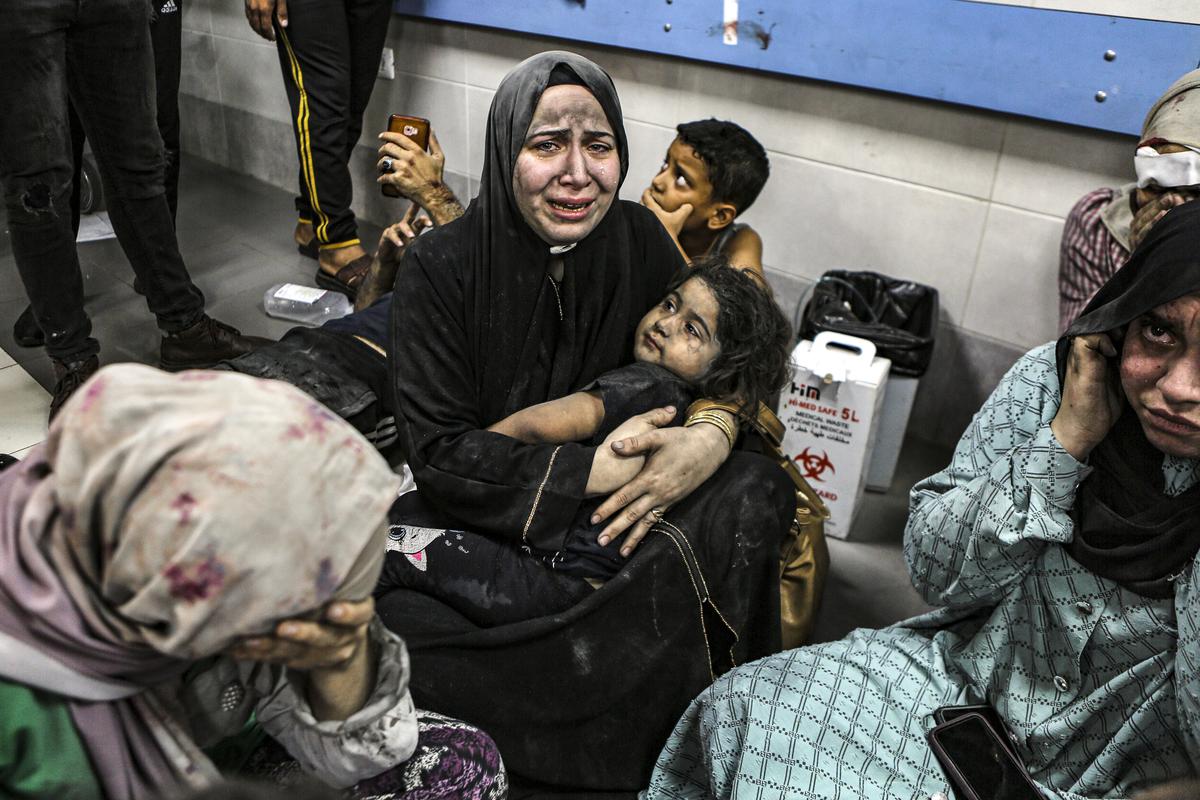
Wounded Palestinians at the Al-Shifa hospital in Gaza City, central Gaza Strip, after arriving from al-Ahli hospital following an explosion there, on Tuesday, October 17, 2023.
The Rafah border remained open during the Israel-Hamas conflict in May to allow the movement of aid to the Gaza Strip. Egypt brokered a ceasefire that ended 11 days of conflict. In August that year, Egypt shut the border again following an escalation between Israel and Hamas, partially reopening it after a few days.
The crossing largely remained open since 2021 except for holidays, but was made “inoperable” earlier this month after war broke out in the region following a surprise attack by Hamas.
What are Egypt’s concerns?
Caught in the crossfire, people in Gaza face a worsening humanitarian crisis, with Israel cutting off the entry of food, water and electricity supplies, even as truckloads of supplies pile up at the closed Rafah border. Egypt, which manages the Rafah border, has been seeking to establish a corridor for humanitarian relief but has been unable to do so far. It says the crossing has been rendered inoperable due to Israeli bombings.
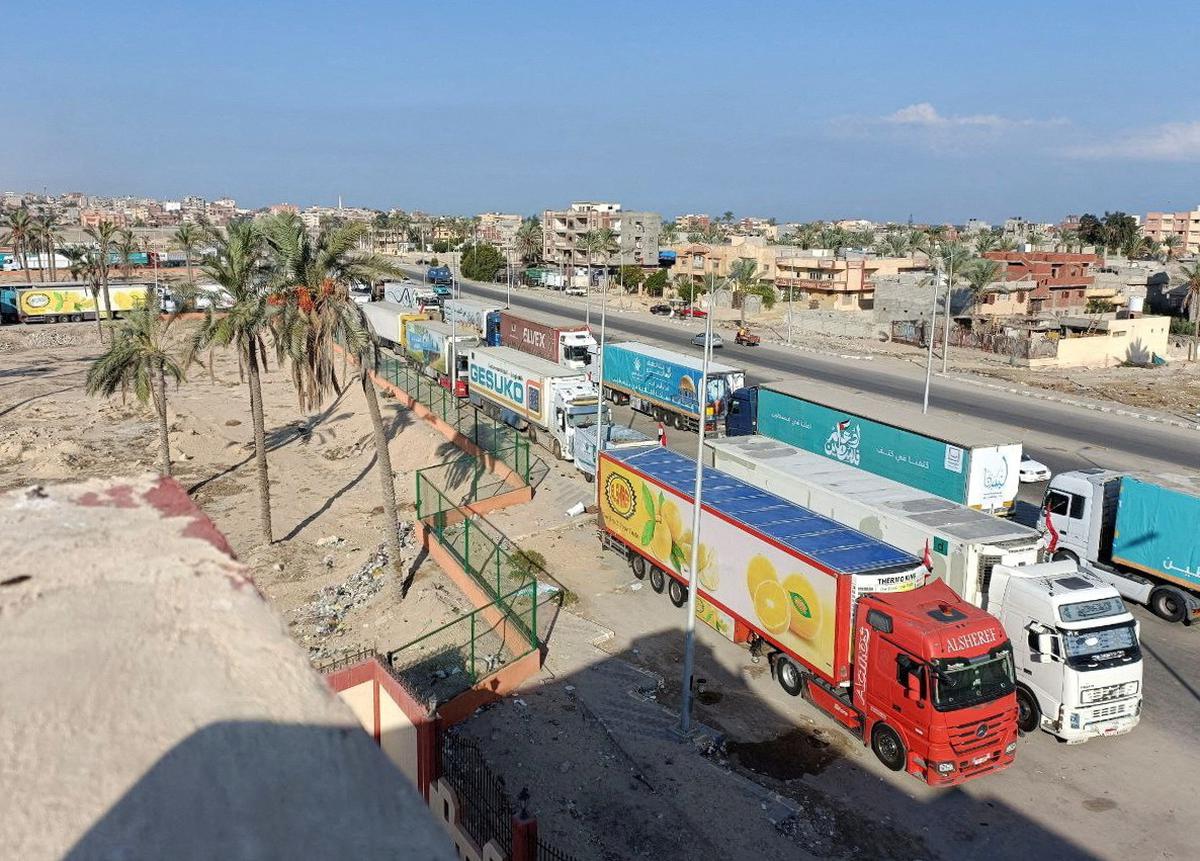
Trucks carrying humanitarian aid for Palestinians wait for the re-opening of the Rafah border crossing to enter Gazas, in the city of Al-Arish, Sinai peninsula, Egypt, October 16, 2023.
| Photo Credit:
Reuters
Egypt, however, has maintained that it won’t allow any forced displacement of Palestinians from the Gaza Strip into the Sinai Peninsula through Rafah. Struggling with a significant migrant population, the nation is reluctant to let in hundreds of thousands of Palestinian refugees fleeing the conflict, concerned about heightened risks to its national security and economy. There is the additional threat of refugees affiliated to Hamas adding to instability in the Sinai Peninsula.
Egyptian President Abdel Fattah al-Sisi has said the forced displacement of Palestinians to Sinai would turn the peninsula into a base for attacks against Israel. “What is happening now in Gaza is an attempt to force civilian residents to take refugees and migrate to Egypt, which should not be accepted… Egypt rejects any attempt to resolve the Palestinian issue by military means or through forced displacement of Palestinians from their land, which would come at the expense of the countries of the region,” he said, adding that Egyptians would “protest in their millions” against any displacement to Sinai.