






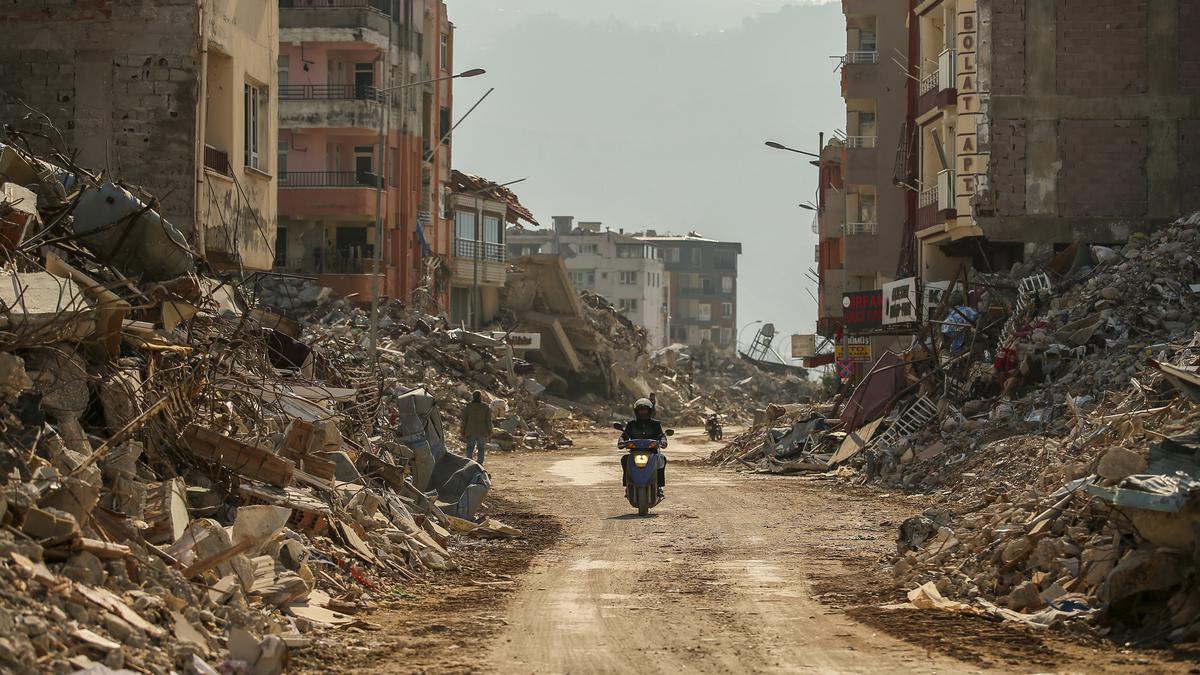
On February 6, 2023, a pair of powerful earthquakes struck Turkey and Syria, leaving destruction in their wake. The latest known death toll is 50,000; more than a lakh other people were injured in 11 provinces. At least 1.5 crore people and 40 lakh buildings were affected; some 3.45 lakh apartments were destroyed.
The earthquakes weren’t entirely unexpected given Turkey’s seismic history, but scientists were startled by their unprecedented scale.
A study published on August 3 in the journal Science unearthed the intricate union of tectonic forces that led to the disaster, advancing researchers’ understanding of these quakes, their unexpected power, and what they portend for the way scientists are trying to forecast others like them.
Geological anatomy
Scientists seek to understand how earthquakes occur and grow to devastating sizes. The earth’s crust consists of tectonic plates. Fault lines form where these plates interact, as they collide, pull apart or slide past each other. When these plates abruptly grind and slip past each other, they release pent-up pressure, leading to earthquakes.
The earthquakes in Turkey occurred along the East and North Anatolian Fault Lines, which run 700 km and 1,500 km long, respectively. And these geological behemoths, the new study found, were in constant dialogue.
“Imagine a conversation among faults, where they communicate through stress interactions,” Zhe Jia, the lead author of the new study paper and a postdoc at the University of San Diego, California, told this writer.
But during the quakes, the conversation was disrupted by something like shouting. A seismic “cascade” broke through fault bends and step-overs, which are otherwise barriers to the propagation of an earthquake.
Fault bends and step-overs are like curves and gaps in a road. For earthquakes, they are places where fault lines change direction or have a little gap. They affect how and where earthquakes happen. “These known fault lines played a significant role, but the sheer magnitude of the quakes far exceeded expectations,” Dr. Jia said.
Cascade of ruptures
The unusual interaction initiated a cascade of ruptures, resulting in a larger-than-usual total rupture length and a more tremendous potential for destruction. A testament to this is the fact that, in places where there were no buildings and/or where no people died, scientists observed craters after the earthquakes.
Dr. Jia has studied many earthquakes, but he said he was still surprised by the ‘dialogue’ between the fault lines. University of Southern California, Los Angeles, seismologist Sylvain Barbot and Istanbul’s Kandilli Observatory seismologist Sezim Guvercin said the same thing.
The first earthquake (M7.8) struck near Gaziantep on a strike-slip fault, a type of tectonic plate boundary where two plates slide horizontally past each other. The next quake (M7.7) hit near Ekinözü, roughly 200 km north. They were Turkey’s strongest in more than 2,000 years and caused substantial damage along the East Anatolian Fault, which runs through eastern Turkey, extending from near Turkey’s border with Syria to the northeastern region.
The Narlı Fault and Çardak–Sürgü Fault Zone are also primarily located in eastern Turkey. They extend from the southern part of Turkey to the northeastern part, roughly parallel to the border with Armenia. They both experienced separate earthquakes. The ground near the coast some 200 km to the southwest began to move like a liquid. The Cyprian geological survey department recorded a minor tsunami near the island in the eastern Mediterranean Sea.
Comparative analysis
One feature of the studies of these earthquakes is that scientists raced against the clock to gather and analyse data after the quakes, allowing them to piece together how they evolved. This is crucial to understand the associated hazards.
Researchers such as Dr. Jia received satellite data nine hours after the earthquake. While some researchers compared the 2023 quakes to historical records and GPS data to make sense of the numbers, Dr. Jia’s group also used supercomputers to run simulations using the available data and compared them to GPS data and images of the earth before and after the events.
Their work in Science was distinguished by two methods: kinematic slip inversion and fault-property modelling. Kinematic slip inversion is like rewinding an earthquake video to understand how fault surfaces moved, indicating what might have occurred underground. In fault-property modelling, researchers estimate the characteristics of the fault, like friction and material properties, to predict how an earthquake is likely to spread along it. These predictions are then compared to real earthquake data to gain insights.
“Think of it as watching for differences between two otherwise identical pictures,” Dr. Jia said.
Such measurements show researchers the surface but also something deeper. They “measured the deformation of the earth’s surface, helping us to determine the shape of faults and the subsurface slip that occurred,” Dr. Barbot, who studied the Turkey-Syria earthquakes separately, said.
Science and policy
Earthquake science extends beyond the lab and influences policy and disaster management. The lessons from Turkey’s quakes have far-reaching implications, according to experts. They were revelations of the planet’s oft-enigmatic inner workings, underscoring the unpredictable nature of seismic events.
Then again, Turkey had been aware of the possibility of such an earthquake, Dr. Barbot said. Turkish law requires its buildings to adhere to building codes designed to prevent the sort of disaster following the events of February 6. However, these policies have reportedly not been fully enforced everywhere in Turkey for various reasons. “Unfortunately, this gamble led to a serious disaster,” Dr. Barbot said.
Shock after shock rippled through Turkey’s grounds as Dr. Guvercin’s team gathered news about people trapped under the rubble of toppled structures. “We undertook this study at times with tears and at times rebelling against the corrupt system that caused the disaster – it will remain a lament in my memory,” she added.
Vijay Shankar Balakrishnan is a freelance science journalist in Germany.