





In a paper published recently in Scientific Reports, scientists from IIT Roorkee have characterised dinosaur fossils from the Middle Jurassic period, found in the Thar desert near the Jaisalmer Basin by the Geological Survey of India. They discovered that they had uncovered remains of a sauropod dinosaur, which is the same clade as the long-necked herbivores in Jurassic Park – only these happened to be the oldest known fossils of this particular kind of sauropod.
Belonging to the family Dicraeosauridae and from the superfamily Diplodocoidea, these fossils are the first dicraeosaurid sauropods to have been found in India. And at 167 million years old, they are the oldest known diplodocoid fossils in the world. The scientists named the dinosaur Tharosaurus indicus, with Tharo deriving from the Thar desert; saurus from the Greek ‘sauros’, or lizard; and indicus from its Indian origin. The fossils were found by Triparna Ghosh, Pragya Pandey, and Krishna Kumar from the Geological Survey of India.
167 million years old
“The most fascinating feature about sauropods is their size,” said Debajit Datta, a postdoctoral researcher in Sunil Bajpai’s group at IIT Roorkee and one of the lead authors of the paper. “They can grow more than a hundred feet. There are many sauropod groups that are even longer than the blue whale.”
However, members of the Dicraeosauridae family of sauropods – to which Tharasaurus belongs – were not nearly as large. This family was unique: its members were smaller and had shorter necks and tails compared to the other long-necked sauropods.
Sauropods first appeared on the earth during the Jurassic period, about 200 million years ago. They were one of the most dominant clades of dinosaurs, surviving until the late Cretaceous period 65 million years ago, when the dinosaurs went extinct.
‘Somewhat of an enigma’
But strangely, in India, while sauropod fossils from the Early Jurassic and the Late Cretaceous period have been found, very few have from the Middle or Late Jurassic period, which would be about 160-180 million years ago.
“The Middle Jurassic remains somewhat of an enigma,” said Advait Jukar, a palaeontologist at the University of Arizona. “Part of the reason is that we don’t have as many exposed rocks from this time period. We also haven’t put in a lot of effort into exploring these rocks in places where they are exposed, like in India.”
India has also been home to a few early, more primitive sauropods, like Kotasaurus and Barapasaurus. They were both discovered in the Kota Formation, a geological rock unit in Telangana, from the Early Jurassic period. “We have extremely primitive sauropods, and now we have a dicraeosaur, which is more evolved,” Dr. Datta said. “When we see this in conjunction with the arrangement of the continents in the Middle Jurassic, things start to get interesting.”
Importance of Indian landmass
Some 167 million years ago when Tharosaurus lived, India was not where it is now; it was part of a group of continents in the southern hemisphere with Africa, South America, Madagascar, and Antarctica, together called Gondwanaland. “Considering the fact that we already have more primitive sauropods in India and now the oldest diplodocoid, it is highly likely that India was the site of radiation of these diplodocoid dinosaurs to other parts of the world,” Dr. Datta said.
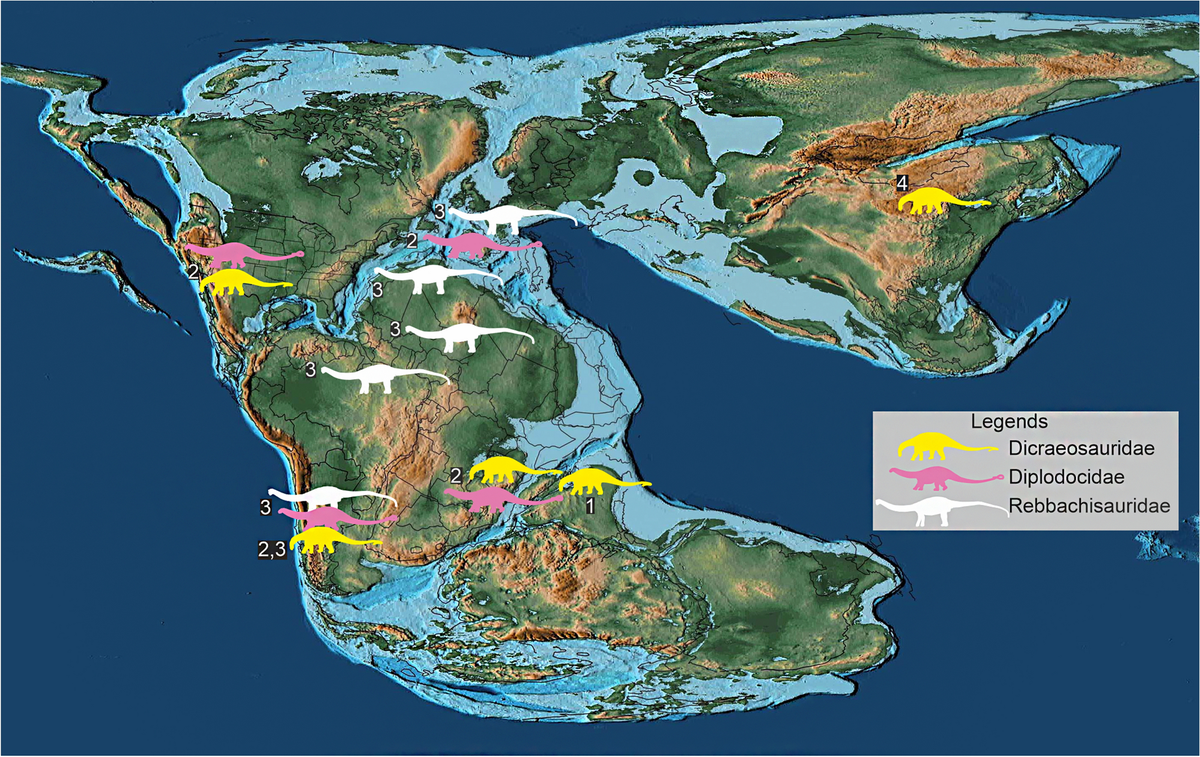
The scientists reasoned that these diplodocoid sauropods could have originated in India during the Middle Jurassic period and used the land connections at the time to migrate to Madagascar, Africa, and South America. After that they could have made their way to North America and the rest of the world.
Another piece of evidence that supports their theory was that diplodocoid fossils in other continents like Africa, the Americas, and Asia come from a younger geological interval. This increases the possibility that the Indian landmass was the site for the Tharosaurus’ early radiation.
That along with the fact that archaic sauropod fossils from during the start of the Jurassic period – like of Kotasaurus and Barapasaurus – were also found in India suggests that this diplodocoid group of sauropods could have evolved and originated in India.
“This discovery of a new dinosaur from the Middle Jurassic in Rajasthan should not be seen in isolation; it must be looked at in conjunction with previously discovered dinosaurs in India,” Dr. Bajpai said. “Together, the record from India suggests that the Indian landmass was one of the most important places for the early evolutionary history of sauropod dinosaurs.”
More fossils needed
Dr. Bajpai cautioned, however, that this was only the beginning. They didn’t find the whole skeleton but parts of the backbone of the dinosaur. “A lot more needs to be discovered. Our science is such that with each new discovery, ideas change, and sometimes even identifications change.”
A palaeogeographic distribution of diplodocoids with taxa of different ages plotted together in a simplified Middle Jurassic (170 Ma) map to show their spatio-temporal distribution across Pangea. Silhouettes indicate the type of diplodocoid and fossil occurrences. Numbers adjoining sauropod silhouettes indicate age of the fossils as follows: 1—Middle Jurassic (early–middle Bathonian); 2—Late Jurassic; 3—Cretaceous; 4—Middle Jurassic.
| Photo Credit:
Bajpai, S., Datta, D., Pandey, P. et al. Fossils of the oldest diplodocoid dinosaur suggest India was a major centre for neosauropod radiation. Sci Rep13, 12680 (2023).
“In the Middle Jurassic, when Tharosaurus lived, the continents were beginning to split apart from the supercontinent Pangea, and as these dinosaurs spread, they evolved into new forms,” said Dr. Jukar. “A caveat here is that the fossil record of Middle Jurassic diplodocoids is comparatively poor, and that will heavily influence how we view their evolution and spread. For example, if we find one that’s even older than Tharosaurus in, say, Russia, we’ll have to re-evaluate our geographic hypotheses.”
Dr. Jukar is impressed with the finding, but like Dr. Bajpai, believes that more fossils need to be found. More fossils of different parts of the Tharosaurus skeleton or of other related skeletons will help us better understand endemic sauropod evolution in India and global sauropod evolution and biogeography.
“I think Tharosaurus is a remarkable find, but it is very fragmentary,” according to Dr. Jukar. “It’s only once we have a better fossil record, not only geographically, but also in terms of fossil completeness, that we can start to get a clear picture of what sauropod evolution was doing during this crucial time in earth history.”
In 2006, an Indo-German team found another middle Jurassic sauropod dinosaur fossil in the Kutch basin of Gujarat, named Camarasaurus supremus, which was also the oldest fossil of that group found at the time. There have been subsequent finds of extremely old sauropod fossils in the region by the same team since.
‘Extremely rare’
Dr. Bajpai said that more work and more expeditions will need to be undertaken in the Jaisalmer area. “This is a potentially important area for the Middle Jurassic dinosaurs in India.”
“Indian dinosaurs are extremely rare,” said Dr. Jukar. “It’s not because they didn’t exist; it’s because we haven’t had the same level of palaeontological interest and investment that we’ve seen in other countries like the U.S., Canada, or China.”
Dr. Bajpai echoed this sentiment, emphasising the need for more attention on paleontological discoveries, specifically given the lack of natural history museums. “We definitely need not one but many natural history museums … given the vast fossil wealth of our country.”
Rohini Subrahmanyam is a freelance journalist.