



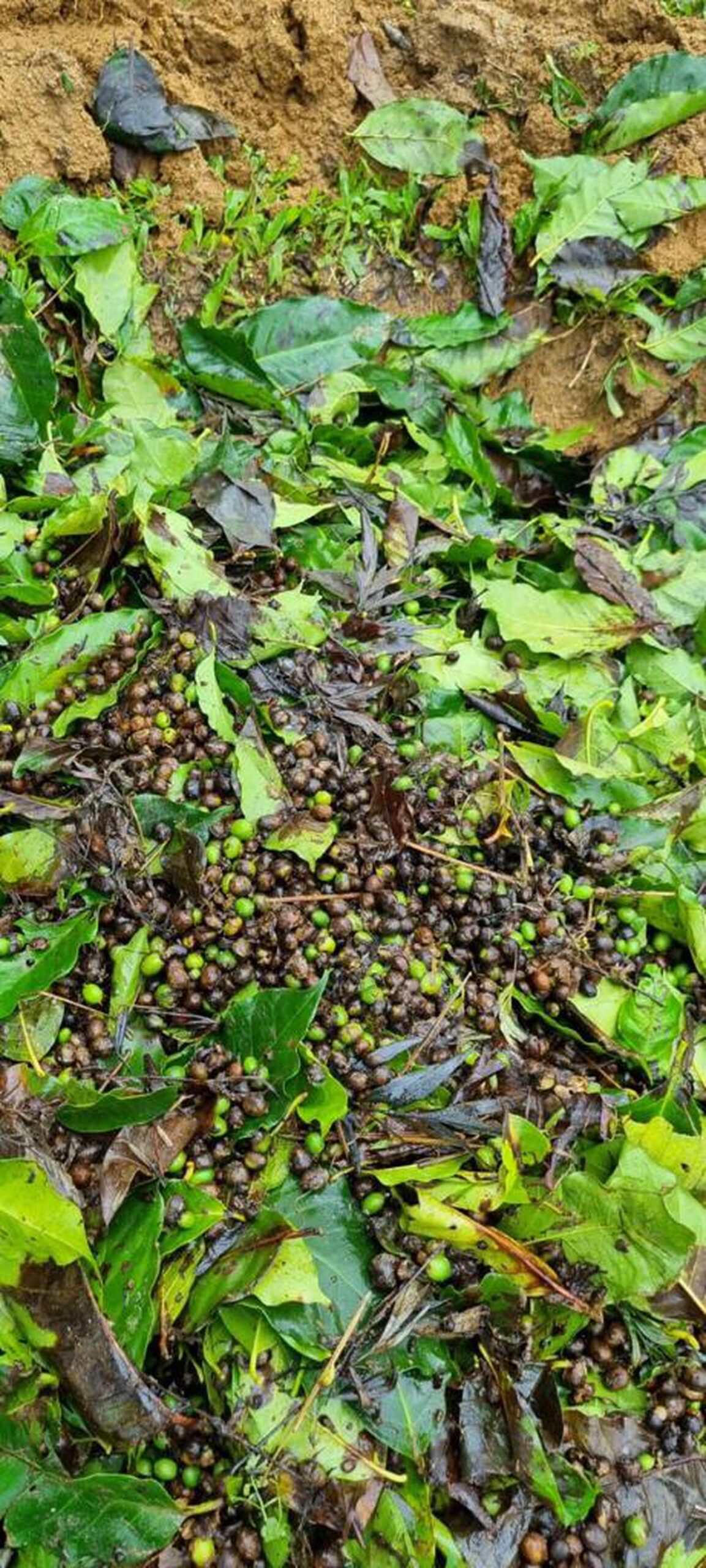
Bose Mandanna was devastated when torrential rains in September thrashed the coffee plants in his plantation and left tender berries and leaves strewn everywhere. The plants stood partially submerged in water for weeks at Subramanya Estate in Suntikoppa in Kodagu district of south Karnataka. Soon, the plants began to rot. Mandanna was among the hundreds of coffee growers in the region to suffer this plight.
In the coffee heartland of Karnataka, comprising the Kodagu, Chikkamagaluru and Hassan districts, big and small planters narrate stories of destruction caused by heavy rains between July and September. The impact of the rains continues, with diseases affecting plants, and estate infrastructure suffering long-term damage. Plantations in Wayanad in Kerala and Palani in Tamil Nadu have also suffered similar losses. “Erratic weather conditions are helping pests to breed and new diseases to emerge,’’ says H.T. Pramod, former Chairman of Karnataka Planters’ Association (KPA) and owner of Hulikere Estate in Chikkamagaluru.
Torrential rains have left tender berries and leaves strewn everywhere. Photo: Special Arrangement
Drastic changes in climate patterns over the last few years have adversely impacted India’s coffee production and the quality of the crop. There were dry spells between 2015 and 2017 and unseasonal heavy rains, floods and landslides between 2018 and 2022. According to the Coffee Board of India’s post-blossom estimate, production for the 2022 crop year was estimated at 3,93,400 metric tonnes. But given the extreme climatic conditions, it is anticipated to be some 30% lower.
The KPA reported fruit rot, stalk rot, root rot and other irreparable damage due to heavy rainfall and landslides. “Affected by stalk rot and root rot, berries turned black and dropped,” says KPA Chairman N. Ramanathan. “Coffee growers are facing a severe financial crisis due to the vagaries of nature.” The KPA expects this year’s production to be down by 35%. “Coffee, which is supposed to be harvested by December, is largely damaged,” says Mandanna, who is also a former member of the Coffee Board.
Most growers fear that the frequently occurring pattern of droughts and floods could wipe out plantations. “Sturdy and weather-resistant varieties of coffee may help, but sadly the government is not providing adequate funds to coffee research stations to develop these,” says Pramod.
Cost of financing and existing debts
Climate change has only compounded the financial issues of growers that have been in the making for long. The volatility in market prices and the reduced influence of producers in the value chain render coffee cultivation an increasingly loss-making proposition. “Producers are getting marginalised. This is rapidly turning out to be a buyer-driven commodity market,” says Ajoy Thipaiah, Coffee Committee Chairman of the United Planters’ Association of Southern India (UPASI).
More than 75% of Indian coffee production is exported. This has an impact on the cost competitiveness of Indian coffee vis-à-vis the coffee that is exported from other producer regions, especially since those growers get their finances at very low interest rates, explains Mr. Thipaiah.
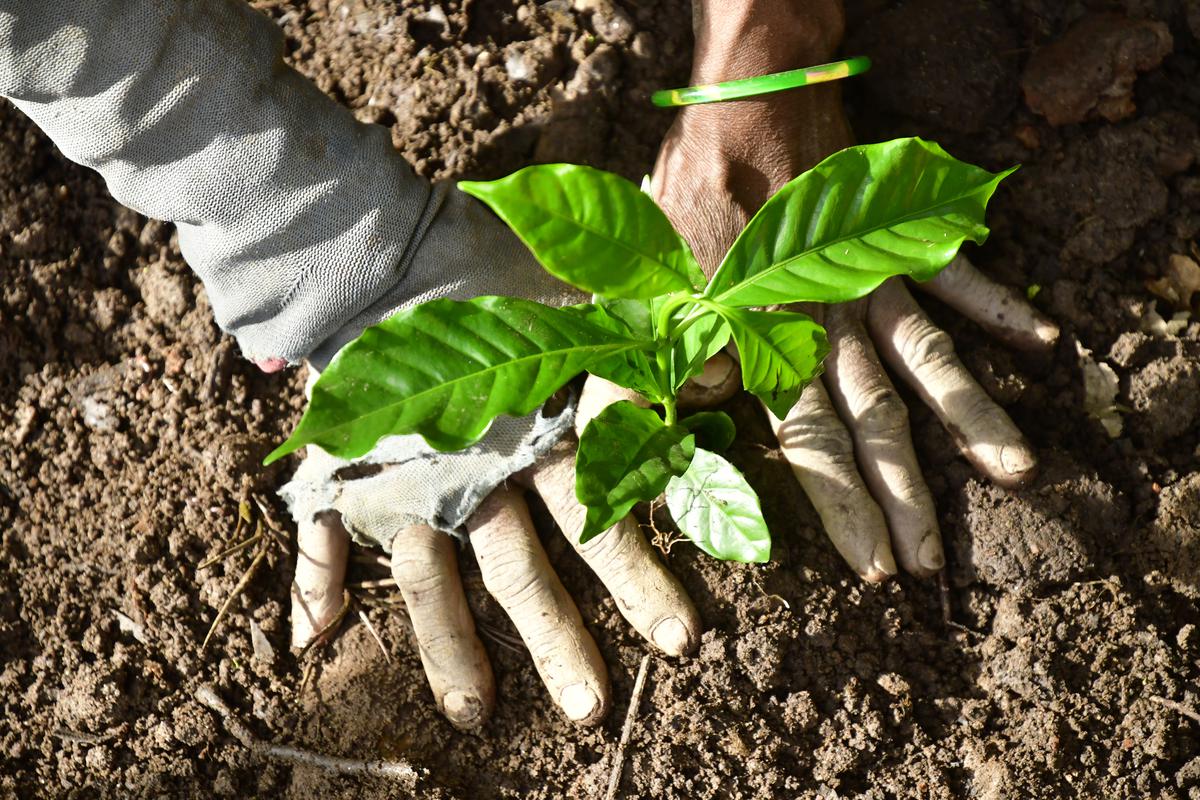
Workers plant new saplings in Chikkamagaluru district.
| Photo Credit:
K. Murali Kumar
According to Jeffry Rebello, President, UPASI, the cost of financing is one of the biggest challenges of the coffee sector. Most private banks insist that growers provide collateral for financing. Since small and medium-size growers are invariably not in a position to provide collateral, the interest rates are high, at around 12%. International interest rates, on the other hand, are negligible, mostly in single digits. This is an advantage for competing coffee-producing regions.
Although the latest position of the industry’s debt outstanding is not available, as per the information compiled by UPASI at the end of 2019, there were around 1,98,000 short-term loan accounts and 5,05,000 long-term loan accounts outstanding, amounting to ₹395.54 crore and ₹40.4 crore, respectively. UPASI and other producer associations have already requested the Coffee Board to recommend the implementation of a special package in line with the Special Coffee Term Loan, expected to be announced later this year, to rescue coffee growers.
“Also, due to the rise in the cost of inputs year on year and the increase in the cost of labour and benefits, which constitute 60% to 70% of total plantation expenditure, coffee growers are left with very little money in hand. This is not adequate to repay loans,” says Ramanathan.
In spite of requests from coffee associations and circulars from the Reserve Bank of India and the State Level Bankers’ Committee, banks have not restructured the loans. The accounts of many coffee growers have turned to non-performing assets (NPAs). These growers are now facing recovery proceedings under the SARFAESI Act (Securitisation and Reconstruction of Financial Assets and Enforcement of Security Interest Act), which gives banks the right to possess the security provided by the defaulting borrower against the loan and sell it to recover losses, without any intervention by any court of law. The KPA had also made a representation to the Union government requesting it to exclude plantations from the provisions of the SARFAESI Act and from the purview of CIBIL (Credit Information Bureau India Limited). “Banks are only worried about controlling their NPAs. Home loans and vehicle loans are now cheaper than agriculture loans, and interests are on the rise in general,” says Rohith Halase Rajagopal of Hoowinahuckloo and Kerehuckloo Estates in Balehonnur, Chikkamagaluru.
Low productivity, high cost of production
In India, production of coffee is low while the cost of production is on the rise compared to other coffee countries such as Vietnam and Brazil. In Brazil, labour charges account for 25% of the entire production cost, but in India, planters say they account for about 65%. It is possible to bring down the cost of production to some extent through mechanisation, but India’s coffee terrains and topography limit this possibility. At the same time, Indian coffee has a unique positioning as it is shade-grown and grown at elevations, while other major producing countries grow coffee in flat lands.
Also read | GI tag for Coorg Arabica Coffee, four others
“We need to take advantage of this by aggressively promoting our shade-grown coffee in the global markets,” says a UPASI representative. However, Shirish Vijayendra, former chairman of the KPA, says, “There is no official price setting mechanism even in the domestic market. So, traders and curers are calling the shots and fixing prices, and growers are at their mercy.”
The cost of production per acre has gone up substantially to ₹80,000-85,000 from ₹50,000 five years ago. The cost of inputs around coffee such as fertilizers and agrochemicals has increased by almost 20% in a year, says Ramesh Rajah, President, Coffee Exporters’ Association.
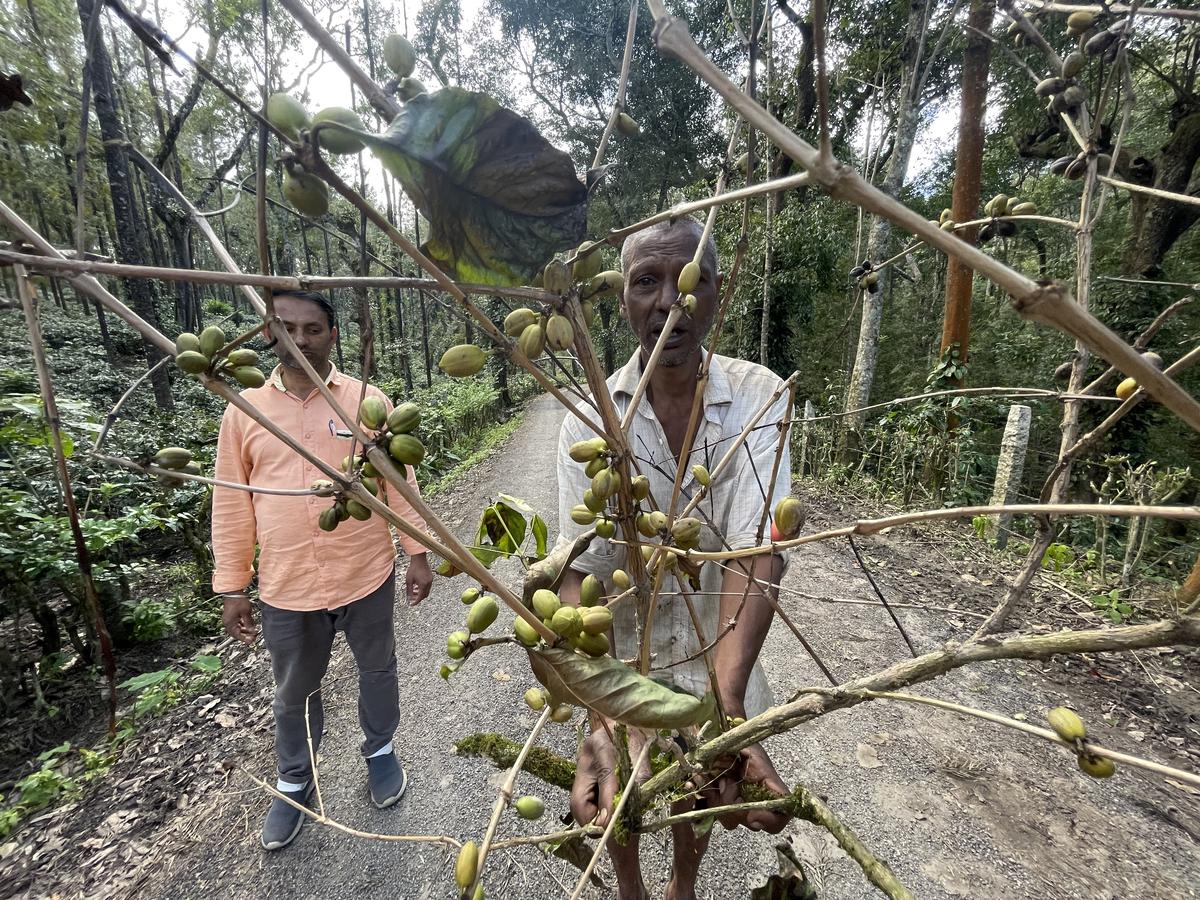
The Karnataka Planters’ Association reported fruit rot, stalk rot, root rot and other irreparable damage due to heavy rainfall and landslides. Damaged coffee plants in Chikkamagaluru.
| Photo Credit:
K. Murali Kumar
According to Ashok Kurien Kandathil, Managing Director of Balanoor Plantations and Industry at Jayapura, Chikkamagaluru, plantations face power cuts during the summer months. This makes irrigation expensive as the cost of diesel is high. “The high cost of inputs leads to the high cost of production which is the main problem for coffee growers. It makes coffee cultivation unviable,” Kandathil says. Earlier, the cost of production would go up by 4% to 5% annually, but now it goes up at least 20% annually, notes Anil Kumar Bhandari, President of India Coffee Trust and a large planter from Suntikoppa in Kodagu.
There is increasingly a shortage of labour while the cost of labour is on the rise in the coffee sector. The children of workers in all the three coffee-growing States — Karnataka, Tamil Nadu and Kerala — prefer to move to urban areas. This means plantations are forced to depend heavily on migrant labours who are unskilled. “A lot of effort, time and energy has to be invested in training migrant labours. As wage costs are not linked to productivity, growers are mandated to pay the usual wage along with other social costs such as housing and medicines, which adds up some 30% more to the wages,” says Rajah.
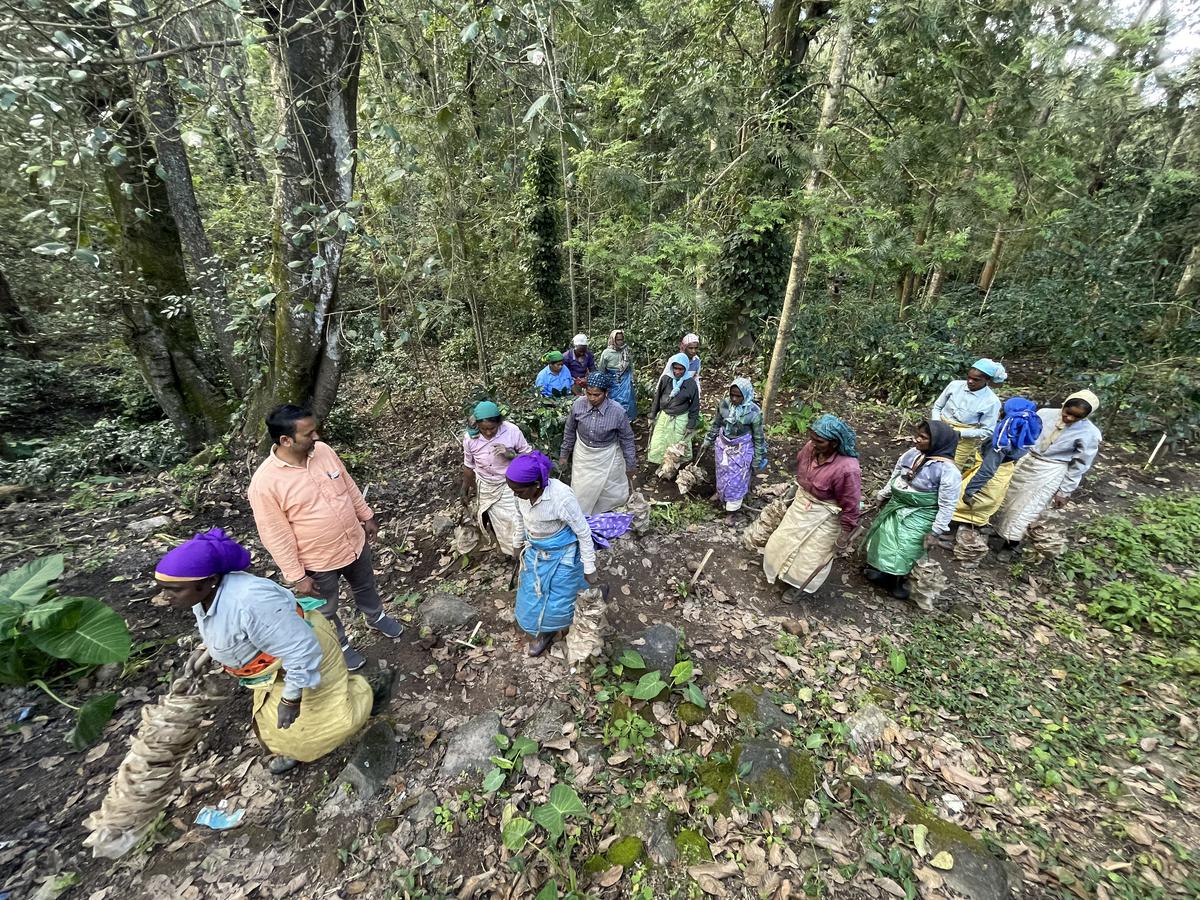
There is increasingly a shortage of labour while the cost of labour is on the rise in the coffee sector. Plantations are forced to depend heavily on migrant labours who are unskilled. Coffee plantation workers at work in Chikkamagaluru.
| Photo Credit:
K. Murali Kumar
Most plantations simply don’t find skilled labour, especially for tasks such as shade-lopping, pruning, and borer tracing, says Vijayendra.
The way forward
The way forward, many feel, is finding alternative sources of revenue and increasing domestic consumption on the one hand and branding and promoting Indian coffee better in the global market on the other.
Coffee Board CEO K.G. Jagadeesha says growers should create additional revenue streams through inter-cropping or through innovative measures. According to the board, in addition to traditional inter-cropping of pepper and cardamom, coffee growers could try planting exotic fruit-bearing trees, food crops, or getting into fish farming, dairy farming, apiary or green tourism to increase incomes from their coffee gardens.
In fact, some like Arasu, a progressive farmer from Thandikudi in Dindigul district in Tamil Nadu, and B.H Mohankumar, from Sakleshpur in Chikkamagaluru district, are growing avocados, mangosteens, oranges, guavas and other fruit-bearing trees, amid their coffee plants. In some seasons they say they have even earned more money from these than from coffee and pepper.
“Considering the change in land use, the government could permit growers to plant alternate crops in a land not suitable for coffee cultivation. Timely conversion will prevent growers from going financially sick,” says Kandathil.
Identity crisis in global markets
On the brand front, Indian coffee is still facing an identity crisis in global markets, although the country started exporting coffee actively before the 19th century.
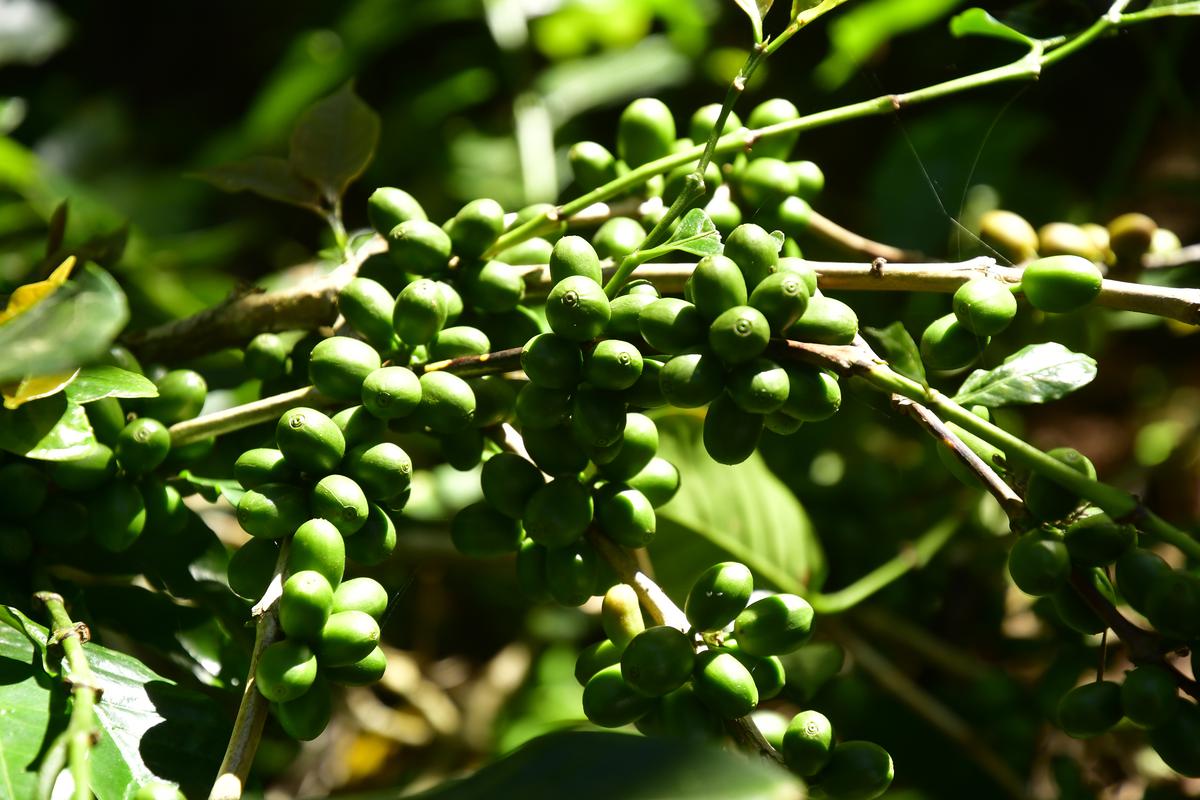
India has several speciality coffees and over three dozen estate brands for the global markets. Coffee beans at one of the plantations in Chikkamagaluru district.
| Photo Credit:
K. Murali Kumar
Indian coffee is highly rated and commands premium prices in the global coffee markets. But a global buyer of Indian coffee may not know about the brew’s India connection as they would have bought it from a coffee roaster. The fact that India sells Robusta and Arabic at a price higher than the hugely advertised Colombia is an indication of the brand building done by the Indian exporter and the quality of Indian coffee. Yet, Indian coffee does not have an individual brand identity in the international markets, say growers and exporters. “Indian coffee was never considered a separate origin coffee. It was always used as filler,” says Mandanna.
This is despite Indian coffee offering innumerable flavours, aromas and blends. The commodity, for several decades, enjoyed a special position in India’s export lists. According to Mandanna, coffee was an important export item for the Union government, when the commodity’s exports were in the range of ₹4,000-₹5,000 crore annually. But around 20 years ago, with the IT and services sector dominating the exports industry, coffee lost its prominence in the power corridors, especially in the Ministry of Commerce.
Coffee has high value and high imagery potential at home and overseas markets, says Harish Bijoor, branding expert and CEO of Harish Bijoor Consults Inc. Over the years the humble berry has been able to value-add. From being handled and sold as a berry, a green bean, a processed bean, a roasted bean and now a roasted and ground offering, coffee has climbed the hierarchy of value-addition, he says.
“India has several speciality coffees and over three dozen estate brands for the global markets. Many more are in the making. The cuppers, graders and tasters are trying to tell a unique story about the origin of a particular coffee. Indian green coffee on its own is capable of fetching premium prices in the global markets,” says Sunalini Menon, founder of Bangalore-based Coffeelab.
Even after getting out of the shackles of the pooling system in 1996, in which the Coffee Board and the government controlled the trade of coffee, the bean maintained a special status as a valuable export commodity for a long time. It earned recognition across the agriculture, commerce, finance and environment ministries as a serious forex earner for the exchequer.
India’s share in the global coffee market may be less than 5%, but the coffee sector is hopeful that the Coffee Act and the new Coffee (Promotion and Development Bill), 2022, will do away the 80-year-old coffee regulation and usher in change. As a precursor, the Coffee Board has embarked on a series of initiatives to unleash the full potential of the cuppa in the domestic and global markets. It is working on a separate India brand and certification system for coffee growers.
The coffee community in India, comprising close to 4 lakh coffee growers, hundreds of large planters, associations that represent growers, planters, curers and exporters, and over a dozen Fair Trade Organisations, hopes to boost coffee in the domestic and international markets and counter the problems the industry faces.