



Skip to content
  • Facebook
  • X
  • Linkedin
  • WhatsApp
  • YouTube
  • Associate Journalism
  • About Us
  • Privacy Policy
  • 033-46046046
  • editor@artifex.news
Artifex.News

Artifex.News

Stay Connected. Stay Informed.

  • Breaking News
  • World
  • Nation
  • Sports
  • Business
  • Science
  • Entertainment
  • Lifestyle
  • Toggle search form
  • Iranian hackers’ targeting of US critical infrastructure has escalated since start of war, U.S. says
    Iranian hackers’ targeting of US critical infrastructure has escalated since start of war, U.S. says World
  • Polish Cinematographer Artur Zurawski on working with Salman Khan and Rani Mukerji
    Polish Cinematographer Artur Zurawski on working with Salman Khan and Rani Mukerji Nation
  • Congress Fields Former Chhattisgarh Chief Minister Bhupesh Baghel From BJP Stronghold
    Congress Fields Former Chhattisgarh Chief Minister Bhupesh Baghel From BJP Stronghold Nation
  • Prices of commercial cylinders, FTL hiked
    Prices of commercial cylinders, FTL hiked Business
  • Reopening of Gaza’s Rafah crossing expected Monday, officials say
    Reopening of Gaza’s Rafah crossing expected Monday, officials say World
  • Access Denied Sports
  • Why did a U.S. aircraft carrier make a port call in Pattaya? | Explained
    Why did a U.S. aircraft carrier make a port call in Pattaya? | Explained World
  • Bangladesh Bowler Misses Run Out, Hits Batter With Throw In Bizarre Incident vs South Africa. Watch
    Bangladesh Bowler Misses Run Out, Hits Batter With Throw In Bizarre Incident vs South Africa. Watch Sports
A World-First Discovery – Twin Stars Trapped Orbiting Galactic Black Hole

A World-First Discovery – Twin Stars Trapped Orbiting Galactic Black Hole

Posted on December 18, 2024 By admin


At the centre of the Milky Way is a supermassive black hole called Sagittarius A*. It is roughly 27,000 light years from Earth and 23.5 million kilometres in diameter.

In a world first, a team of astronomers led by Florian Peißker from the University of Cologne, Germany, have discovered a binary star system orbiting this black hole.

The system is known as D9. Its discovery, announced in a new paper published today in Nature Communications, sheds light on the extreme environment at the centre of our Milky Way galaxy.

It also helps explain a long-running cosmic mystery about why some stars hurtle through space much faster than others.

What Is A Binary Star System?

A binary star system is simply two stars orbiting each other.

Our Sun is not part of a binary, which is a good thing: we wouldn’t want another star wandering through our Solar System. It would disrupt the orbit of the Earth; we’d fry or freeze.

Observations show about two thirds of the stars in the Milky Way are single stars, and the remainder are part of a binary or multiple star system. Larger stars are more likely to be paired.

Binary star systems are useful to astronomers because their motion contains a wealth of information. For example, the speed and distance of the orbits tell us about the masses of the stars.

For a single star, by contrast, we usually work out its mass from how bright it is.

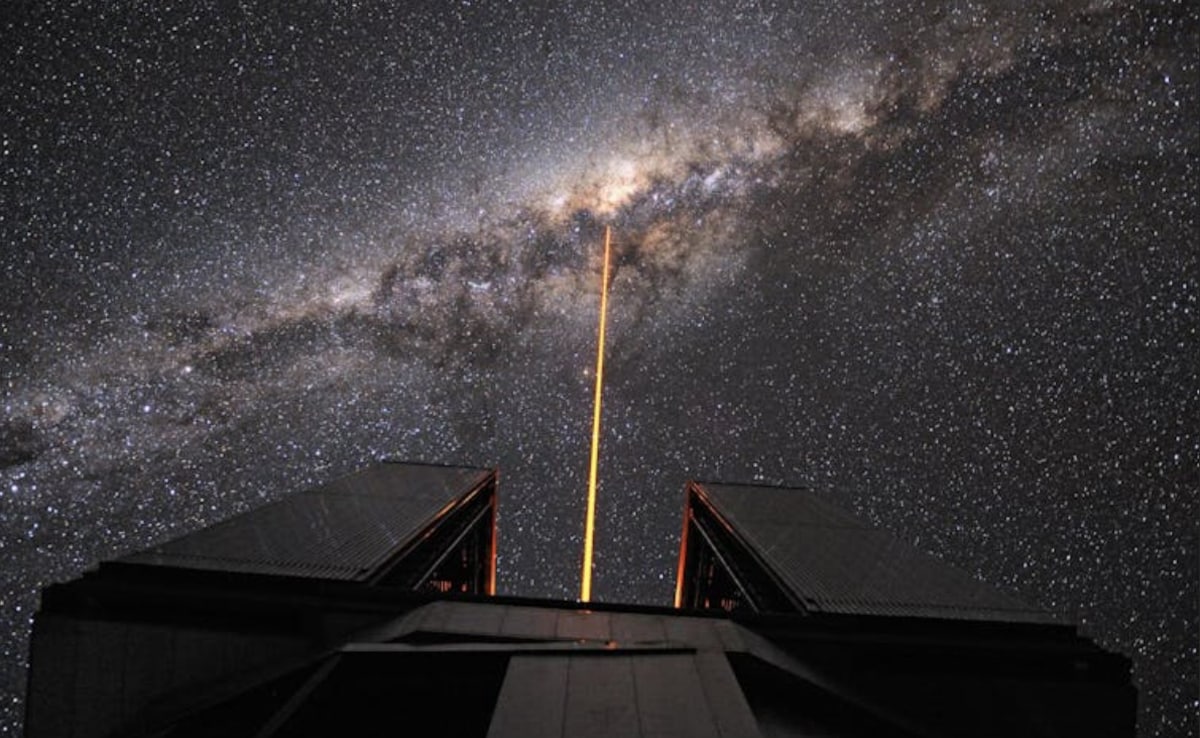
This image indicates the location of the newly discovered binary star D9, which is orbiting Sagittarius A*, the supermassive black hole at the centre of our galaxy. F. Peißker et al., S. Guisard/ESO

A Technically Challenging Discovery

Although scientists have previously predicted that binary star systems exist near supermassive black holes, they have never actually detected one.

This recent discovery was technically quite challenging. We can’t simply look at the system and see two stars, because it’s too far away. Rather, the astronomers used the European Southern Observatory’s Very Large Telescope to measure the shifting of the starlight – known as the Doppler effect. This showed that the stellar system’s light had a characteristic wobble, indicating an orbit.

But the team did much more than that.

Because binary stars contain a wealth of information, the astronomers could calculate that this particular system is approximately 2.7 million years old. That is, 2.7 million years ago, these stars first ignited.

They probably weren’t born in the black hole’s extreme surroundings, so unless they only recently wandered into this neighbourhood, they have lasted about a million years in their current environment.

This, in turn, tells us about the black hole’s ability to disrupt stars in its orbit. Black holes are mysterious beasts, but clues such as this are helping us unravel their nature.
Animation of white circles moving through black space.
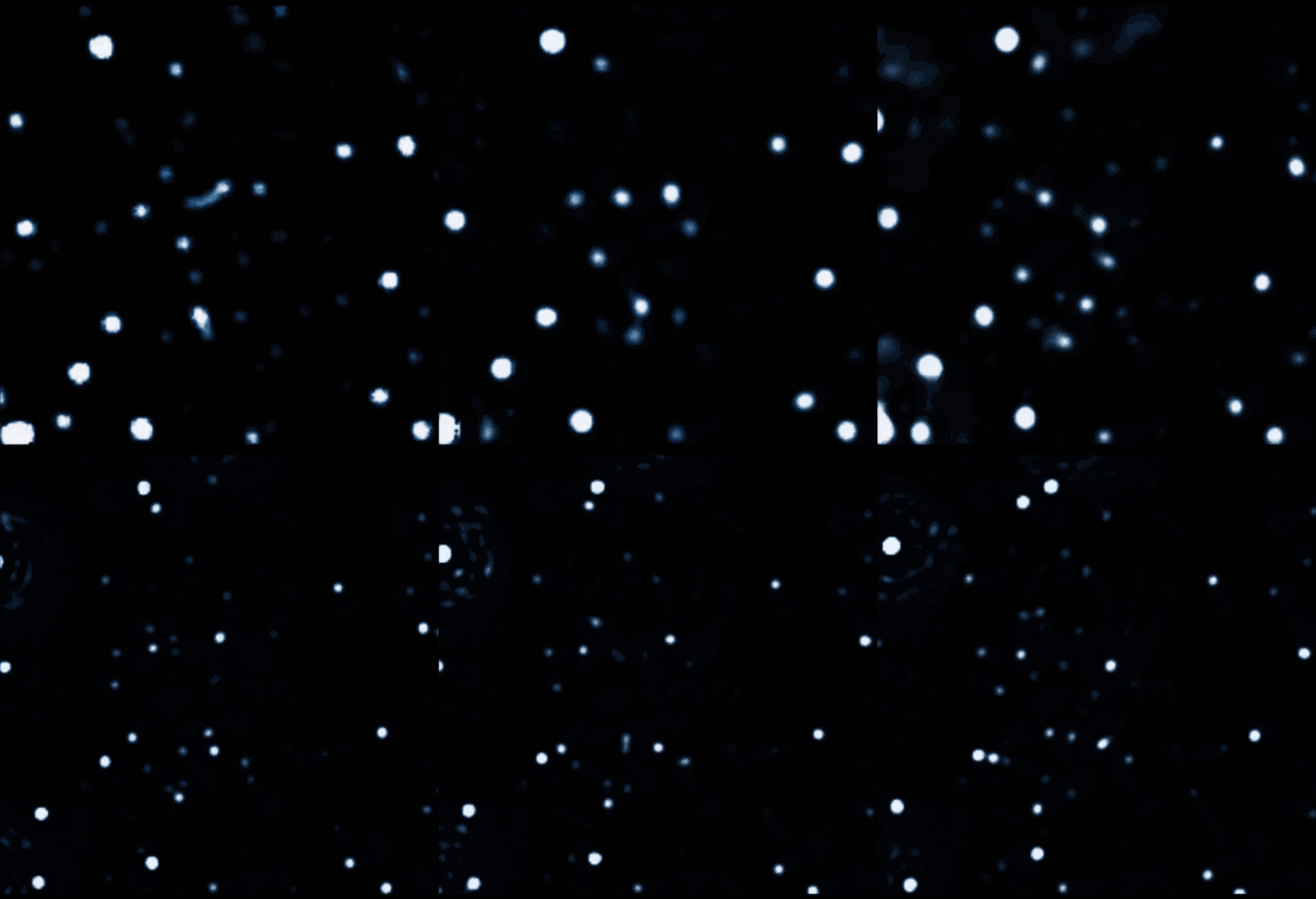
A20-year time lapse of stars orbiting the black hole at the centre of the galaxy. ESO/MPE, CC BY-NC

Circling A Black Hole

The situation the astronomers discovered is quite familiar.

Think of the Moon: it orbits the Earth, and the Earth and the Moon together orbit the Sun. Because gravity is an attractive force, it can pull multiple celestial objects into complicated orbits. The complexity of this scenario inspired the recent book and Netflix series, The Three Body Problem.

If they are complicated, could the whole thing drift apart? The Moon–Earth–Sun arrangement is stable because two of the three bodies – the Earth and Moon – are much closer together than the other body, the Sun. The Moon and Earth are close enough that, so far as the Sun is concerned, it’s effectively a two-body system, which is stable.

But if all three bodies interact, the system can come apart. It is even possible for two of the bodies to eject the third body entirely.

A visualisation of the instability of a three body system.

Stars Of Unusual Speed

This mechanism probably explains a cosmic mystery: hypervelocity stars.

Most stars in the night sky are in a typical, almost-circular orbit around the centre of our galaxy. Orbital speeds are about 200 kilometres per second: very fast on Earth, but nothing special in space.

However, since 2005 we have discovered about 20 hypervelocity stars, which are hurtling through our galaxy at more than 1,000 kilometres per second. How?

Our best current idea is that hypervelocity stars were once part of a binary system orbiting our supermassive black hole. In time, the stars got too close to the black hole, and a complicated orbit resulted. In the kerfuffle, with a black hole calling the shots, one of the stars got ejected. It escaped to the outer Milky Way, where we see it as a hypervelocity star.

Finding The Hypervelocity Factory

It’s an interesting theory.

Theoretical calculations show the mechanism works and the speeds are about right. Observations show many of the known hypervelocity stars appear to be shooting away from the galactic centre, which is another plus for the theory. But how else could we test this idea?

An obvious way is to look for binary stars around our supermassive black hole.

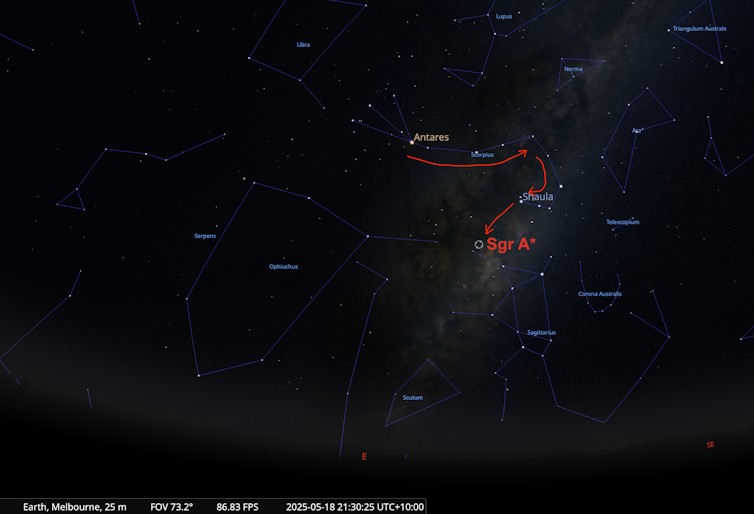
Astronomers have been keeping a close eye on our galactic centre for decades. It’s not too difficult to find in the night sky, as you can see from the image below.
Map of the night sky.
This map shows the location of Sagittarius A* in relation to Antares. The black hole is marked with a circle within the constellation of Sagittarius (The Archer). Stellarium

Here are two reliable methods to find Sagittarius A*. First, find Antares (bright and red), which is the centre of the back of Scorpio, and then follow the scorpion’s body to the tip of the tail, and that’s close-ish to the black hole. Alternatively, get a good night sky app on your phone; they’re amazing.

In the context of these theories, this recent discovery is very important. Astronomers found a binary star system around our supermassive black hole. An important piece of the hypervelocity puzzle falls into place.The Conversation

(Author: Luke Barnes, Lecturer in Physics, Western Sydney University)

(Disclosure Statement: Luke Barnes does not work for, consult, own shares in or receive funding from any company or organisation that would benefit from this article, and has disclosed no relevant affiliations beyond their academic appointment)

This article is republished from The Conversation under a Creative Commons license. Read the original article.



Source link

World Tags:Astro Physics, Astronomy, black hole, Cosmology, Cosmos, Milky Way Black Hole Sagittarius A*, Scientific discovery, Stars Orbiting Black Hole, supermassive black hole, Twin Stars Orbiting Galactic Black Hole

Post navigation

Previous Post: Congress’s M Kharge Targets Amit Shah
Next Post: Elderly Couple Dies After Fires Breaks Out At House In South Delhi

Related Posts

  • Deepfakes Target Women Leaders In Pakistan
    Deepfakes Target Women Leaders In Pakistan World
  • Thailand confirms three deaths from vessel attacked in Strait of Hormuz
    Thailand confirms three deaths from vessel attacked in Strait of Hormuz World
  • Mahsa Amini’s death anniversary | Biden announces more Iran sanctions
    Mahsa Amini’s death anniversary | Biden announces more Iran sanctions World
  • The View From India newsletter: Is all well in Indo-U.S. partnership?
    The View From India newsletter: Is all well in Indo-U.S. partnership? World
  • Morning Digest | 10 civilians dead, 22 army men still missing in Sikkim, rescue operations on; Media bodies write to CJI, call for norms on interrogation of journalists and more
    Morning Digest | 10 civilians dead, 22 army men still missing in Sikkim, rescue operations on; Media bodies write to CJI, call for norms on interrogation of journalists and more World
  • MEA denies Epstein claim that U.S. played a role in PM’s 2017 visit to Israel
    MEA denies Epstein claim that U.S. played a role in PM’s 2017 visit to Israel World

More Related Articles

US Woman Died After Abortion Ban Delayed Her Medical Care: Report US Woman Died After Abortion Ban Delayed Her Medical Care: Report World
U.S. President Trump appoints Brent Christensen as new U.S. Ambassador to Bangladesh U.S. President Trump appoints Brent Christensen as new U.S. Ambassador to Bangladesh World
South Korea police raid Jeju Air, airport over fatal crash South Korea police raid Jeju Air, airport over fatal crash World
U.S. military strikes ‘multiple targets’ in Iran in second day of renewed fire U.S. military strikes ‘multiple targets’ in Iran in second day of renewed fire World
Photos: Donald Trump’s Cabinet – Who’s Been Picked, Who’s In The Running Photos: Donald Trump’s Cabinet – Who’s Been Picked, Who’s In The Running World
What We Know So Far What We Know So Far World
SiteLock

Archives

  • September 2026
  • August 2026
  • July 2026
  • June 2026
  • May 2026
  • April 2026
  • March 2026
  • February 2026
  • January 2026
  • December 2025
  • November 2025
  • October 2025
  • September 2025
  • August 2025
  • July 2025
  • June 2025
  • May 2025
  • April 2025
  • March 2025
  • February 2025
  • January 2025
  • December 2024
  • November 2024
  • October 2024
  • September 2024
  • August 2024
  • July 2024
  • June 2024
  • May 2024
  • April 2024
  • March 2024
  • February 2024
  • January 2024
  • December 2023
  • November 2023
  • October 2023
  • September 2023
  • August 2023
  • July 2023
  • June 2023
  • May 2023
  • April 2023
  • March 2023
  • February 2023
  • January 2023
  • December 2022
  • November 2022
  • October 2022
  • September 2022
  • August 2022
  • July 2022
  • June 2022
  • May 2022

Categories

  • Business
  • Nation
  • Science
  • Sports
  • World

Recent Posts

  • Police arrest 12 bus drivers for ‘vandalism’ as DTC drivers’ protest over higher wages enters Day 6
  • ‘Stop Vizag Data Centers’ Instagram account blocked in India
  • Chandni Chowk’s Town Hall to be developed as ‘Global Heritage Centre’: CM
  • Missing measure in India’s magnet mission
  • Dengue cases in Tamil Nadu decline for third consecutive year as per government data

Recent Comments

  1. LarryKef on UP Teacher Who Asked Students To Slap Muslim Classmate
  2. Josephjab on UP Teacher Who Asked Students To Slap Muslim Classmate
  3. LarryKef on UP Teacher Who Asked Students To Slap Muslim Classmate
  4. Jasonnekly on UP Teacher Who Asked Students To Slap Muslim Classmate
  5. Jasonnekly on UP Teacher Who Asked Students To Slap Muslim Classmate
  • Access Denied
    Access Denied Nation
  • India, UK Ministers Discuss Plan To Take Forward Talks On Free Trade Deal
    India, UK Ministers Discuss Plan To Take Forward Talks On Free Trade Deal World
  • Nepal’s ruling parties’ bid to change electoral laws could deal a blow to inclusivity  
    Nepal’s ruling parties’ bid to change electoral laws could deal a blow to inclusivity   World
  • Access Denied Sports
  • Do phone batteries last longer when it’s cooler outside?
    Do phone batteries last longer when it’s cooler outside? Science
  • Pakistan vs Bangladesh 2nd Test Day 2 Live Updates: Pakistan Dealt Early Blow, Taskin Removes Shafique
    Pakistan vs Bangladesh 2nd Test Day 2 Live Updates: Pakistan Dealt Early Blow, Taskin Removes Shafique Sports
  • Mendelian genetics, Darwinian evolution closely linked with chemistry, says expert
    Mendelian genetics, Darwinian evolution closely linked with chemistry, says expert Science
  • Access Denied Sports

Editor-in-Chief:
Mohammad Ariff,
MSW, MAJMC, BSW, DTL, CTS, CNM, CCR, CAL, RSL, ASOC.
editor@artifex.news

Associate Editors:
1. Zenellis R. Tuba,
zenelis@artifex.news
2. Haris Daniyel
daniyel@artifex.news

Photograher:
Rohan Das
rohan@artifex.news

Artifex.News offers Online Paid Internships to college students from India and Abroad. Interns will get a PRESS CARD and other online offers.
Send your CV (Subjectline: Paid Internship) to internship@artifex.news

Links:
Associate Journalism
About Us
Privacy Policy

News Links:
Breaking News
World
Nation
Sports
Business
Entertainment
Lifestyle

Registered Office:
72/A, Elliot Road, Kolkata - 700016
Tel: 033-22277777, 033-22172217
Email: office@artifex.news

Editorial Office / News Desk:
No. 13, Mezzanine Floor, Esplanade Metro Rail Station,
12 J. L. Nehru Road, Kolkata - 700069.
(Entry from Gate No. 5)
Tel: 033-46011099, 033-46046046
Email: editor@artifex.news

Copyright © 2023 Artifex.News Newsportal designed by Artifex Infotech.