





Skip to content
  • Facebook
  • X
  • Linkedin
  • WhatsApp
  • Associate Journalism
  • About Us
  • Privacy Policy
  • 033-46046046
  • editor@artifex.news
Artifex.News

Artifex.News

Stay Connected. Stay Informed.

  • Breaking News
  • World
  • Nation
  • Sports
  • Business
  • Science
  • Entertainment
  • Lifestyle
  • Toggle search form
  • Liverpool Face Merseyside Derby Cauldron, Chelsea Defy Expectations Sports
  • Madrassa Teacher Holds 12-Year-Old Captive, Rapes Her In UP’s Gorakhpur Nation
  • Nigeria Reels Under ‘Cryptic Pregnancy’ Scam. All Your Questions Answered World
  • Mike Tyson Says Decision To Comeback At 57 Was No-Brainer World
  • Luxury influencers vanish from Chinese social media in wealth crackdown World
  • Cricket World Cup: Mohammed Shami’s Role Is Clear But There Is No Place For Him In India’s ‘Perfect Playing XI’ Sports
  • Team including Indian scientists designs potent antidote to cobra, krait venom toxins Science
  • When did an uptick in dental cavities in humans begin? Science

A World-First Discovery – Twin Stars Trapped Orbiting Galactic Black Hole

Posted on December 18, 2024 By admin


At the centre of the Milky Way is a supermassive black hole called Sagittarius A*. It is roughly 27,000 light years from Earth and 23.5 million kilometres in diameter.

In a world first, a team of astronomers led by Florian Peißker from the University of Cologne, Germany, have discovered a binary star system orbiting this black hole.

The system is known as D9. Its discovery, announced in a new paper published today in Nature Communications, sheds light on the extreme environment at the centre of our Milky Way galaxy.

It also helps explain a long-running cosmic mystery about why some stars hurtle through space much faster than others.

What Is A Binary Star System?

A binary star system is simply two stars orbiting each other.

Our Sun is not part of a binary, which is a good thing: we wouldn’t want another star wandering through our Solar System. It would disrupt the orbit of the Earth; we’d fry or freeze.

Observations show about two thirds of the stars in the Milky Way are single stars, and the remainder are part of a binary or multiple star system. Larger stars are more likely to be paired.

Binary star systems are useful to astronomers because their motion contains a wealth of information. For example, the speed and distance of the orbits tell us about the masses of the stars.

For a single star, by contrast, we usually work out its mass from how bright it is.

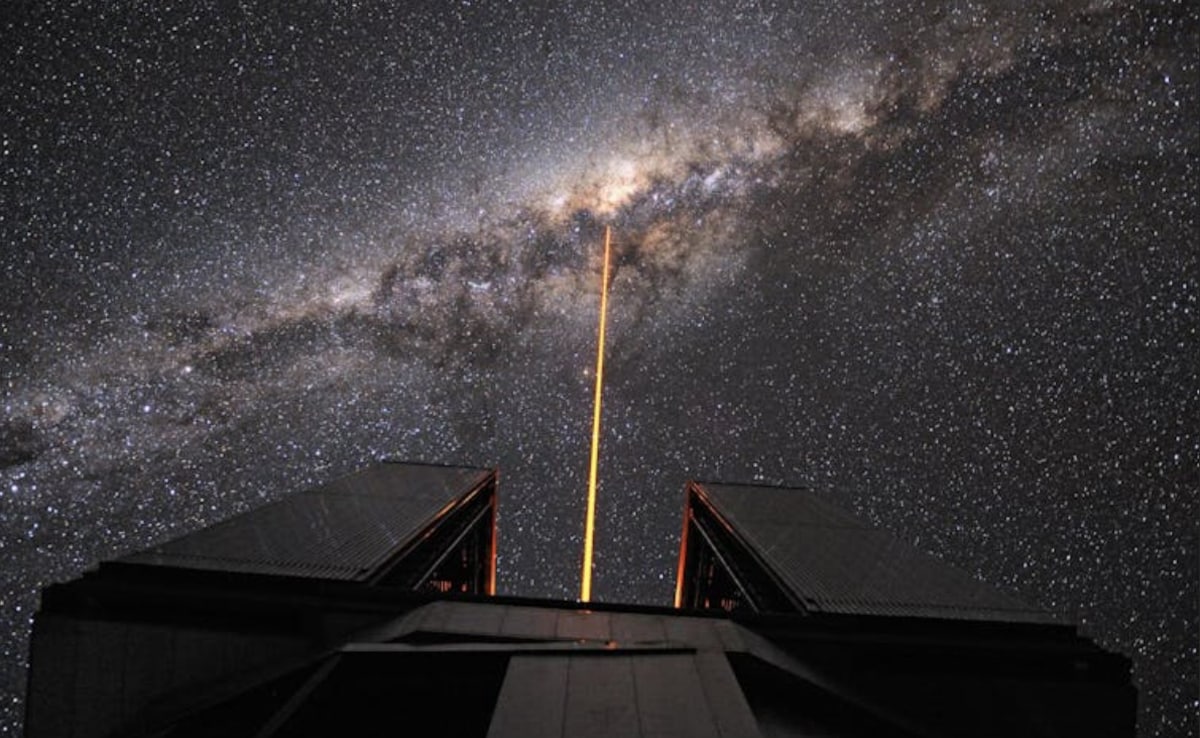
This image indicates the location of the newly discovered binary star D9, which is orbiting Sagittarius A*, the supermassive black hole at the centre of our galaxy. F. Peißker et al., S. Guisard/ESO

A Technically Challenging Discovery

Although scientists have previously predicted that binary star systems exist near supermassive black holes, they have never actually detected one.

This recent discovery was technically quite challenging. We can’t simply look at the system and see two stars, because it’s too far away. Rather, the astronomers used the European Southern Observatory’s Very Large Telescope to measure the shifting of the starlight – known as the Doppler effect. This showed that the stellar system’s light had a characteristic wobble, indicating an orbit.

But the team did much more than that.

Because binary stars contain a wealth of information, the astronomers could calculate that this particular system is approximately 2.7 million years old. That is, 2.7 million years ago, these stars first ignited.

They probably weren’t born in the black hole’s extreme surroundings, so unless they only recently wandered into this neighbourhood, they have lasted about a million years in their current environment.

This, in turn, tells us about the black hole’s ability to disrupt stars in its orbit. Black holes are mysterious beasts, but clues such as this are helping us unravel their nature.
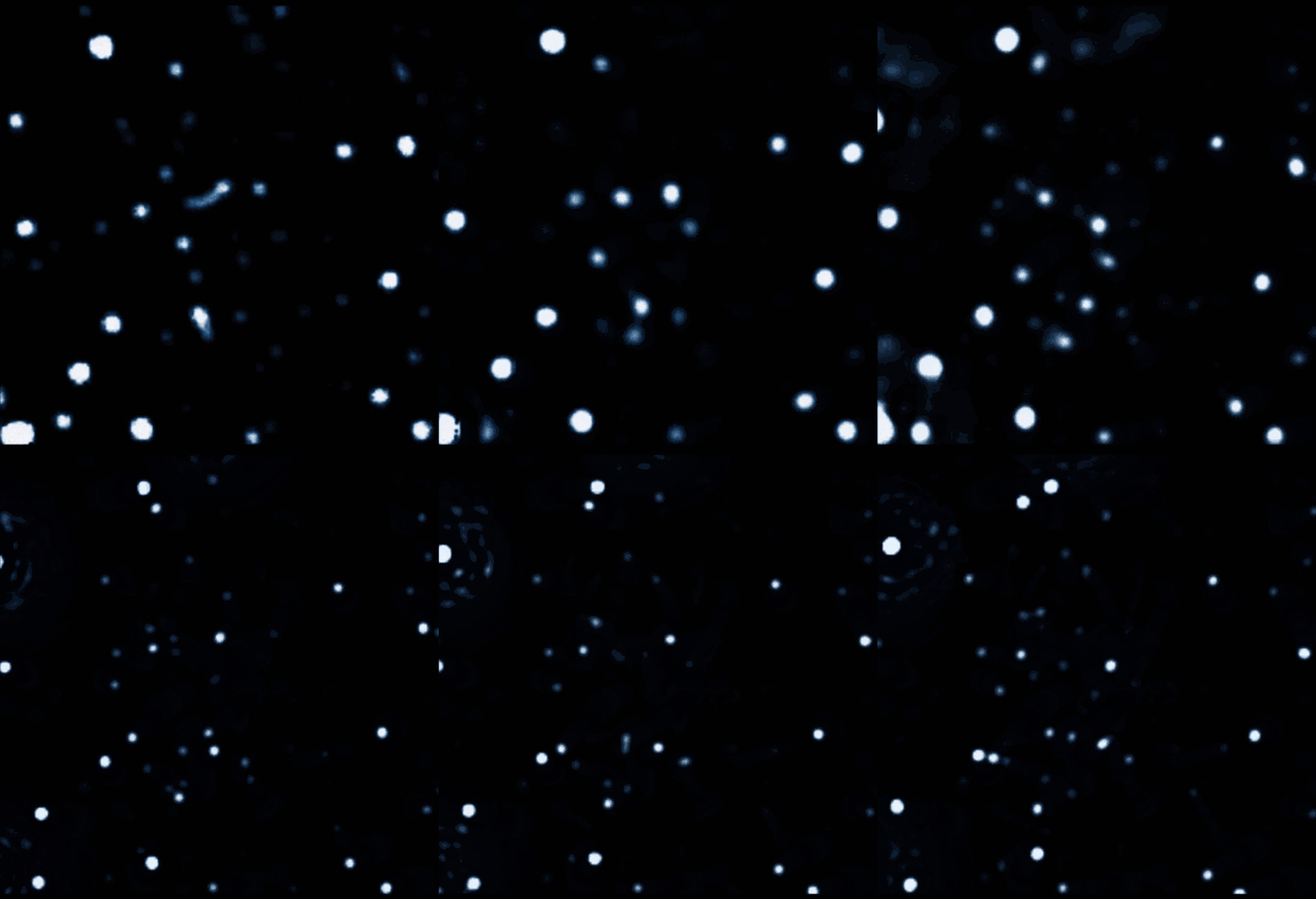
Animation of white circles moving through black space.
A20-year time lapse of stars orbiting the black hole at the centre of the galaxy. ESO/MPE, CC BY-NC

Circling A Black Hole

The situation the astronomers discovered is quite familiar.

Think of the Moon: it orbits the Earth, and the Earth and the Moon together orbit the Sun. Because gravity is an attractive force, it can pull multiple celestial objects into complicated orbits. The complexity of this scenario inspired the recent book and Netflix series, The Three Body Problem.

If they are complicated, could the whole thing drift apart? The Moon–Earth–Sun arrangement is stable because two of the three bodies – the Earth and Moon – are much closer together than the other body, the Sun. The Moon and Earth are close enough that, so far as the Sun is concerned, it’s effectively a two-body system, which is stable.

But if all three bodies interact, the system can come apart. It is even possible for two of the bodies to eject the third body entirely.

A visualisation of the instability of a three body system.

Stars Of Unusual Speed

This mechanism probably explains a cosmic mystery: hypervelocity stars.

Most stars in the night sky are in a typical, almost-circular orbit around the centre of our galaxy. Orbital speeds are about 200 kilometres per second: very fast on Earth, but nothing special in space.

However, since 2005 we have discovered about 20 hypervelocity stars, which are hurtling through our galaxy at more than 1,000 kilometres per second. How?

Our best current idea is that hypervelocity stars were once part of a binary system orbiting our supermassive black hole. In time, the stars got too close to the black hole, and a complicated orbit resulted. In the kerfuffle, with a black hole calling the shots, one of the stars got ejected. It escaped to the outer Milky Way, where we see it as a hypervelocity star.

Finding The Hypervelocity Factory

It’s an interesting theory.

Theoretical calculations show the mechanism works and the speeds are about right. Observations show many of the known hypervelocity stars appear to be shooting away from the galactic centre, which is another plus for the theory. But how else could we test this idea?

An obvious way is to look for binary stars around our supermassive black hole.

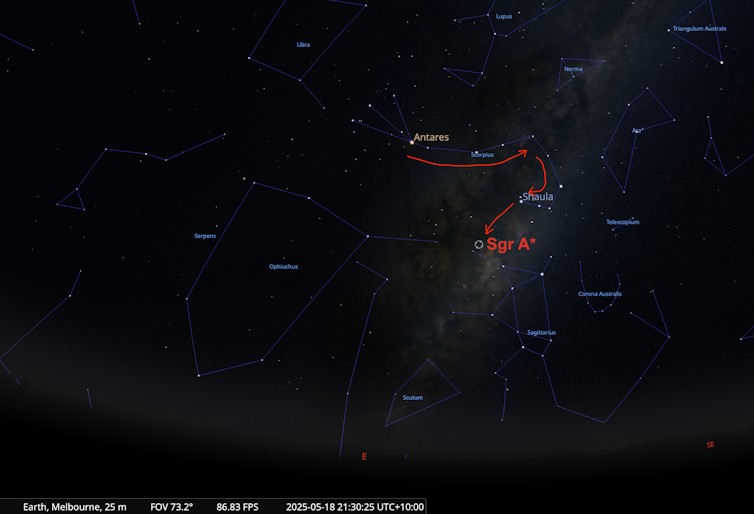
Astronomers have been keeping a close eye on our galactic centre for decades. It’s not too difficult to find in the night sky, as you can see from the image below.
Map of the night sky.
This map shows the location of Sagittarius A* in relation to Antares. The black hole is marked with a circle within the constellation of Sagittarius (The Archer). Stellarium

Here are two reliable methods to find Sagittarius A*. First, find Antares (bright and red), which is the centre of the back of Scorpio, and then follow the scorpion’s body to the tip of the tail, and that’s close-ish to the black hole. Alternatively, get a good night sky app on your phone; they’re amazing.

In the context of these theories, this recent discovery is very important. Astronomers found a binary star system around our supermassive black hole. An important piece of the hypervelocity puzzle falls into place.The Conversation

(Author: Luke Barnes, Lecturer in Physics, Western Sydney University)

(Disclosure Statement: Luke Barnes does not work for, consult, own shares in or receive funding from any company or organisation that would benefit from this article, and has disclosed no relevant affiliations beyond their academic appointment)

This article is republished from The Conversation under a Creative Commons license. Read the original article.



Source link

World Tags:Astro Physics, Astronomy, black hole, Cosmology, Cosmos, Milky Way Black Hole Sagittarius A*, Scientific discovery, Stars Orbiting Black Hole, supermassive black hole, Twin Stars Orbiting Galactic Black Hole

Post navigation

Previous Post: Congress’s M Kharge Targets Amit Shah
Next Post: Elderly Couple Dies After Fires Breaks Out At House In South Delhi

Related Posts

  • Atleast 80 killed in strike by Sudan paramilitary forces World
  • Rafi Songs To Roti, Brunei’s Deep Cultural Connect With India World
  • China’s Wang meets Indonesia’s Jokowi, president-elect Prabowo World
  • Full list of Hezbollah, Hamas leaders killed by Israel since October 7, 2023 World
  • Climate Change Worsened Deadly Africa Floods: Study World
  • All You Need To Know About Bird Flu Virus Found In Humans In 2024 World

More Related Articles

Ukraine vs Elon Musk In Meme Battle Over Aid, Failed SpaceX Launch World
Progress In Women’s Leadership In India’s Panchayati Raj System Highlighted In UN World
Donald Trump Names Ex-Democrat Tulsi Gabbard As Director of National Intelligence World
“Cash Reward” For Chinese Couples If Bride Is Aged 25 Or Younger World
Landslides, flash floods hit Indonesia’s Java island, leaving 10 dead; two missing World
India has a ‘significant role’ in resolving Gaza violence: Palestinian PM Mustafa World
SiteLock

Archives

  • December 2024
  • November 2024
  • October 2024
  • September 2024
  • August 2024
  • July 2024
  • June 2024
  • May 2024
  • April 2024
  • March 2024
  • February 2024
  • January 2024
  • December 2023
  • November 2023
  • October 2023
  • September 2023
  • August 2023
  • July 2023
  • June 2023
  • May 2023
  • April 2023
  • March 2023
  • February 2023
  • January 2023
  • December 2022
  • November 2022
  • October 2022
  • September 2022
  • August 2022
  • July 2022
  • June 2022
  • May 2022

Categories

  • Business
  • Nation
  • Science
  • Sports
  • World

Recent Posts

  • Pakistan developing missiles that eventually could hit U.S., top U.S. official says
  • No Organisation Called Kuki-Zo Council Exists, No District Called Lamka, Says Manipur Government
  • Pak Developing Missiles That Eventually Could Hit US: White House Official
  • Camera Found in Changing Room Of Bhopal MRI Centre, Footage Seized
  • ‘One Nation, One Poll’ Panel Gets More Members After Some Parties Object

Recent Comments

  1. dfb{{98991*97996}}xca on UP Teacher Who Asked Students To Slap Muslim Classmate
  2. "dfbzzzzzzzzbbbccccdddeeexca".replace("z","o") on UP Teacher Who Asked Students To Slap Muslim Classmate
  3. 1}}"}}'}}1%>"%>'%> on UP Teacher Who Asked Students To Slap Muslim Classmate
  4. bfg6520<s1﹥s2ʺs3ʹhjl6520 on UP Teacher Who Asked Students To Slap Muslim Classmate
  5. pHqghUme9356321 on UP Teacher Who Asked Students To Slap Muslim Classmate
  • The US Media Verdict On High-Stakes Donald Trump-Kamala Harris Debate 2024 World
  • US Troops Targeted At Base In Western Iraq, Second Attack Since February 4 World
  • With Special Message For Rohit Sharma, Rahul Dravid’s Final Head Coach Speech Guarantees Goosebumps. Watch Sports
  • Three killed, 17 injured as Israeli strikes Beirut after Hezbollah rocket attack World
  • ‘Don’t Think India Should Go To Pakistan If…’: Harbhajan Singh’s Explosive Verdict Sports
  • 52-Year-Old Climber Dies After 1,000 Feet Fall From Alaska Mountain World
  • Malaysian PM Anwar Ibrahim warns of action against rice hoarders as prices soar World
  • India vs PM’s XI match: Rain plays spoilsport on day one Sports

Editor-in-Chief:
Mohammad Ariff,
MSW, MAJMC, BSW, DTL, CTS, CNM, CCR, CAL, RSL, ASOC.
editor@artifex.news

Associate Editors:
1. Zenellis R. Tuba,
zenelis@artifex.news
2. Haris Daniyel
daniyel@artifex.news

Photograher:
Rohan Das
rohan@artifex.news

Artifex.News offers Online Paid Internships to college students from India and Abroad. Interns will get a PRESS CARD and other online offers.
Send your CV (Subjectline: Paid Internship) to internship@artifex.news

Links:
Associate Journalism
About Us
Privacy Policy

News Links:
Breaking News
World
Nation
Sports
Business
Entertainment
Lifestyle

Registered Office:
72/A, Elliot Road, Kolkata - 700016
Tel: 033-22277777, 033-22172217
Email: office@artifex.news

Editorial Office / News Desk:
No. 13, Mezzanine Floor, Esplanade Metro Rail Station,
12 J. L. Nehru Road, Kolkata - 700069.
(Entry from Gate No. 5)
Tel: 033-46011099, 033-46046046
Email: editor@artifex.news

Copyright © 2023 Artifex.News Newsportal designed by Artifex Infotech.