



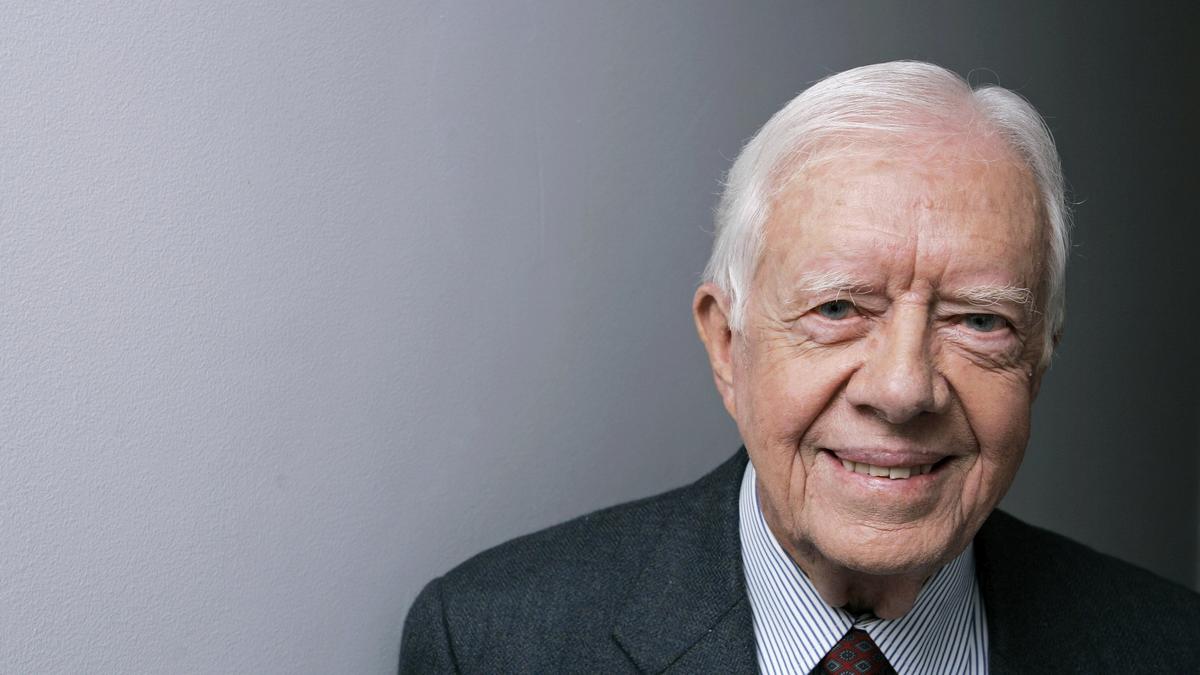
Former President Jimmy Carter poses for a portrait during the Toronto International Film Festival, Sept. 10, 2007, in Toronto.
| Photo Credit: AP
When Jimmy Carter, the 39 President of the U.S., exited the White House in 1981, he was largely written off as an inconsequential leader. The U.S. economy was stagnant. Inflation and unemployment were stubbornly high. In 1979, the Shah of Iran, an American ally, was overthrown by a popular revolution. An Iranian mob seized the U.S. embassy and took 52 Americans hostage. A commando operation aimed at rescuing the hostages turned out to be a disaster in the Iranian deserts. In 1978, communists took over Kabul, allowing the Soviet Union to expand its influence to the borders of Pakistan, America’s South Asian ally. A year later, the Soviets sent troops to Afghanistan. Carter, a Democrat, sought re-election in 1980 with the image of a weak President. And he was easily defeated by Republican Ronald Reagan
China
Mr. Carter, who died on Sunday at age 100, lived long enough to see historians taking a kinder view of his legacy. From his energy policies to his emphasis on human rights, many today laud him as a visionary. He also reinvented the post-presidency life, placing himself at the centre of America’s liberal internationalism, and won the Nobel Peace Prize in 2002. While the debate over his legacy continues, it’s not difficult to see that at least three foreign policy decisions he made continued to define his record in the White House and set a new direction for American foreign policy for decades.
One, Mr. Carter seized the momentum created by Richard Nixon’s diplomatic breakthrough with communist China and took quick steps to complete the normalisation process. One of the sticking points in talks was the status of Taiwan. China wanted the U.S. to recognise the One China policy. The Carter administration agreed to pull back American military presence from Taiwan and the Taiwan Strait, cut diplomatic ties with Taipei and establish full diplomatic relations with Beijing. However, Washington insisted that it would continue to maintain defence and commercial ties with Taiwan, a position China agreed. The normalisation agreement was announced in December 1978 by Carter and China’s leader Deng Xiaoping. The rapprochement Nixon initiated was institutionalised by Carter. It evolved into an anti-Soviet quasi alliance under Reagan, and a post-COld War pro-business partnership under Bill Clinton.

Afghanistan
When the communist People’s Democratic Party of Afghanistan (PDPA) captured power in Kabul in 1978, the Americans remained helpless spectators. But when Soviet leader Leonid Brezhnev decided to send troops to Afghanistan, the U.S. saw it as an opportunity. It was President Carter who launched the policy of supporting the Afghan Mujahideen against the communist government in Kabul and its Soviet backers. His National Security Adviser Zbigniew Brzezinski travelled to Pakistan, met the Afghan refugees and the Mujahideen and promised American support. The American policy was to fund and train the Afghan tribal warlords, with help from Pakistan and Saudi Arabia, in their fight against communism. Reagan would embrace this policy with open hands in later years. Ten years after its military intervention, the Soviets were forced to withdraw from Afghanistan by February 1989. In the same year, Soviet-aligned communist governments in eastern Europe would fall one after another, leading to the eventual collapse of the Soviet Union in 1991. Within months, the PDPA government in Kabul would also fall. The American policy, critics would argue, had played a role in the destruction of Afghanistan and the rise of the Taliban in 1996. But what Washington wanted was to defeat the Soviets in Afghanistan and they achieved it in 1989.
Israel-Palestine
Mr. Carter’s most profound achievement was perhaps the Camp David Accords of 1978. The agreements, signed between Israeli Prime Minister Menachem Begin and Egyptian President Anwar Sadat, was a signature moment in the Arab-Israeli conflict. In October 1973, Egypt and Syria launched a surprise attack against Israel. Israel had captured Egypt’s Sinai Peninsula and Syria’s Golan Heights, along with Palestinian West Bank, Gaza and East Jerusalem, in the 1967 war. With American help Israel managed to push back the Egyptians and the Syrians in 1973, but the attack remained a shock in Israel’s psyche.
Mr. Carter sensed an opportunity for peace between Egypt and Israel and pushed for it. He also said he could not ignore the plight of the Palestinians. Egypt wanted Sinai back and Israel to recognise Palestinian sovereignty. Begin initially resisted the pressure tactics of Egypt and the U.S., but finally gave in. As part of the agreement, Israel agreed to return Sinai back to Egypt and establish a self-rule administration in the occupied Palestinian territories. In return Egypt became the first Arab country to recognise the state of Israel. The Framework for Peace in the Middle East agreement, which promised Palestinian self rule, was the foundation on which the Oslo Accords of the 1990s and the promise of the two-state solution were built.
Even after exiting the White House, Carter remained a strong supporter of the Palestinian cause. “In my opinion it was imperative that the United States work to obtain for these [Palestinian] people the right to vote, the right to assemble, and to debate issues that affected their lives, the right to own property without fear of it’s confiscated, and the right to be free of military rule. To deny these rights was an indefensible position for a free and democratic society.” Carter wrote in his memoir, Keeping Faith.
Published – December 30, 2024 05:29 pm IST