



The Indian Space Research Organisation (ISRO) hopes to end 2024 on a high with an exciting mission on the launch pad to test technologies that will one day be used for interplanetary and human spaceflight. It also hopes to kickstart preparations for human spaceflight missions that have already been delayed for years.
Mission updates
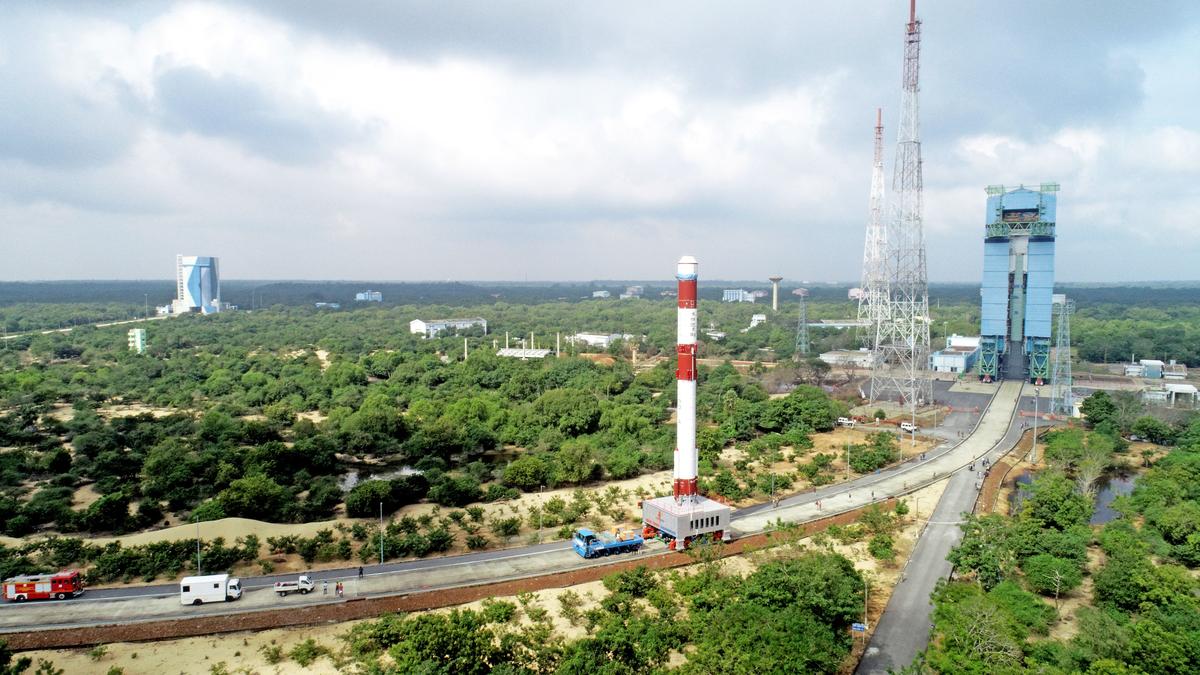
PSLV-C59: The PSLV-C59 mission dedicated to NewSpace India Ltd. (NSIL) placed the European Space Agency’s (ESA) Proba-3 spacecrafts — short for ‘Project for Onboard Autonomy’ — into a highly elliptical orbit of 600 km x 60,500 km as planned 18 minutes after liftoff. The liftoff was from the Satish Dhawan Space Center’s first launch pad at 4:04 pm IST on December 5. This mission demonstrated the ability of ISRO’s Polar Satellite Launch Vehicle (PSLV) to launch a spacecraft into such orbits.
After the lunch, the ESA said the Yatharagga station in Australia began receiving telemetry from the satellite “almost immediately after separation”. The telemetry will be passed on to the ESA’s mission control centre in Belgium.
Gaganyaan: Ahead of its experimental flight of the Launch Vehicle Mark 3 (LVM-3) X in 2014, ISRO had wanted to test the vehicle’s ability to fly through the thickest part of the earth’s atmosphere. The organisation designed a suborbital flight for this with an altitude of 126 km and a range of 1,600 km from Satish Dhawan Space Centre. The vehicle didn’t carry a cryogenic engine in its third stage and didn’t reach earth orbit by design.
The LVM-3 X test flight also tested the reentry characteristics of the crew module using the Crew-module Atmospheric Re-entry Experiment (CARE). On December 18, 2014, the CARE module re-entered the earth’s atmosphere after separating from the rocket and performed a controlled landing in the Bay of Bengal using its thrusters and parachutes. This successful mission was an important precursor to India’s human spaceflight mission.
Ten years later on the same day, December 18, 2024, ISRO began assembling the human-rated LVM-3 (HLVM-3) for its first uncrewed mission. This was done by stacking the nozzle end segment of the S-200 solid rocket motor with the full flex seal nozzle at 8.45 am on December 18. This marked the official launch campaign for the HLVM-3 G1/OM-1 mission. ‘G1’ stands for the first Gaganyaan mission and ‘OM-1’ for the first orbital module mission. The orbital module consists of the crew module and a service module.
PSLV-C60 SpaDeX
Just like the CARE mission preceded the human spaceflight mission, the SpaDeX — short for ‘Space Docking Experiment’ — is a predecessor to ISRO’s Bharatiya Antariksh Station (BAS) and the Chandrayaan-4 missions. SpaDeX will demonstrate in-orbit docking.
The year 2024 began with a PSLV flight and looks like it will end with one as well. The PSLV-C60 flight is currently scheduled for 9.58 pm on December 30, 2024. The rocket will carry two satellites called SDX01, dubbed ‘Chaser’, and SDX02, dubbed ‘Target’. Each weighs 220 kg. After launch and orbit insertion, the two satellites will rendezvous in low-earth orbit, dock, and then undock.
In addition, the fourth stage of the PSLV-C60 rocket will carry 20-plus payloads of its own, designed by various ISRO centers, academic institutions, and Indian private companies. After inserting the satellites in orbit, the fourth stage will enter a orbit of its own, where its payloads will perform various tests.
The PSLV-C60 mission will fly the rocket in its core alone configuration (called CA): i.e. its first stage will fly without its strap-on boosters.
The ‘Chaser’ and ‘Target’ satellites will be placed in a 470-km-wide circular orbit with an inclination of 55°. The duo will also have different velocities such that the gap between them increases to 10-20 km after a day.
The propulsion system on-board the ‘Target’ satellite will be used to slow it down to the same speed as the ‘Chaser’ over time. They will eventually maintain a distance of 20 km in the same orbit heading up to the SpaDeX mission’s first milestone, called far rendezvous. Then they will move closer such that the gap drops to 5 km, 1.5 km, 500 m, 225 m, 15 m, and finally 3 m. Then ‘Chaser’ and ‘Target’ will dock.
After a rigid mechanical connection is realised between the two satellites, electrical power transfer between ‘Target’ and ‘Chaser’ will be demonstrated before they undock and drift apart.
They will then operate their on-board payloads with a mission life of two years. The ‘Chaser’ has a high resolution camera. The ‘Target’ has a miniature multispectral payload and a radiation monitor. Earlier, an Indian private space company named Ananth Technologies became the first of its kind to integrate and test the two satellites.
POEM’s two dozen payloads
PSLV-C60’s fourth stage, called the PSLV Orbital Experimental Module (POEM-4), carries 24 payloads: 14 contributed by various ISRO centers and 10 by academia and private industry. POEM-4 will begin operations after satellite separation.
Of these, the Relocatable Robotic Manipulator-Technology Demonstrator, a.k.a. the ‘Walking Robotic Arm’, developed by ISRO Inertial Systems Unit (IISU), is expected to demonstrate a robotic arm that can move to defined targets on the POEM using an inch-worm walking technique.
The Vikram Sarabhai Space Center (VSSC) developed the Debris Capture Robotic Manipulator. In a proof of concept, it will attempt to capture tethered space debris with a robotic manipulator. The VSSC also built the Compact Research module for Orbital Plant Studies to study the germination and growth of eight cowpea seeds in a five- to seven-day experiment in a controlled environment.
The other experiments from ISRO centres include — to quote from a press release — the Gradient Control Reaction Wheel Assembly (IISU), the Multi-Sensor Inertial Reference System with in-house gyroscopes (IISU), the MEMS-based High Angular Rate Sensor (VSSC), the Lead Exempt Experimental System (VSSC), the Highly Configurable Onboard Common Controller (Space Physics Laboratory), and the PILOT-G2 payload (Indian Institute of Space Science and Technology) “that hopes to qualify in-house equipments for small satellites”.
One experiment of note is the Amity Plant Experimental Module in Space (APEMS) payload developed by Amity University, Mumbai. It will compare growth-related changes in plant callus cells using spinach plants (Spinacia oleracea) in microgravity and earth gravity. For this, two parallel experiments will be carried out — one on POEM 4 and the other at Amity University.
Another biological payload of note is the RVSat-1 developed by R.V. College of Engineering, Bengaluru. It will measure the growth of the gut bacterium Bacteroides thetaiotaomicron in space. The experiment is expected to provide data to understand human physiology in space and astronaut health during crewed missions.
There are two notable communications payloads called BGS Amateur Radio Payload for Information Transmission (ARPIT) and Swetchasat. BGS ARPIT was developed by the S.J.C. Institute of Technology, Karnataka, and the Upagraha Amateur Radio Club at the U.R. Rao Satellite Centre. It can transmit audio, text, and images from a satellite to the ground with frequency modulation in the VHF band. It is designed to provide amateur radio satellite services worldwide.
The Swetchasat payload, developed by Nspace Tech, a private entity in Andhra Pradesh, plans to demonstrate an onboard UHF transmitter’s capability to store data and establish a communication link, and transmit data and telemetry with the ISRO Telemetry and Tracking Command ground station.
There are two propulsion payloads developed by private industry. RUDRA 1.0 HPGP, developed by Bellatrix Aerospace, will test a green propulsion system with a thrust of 1 newton and a specific impulse of 220 seconds. Likewise, the VYOM 2U developed by Manastu Space will test a monopropellant the company has said is a safer and better performing alternative to hydrazine, which is the most widely used propellant in the Indian space programme at present. VYOM has a thrust of 1.1 N and a specific impulse greater than 250 seconds.
Two payloads will also be hoping to demonstrate synthetic aperture radar (SAR) capabilities. SAR creates high-resolution images of objects on the ground by moving a radio-emitting antenna over the objects of interest. The SAR Imaging Demonstration Payload (GLX-SQ) from GalaxEye Space will test the generation, capture, and processing of SAR images in a space environment. The Varuna payload, from Piersight Space, will demonstrate SAR in a cubesat form factor and test the performance of seven advanced subsystems — including a deployable reflectarray antenna — that can help monitor all human and industrial activities at sea.
Finally, the MEMS-based Inertial Measurement Unit (STeRG-P1.0) was developed at the MIT World Peace University, Pune, and the MOI-TD by the private company TakeMe2Space. STeRG-P1.0 will perform attitude determination and higher efficiency data processing. The MOI-TD payload is a technology demonstrator planning to perform real-time data processing for earth observation. It will attempt to receive three machine learning models through an uplink from ground to orbit, conduct in-orbit computation, and downlink the models’ inferences.
Onward to 2025
The year 2025 will be a pivotal year in Indian spaceflight with the launch of the first uncrewed HLVM-3 missions to orbit.
Indians will potentially get to see the sight of the first Indian in space since Rakesh Sharma in 1984 when Shubanshu Shukla flies — schedule permitting — to the International Space Station on board a Falcon 9 rocket as part of the Axiom 4 mission in 2025.
We will also have the launch of the innovative NASA-ISRO SAR mission.
In all, 2025 promises to be an action-packed and, by all means, a defining year for space for India.
Pradeep Mohandas is a technical writer and space enthusiast in Pune.
Published – December 30, 2024 05:30 am IST