




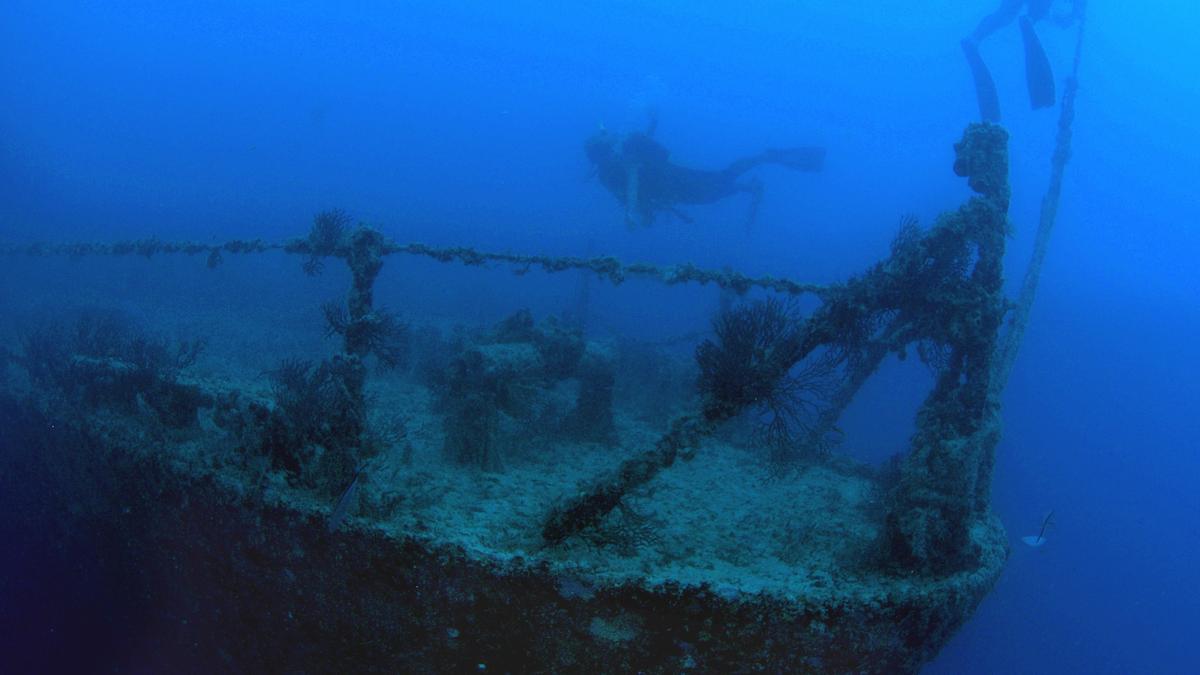
At the bottom of the oceans and seas lie more than 8,500 shipwrecks from two world wars. These wrecks have been estimated to contain as much as 6 billion gallons of oil, as well as munitions, toxic heavy metals and even chemical weapons.
For decades, these wrecks have largely lain out of sight and out of mind. But all this time, their structures have been degrading, inexorably increasing the chances of sudden releases of toxic substances into the marine environment.
In parts of the globe, climate change is exacerbating this risk. Rising ocean temperatures, acidification and increasing storminess accelerate the breakdown of these wrecks.
Of course, wrecks from the world wars are far from the only ones to be found at the bottom of the sea, with many others adding to the problem. The cost of addressing this global issue has been estimated at US$340 billion (£261 billion).
How many of these wrecks pose a threat to people’s safety, to coastal communities and to the environment? What can be done – and why haven’t we done it sooner?
Mapping the problem
The raw figures in dollars and the numbers of wrecks on the map rightly cause concern. Work by researchers such as Paul Heersink have drawn together different datasets to help visualise the scale of the challenge. Yet these figures, and the position of dots on maps, may also give a false sense of certainty.
It remains the case that the world’s oceans and seas are not as well mapped as we would like, with about 23% having been described and mapped in detail. Even that level of detail often falls short of what we need to positively identify a wreck, let alone determine the risk it might pose.
There is an ongoing global push to improve our mapping of ocean space under the auspices of the Seabed 2030 project, which is looking to reach a universal resolution of 100x100m. That means one “pixel” of information would be equivalent to about two football pitches. This will be transformative for our understanding of the ocean floor, but will not reveal the detail of all those things that you could hide within those two football pitches (which includes quite a few wrecks).
Many of the wrecks that may pose the greatest problems are found in shallower coastal waters, where government mapping initiatives and work by industry provide much higher resolutions, yet still the challenge of identification remains.
What about archival records? Historical records, such as those held by Lloyd’s Register Foundation in London, are fundamental to bringing greater certainty to the scale and nature of the challenge. They contain the details of ship structures, cargos carried and last known positions prior to loss.
The accuracy of those positions, however, is variable, meaning that knowing exactly where on the seabed a wreck might be, and so how to survey it and assess its risk, is not straightforward. This is placed in stark relief by the work of British maritime archaeologist Innes McCartney and oceanographer Mike Roberts, whose detailed geophysical and archival investigations in the Irish Sea demonstrated that historic wrecks have been frequently misattributed and mislocated. This means that the dots on the map are often in the wrong places, and up to 60% can be sitting in unknown locations on the sea floor.
A race against time
Most of the wrecks causing greatest concern are of metal, or metal and wood construction. The steel in these wrecks is slowly degrading, increasing the chance of cargos being spilt, and components breaking down. However, this is only part of the risk.
The sea is becoming an ever busier place, as we carry out more intensive fishing and ramp up the construction of offshore wind farms and other energy installations to meet net zero commitments. These all affect the seabed and can physically disturb or change the dynamics of wreck sites.
There is increasing global recognition of the need to address this problem. It has remained unresolved to date because of the complex international and interdisciplinary challenge it poses.
Many of the wrecks lie in waters off countries that have nothing to do with the original owner of the ship. How then, do we determine who is responsible? And who pays for the clean-up – especially when the original owner benefits from the legal loophole of sovereign immunity? Under this concept, the flag State (the country where the ship is registered) cannot be held responsible under international law and therefore is not legally obliged to pay up.
Beyond these fundamental questions of responsibility, there are technical challenges. It’s difficult to know exactly how many wrecks of concern there are, and how to locate them. So how do we assess their condition and determine if intervention is needed? And if so, how do we intervene?
Each of these questions is a complex challenge, and solving them requires the contributions of historians, archaeologists, engineers, biologists, geophysicists, geochemists, hydrographic surveyors, geospatial data analysts and engineers.

This has already been happening, with regional projects making critical headway and demonstrating what can be achieved. However, the immense scale of the problem outweighs the amount of work done to date.
New technologies are clearly critical, as are new attitudes. At the heart of the problem is an issue of knowledge and certainty – is this the wreck we think it is, does it pose a problem and if so, over what time scale?
Advances in subsea drones known as Autonomous Underwater Vehicles (AUVs), which are fitted with an array of sensors to measure the seabed and detect pollutants, could help enhance our knowledge about the locations of wrecks, what they’re carrying and their state of deterioration. AUVs can provide relatively cheap, high resolution data that produces fewer emissions than a comparable survey campaign conducted from a large research vessel.
But we also need to share that information, and compare it with data from archives to help generate knowledge and higher levels of certainty. Too often, underwater surveys and investigations occur in silos, with data held by individual agencies or companies, preventing a rapid and cumulative increase in understanding.
The severity of the environmental and safety risk posed by wrecks on the ocean floor, and how it changes over time, is not fully known. But this is a problem we can solve.
Action is needed now, driven by a robust regulatory and funding framework, and technical standards for remediation. A global partnership – codenamed Project Tangaroa – has been convened to stimulate that framework – but political will and financing is required to make it a reality.
Through targeted archival and survey work, and by sharing data and ideas, we can chart a course to a future where the sea is not a place where we ignore things today that will threaten us tomorrow.
This article is republished from The Conversation under a Creative Commons license. Read the original article here.
Published – December 18, 2024 04:34 pm IST