



Skip to content
  • Facebook
  • X
  • Linkedin
  • WhatsApp
  • Associate Journalism
  • About Us
  • Privacy Policy
  • 033-46046046
  • editor@artifex.news
Artifex.News

Artifex.News

Stay Connected. Stay Informed.

  • Breaking News
  • World
  • Nation
  • Sports
  • Business
  • Science
  • Entertainment
  • Lifestyle
  • Toggle search form
  • Yogi Adityanath Says Faces In Congress Have Changed But Its Character, Gestures Remain Same Nation
  • Three BJP Allies Question UP Order To Eateries For Kanwar Yatra, Demand Rollback Nation
  • What inflamed the far-right riots in Britain? | Explained World
  • Weather Body Forecasts Milder Winter, Fewer Coldwave Days Ahead Nation
  • 31-Year-Old Woman Dies After Being Chased By A Bear In Slovakia World
  • PCB Contemplates Appointing Waqar Younis As Director Of Cricket Sports
  • Yashasvi Jaiswal Does A First In 92 Years For Indian Cricket, Surpasses Virender Sehwag For Another Major Feat Sports
  • Top Court On CBI Saying Why No Bail For Arvind Kejriwal Nation

What is a dark comet? A quick guide to the ‘new’ kids in the Solar System

Posted on December 18, 2024 By admin


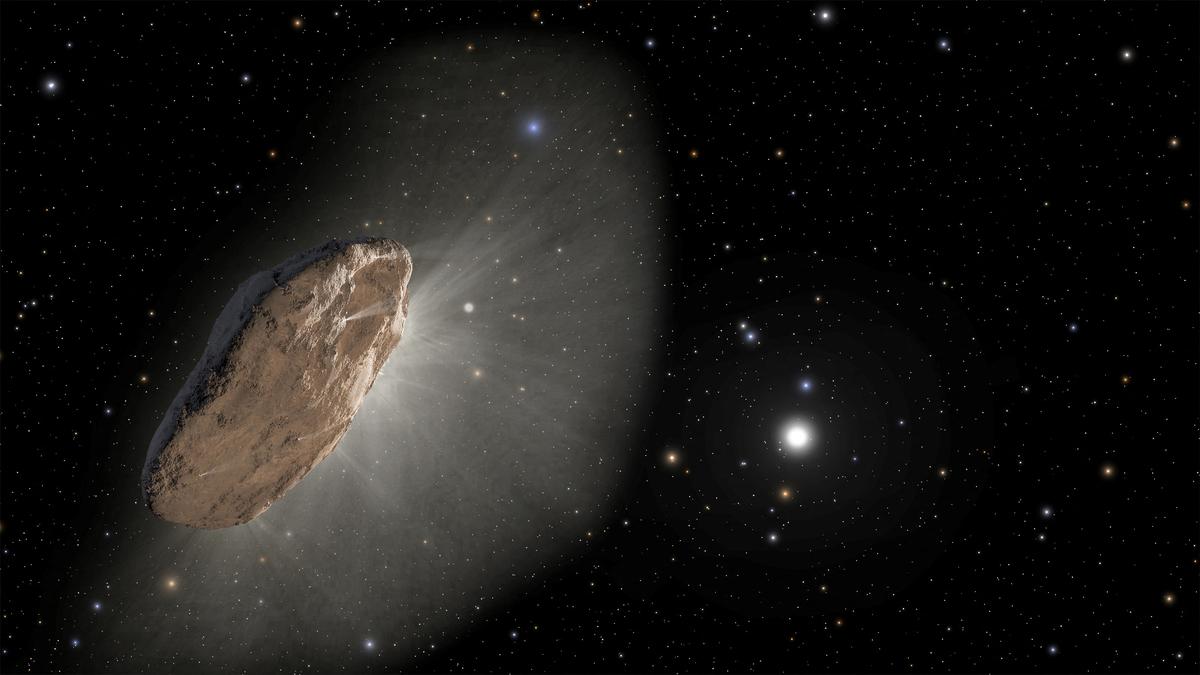
This artist’s illustration shows the wayward interstellar visitor ‘Oumuamua (pronounced oh-MOO-ah-MOO-ah) racing toward the outskirts of our solar system. The object, heated by the Sun (lower right),
is venting gaseous material from its surface, as a comet would.
| Photo Credit: Reuters

In 2017, NASA discovered and later confirmed the first interstellar object to enter our Solar System.

It wasn’t aliens. But artist impressions of the object (called ‘Oumuamua, the Hawaiian word for “scout”) do resemble an alien spaceship out of a sci-fi novel. This strange depiction is because astronomers don’t quite know how to classify the interstellar visitor.

Its speed and path around the Sun don’t match a typical asteroid, but it also has no bright tail or nucleus (icy core) we normally associate with comets. However, ‘Oumuamua has erratic motions that are consistent with gas escaping from its surface. This “dark comet” has had astronomers scratching their heads ever since.

Flash forward to today, and more of these mysterious objects have been discovered, with another ten announced just last week. While their nature and origins remain elusive, astronomers recently confirmed dark comets fall into two main categories: smaller objects that reside in our inner Solar System, and larger objects (100 metres or more) that remain beyond the orbit of Jupiter.

In fact, 3200 Phaethon – the parent body of the famous Geminid meteor shower – may be one of these objects.

How do dark comets differ from normal comets?

Comets, often described as the Solar System’s “dirty snowballs”, are icy bodies made of rock, dust and ices. These relics of the early Solar System are critical to unlocking key mysteries around our planet’s formation, the origins of Earth’s water, and even the ingredients for life.

Astronomers are able to study comets as they make their close approach to our Sun. Their brilliant tails form as sunlight vaporises their icy surfaces. But not all comets put on such a dazzling display.

The newly discovered dark comets challenge our typical understanding of these celestial wanderers.

Dark comets are more elusive than their bright siblings. They lack the glowing tails and instead resemble asteroids, appearing as a faint point of light against the vast darkness of space.

However, their orbits set them apart. Like bright comets, dark comets follow elongated, elliptical paths that bring them close to the Sun before sweeping back out to the farthest reaches of the Solar System.

They go beyond Pluto, some even making it out to the Oort Cloud, a vast bubble of tiny objects at the fringe of our Solar System. Their speed and paths are what allow astronomers to determine their origins.

But what makes these comets so dark? There are three main reasons: size, spin and composition or age.

Dark comets are often small, just a few metres to a few hundred metres wide. This leaves less surface area for material to escape and form into the beautiful tails we see on typical comets. They often spin quite rapidly and disperse escaping gas and dust in all directions, making them less visible.

Lastly, their composition and age may result in weaker or no gas loss, as the materials that go into the tails of bright comets are depleted over time.

These hidden travellers may be just as important for astronomical studies, and they may even be related to their bright counterparts. Now, the challenge is to find more dark comets.

How can we find dark comets?

How do we even find these mysterious dark comets in the first place? As they get closer to the Sun, we don’t see spectacular tails of debris.

Instead, we rely on the light they reflect from our Sun.

These little guys might be stealthy for our eyes, but they are often no match for our large telescopes around the world. The discovery of ten new dark comets revealed last week was all thanks to one amazing instrument, the Dark Energy Camera (DECam) on a large telescope in Chile.

This camera can’t “see” dark energy directly, but it was designed to take massive photos of our universe – for us to see distant stars, galaxies and even hidden Solar System objects.

In their recent study, astronomers pieced together that some of these nightly images contained likely dark comets.

The good news is, we are starting to focus more attention on these objects and on how to find them.

In even better news, in 2025, we’ll have a brand new mega camera in Chile ready to find them. This will be the Vera C. Rubin Observatory, with the largest digital camera ever built.

It will allow us to take more images of our night sky more quickly, and see objects that are even fainter. It’s likely that in the next ten years we could double or even triple the amount of known dark comets, and start to understand their interesting origin stories.

There could be more ‘Oumuamua-like objects out there, just waiting for us to find them.

This article is republished from The Conversation under a Creative Commons license. Read the original article here.

Published – December 18, 2024 03:45 pm IST


Source link

Science Tags:astronomy news, Dark comet, Oumuamua comet, science news, what is a dark comet

Post navigation

Previous Post: Primates often gave birth to twins 60M years ago: new research
Next Post: Why NASA Delayed Sunita Williams’ Return From Space

Related Posts

  • Synthetic human embryos let scientists sidestep ethical hurdles Science
  • How was popcorn discovered? An archaeologist explains Science
  • Proba-3 mission would significantly advance understanding of Sun’s Corona: Ex-ISRO scientist Science
  • New mRNA vaccine fights brain cancer in children by triggering attack from within Science
  • Sci-Five | The Hindu Science Quiz: On Electroreception Science
  • After a health emergency, air pollution foretells an economic one Science

More Related Articles

Ritual to Reality: Unmasking the evolution of hand hygiene post-covid-19 Science
What is the butterfly effect? Science
Sci-Five | The Hindu Science Quiz: On Gharials Science
Sustainability science for FMCGs – The Hindu Science
The Science Quiz | On Attosecond physics Science
35% doctors in India feel unsafe while at work, study shows Science
SiteLock

Archives

  • December 2024
  • November 2024
  • October 2024
  • September 2024
  • August 2024
  • July 2024
  • June 2024
  • May 2024
  • April 2024
  • March 2024
  • February 2024
  • January 2024
  • December 2023
  • November 2023
  • October 2023
  • September 2023
  • August 2023
  • July 2023
  • June 2023
  • May 2023
  • April 2023
  • March 2023
  • February 2023
  • January 2023
  • December 2022
  • November 2022
  • October 2022
  • September 2022
  • August 2022
  • July 2022
  • June 2022
  • May 2022

Categories

  • Business
  • Nation
  • Science
  • Sports
  • World

Recent Posts

  • No Organisation Called Kuki-Zo Council Exists, No District Called Lamka, Says Manipur Government
  • Pak Developing Missiles That Eventually Could Hit US: White House Official
  • Camera Found in Changing Room Of Bhopal MRI Centre, Footage Seized
  • Reality check on Sri Lanka’s Tamil question
  • Notebook: The social character of scientific knowledge

Recent Comments

  1. dfb{{98991*97996}}xca on UP Teacher Who Asked Students To Slap Muslim Classmate
  2. "dfbzzzzzzzzbbbccccdddeeexca".replace("z","o") on UP Teacher Who Asked Students To Slap Muslim Classmate
  3. 1}}"}}'}}1%>"%>'%> on UP Teacher Who Asked Students To Slap Muslim Classmate
  4. bfg6520<s1﹥s2ʺs3ʹhjl6520 on UP Teacher Who Asked Students To Slap Muslim Classmate
  5. pHqghUme9356321 on UP Teacher Who Asked Students To Slap Muslim Classmate
  • On unemployment in Indian States Business
  • PM Narendra Modi Visits Ruins Of Ancient Nalanda University In Bihar’s Rajgir Nation
  • “Can’t Predict Anything”: India Men’s Hockey Coach Craig Fulton On Paris Olympics 2024 Chances Sports
  • Hearing tests show that minke whales can hear high-frequency sounds Science
  • N Sitharaman’s Balraj Sahni Example To Slam Congress In Constitution Debate Nation
  • Once Again, A Trump-Sized Fear For COP World
  • Russia says captured district of key Ukraine town of Chasiv Yar World
  • What Led To Killer UP Stampede Nation

Editor-in-Chief:
Mohammad Ariff,
MSW, MAJMC, BSW, DTL, CTS, CNM, CCR, CAL, RSL, ASOC.
editor@artifex.news

Associate Editors:
1. Zenellis R. Tuba,
zenelis@artifex.news
2. Haris Daniyel
daniyel@artifex.news

Photograher:
Rohan Das
rohan@artifex.news

Artifex.News offers Online Paid Internships to college students from India and Abroad. Interns will get a PRESS CARD and other online offers.
Send your CV (Subjectline: Paid Internship) to internship@artifex.news

Links:
Associate Journalism
About Us
Privacy Policy

News Links:
Breaking News
World
Nation
Sports
Business
Entertainment
Lifestyle

Registered Office:
72/A, Elliot Road, Kolkata - 700016
Tel: 033-22277777, 033-22172217
Email: office@artifex.news

Editorial Office / News Desk:
No. 13, Mezzanine Floor, Esplanade Metro Rail Station,
12 J. L. Nehru Road, Kolkata - 700069.
(Entry from Gate No. 5)
Tel: 033-46011099, 033-46046046
Email: editor@artifex.news

Copyright © 2023 Artifex.News Newsportal designed by Artifex Infotech.