





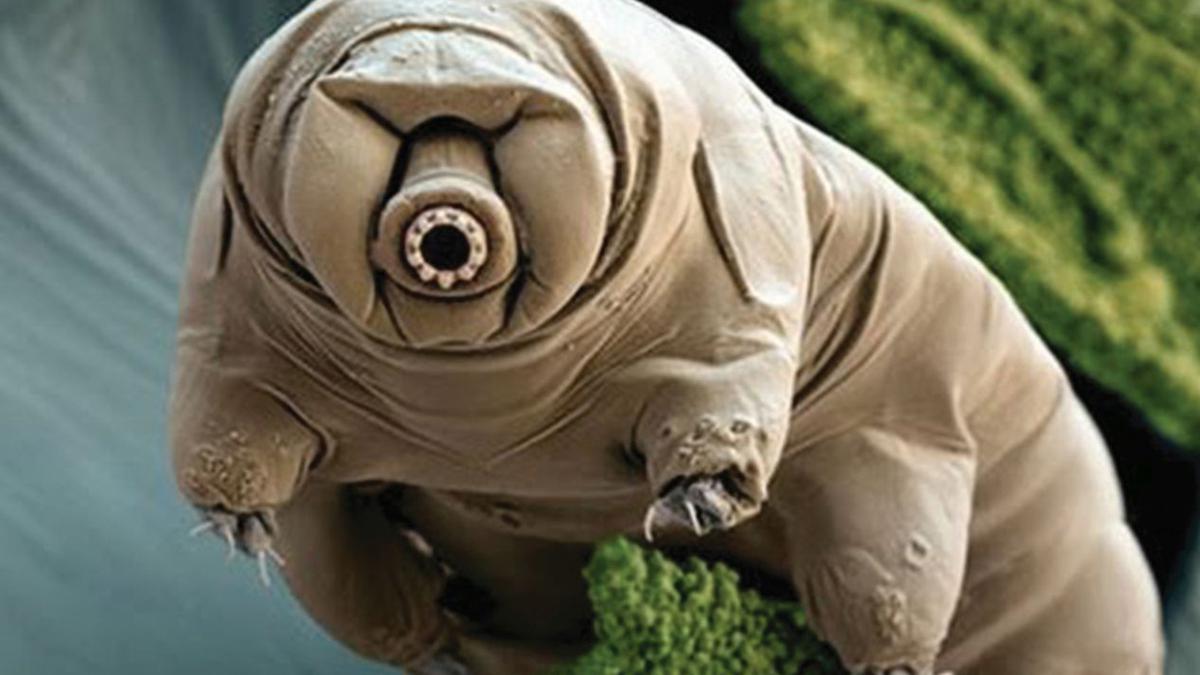
Tardigrades are one of the most resilient as well as enigmatic life forms on the earth. These organisms, also called water bears and moss piglets, are microscopic eight-legged creatures without a backbone.
They inspire awe with their remarkable ability to survive in extreme environments, including areas so very radioactive that they are easily lethal to humans. They can also survive starvation, lack of air and water, and subzero temperatures.
An ancient survivor
Belonging to a phylum of their own (Tardigrada), these remarkable creatures inhabit some of the more extreme ecosystems on the planet, from the frigid expanses of the Arctic and deep-sea floors to scorching deserts and even the vacuum of space. Researchers have identified more than 1,300 tardigrade species to date; each species is uniquely adapted to conditions that would be deadly to most other forms of life.
Evolutionarily, the tardigrades are an ancient species. The earliest known fossils date from around 90 million years ago, in the Cretaceous Period. Molecular dating suggests they originated at least 600 million years ago.
When facing hostile environments, tardigrades can enter a state called cryptobiosis, effectively pausing almost all their biological processes and lingering in a state of suspended animation. This peculiar state allows them to tolerate extreme dryness, intense radiation, and freezing. Tardigrades’ ability to survive radiation is due to specialised mechanisms that can shield their genetic material from damage. In fact, they don’t just survive otherwise hazardous radiation: they are able to recover and resume normal life.
Lessons of the tardigrade
Their features have rendered tardigrades a subject of intense scientific study. Researchers hope unlocking the secrets of their specialised survival mechanisms will pave the way to advances in human medicine, space exploration, and others.
Research has indicated the presence of many mechanisms that help tardigrades, and insights into them are expected to hold great biomedical and industrial value. For example, researchers have of late been discussing the role of a specific class of proteins: these proteins have flexible bodies and don’t have an intrinsic structure. Thus they have been named intrinsically disordered proteins.
One subgroup of these is secretory-abundant heat-soluble proteins. Researchers recently attempted to synthesise these proteins in other microbes by cloning the underlying genes and transferring them to the latter. Their work suggested such a method is capable of enhancing the tolerance of the microbes against desiccation (completely drying up). This work was published in Nature Communications Biology in May.
Another paper published last year in the same journal explored molecules called small heat shock proteins and, in a similar approach, demonstrated that they could enhance microbes’ ability to survive hot conditions as well as prevent proteins from clumping up when they dry out.

Survival begins in the cell
More recently, researchers from China reported a new tardigrade species, Hypsibius henanensis. Their findings, reported on October 25 in Science, included a chromosome-level genome assembly that revealed many details about the genes that give tardigrades the ability to withstand radiation. They exposed tardigrades to gamma rays at doses around 1,000-times greater than the lethal limit for humans, and tracked which genes were expressed using genomic tools.
The researchers found thousands of genes upregulated when the tardigrades were exposed to extreme radiation. Further analysis suggested that the radiation resistance is likely modulated by genes that can be acquired by horizontal transfer, i.e. from other species in their environment. The researchers also discovered some tardigrade-specific genes, as well as genes similar, yet not identical, to ones in other organisms.
In fact, horizontal gene transfer contributed more than 0.5% of the tardigrades’ genes, which is a significant fraction that signals its significance to the tardigrades’ survival and evolution. The DODA1 gene is of particular note: tardigrades need it to synthesise betalains, a type of antioxidant pigments that could be protecting the tardigrades’ cells against radiation damage. The creatures probably acquired it from a bacterial species.
A second class of genes involved in radiation resistance are unique to the tardigrades themselves. One of them is TRID1, which plays a role in repairing damaged DNA mediated by phase separation. Another is NDUFB8, associated with mitochondrial function. The researchers identified them to be crucial to the species’ ability to survive extreme conditions by (likely) helping maintain the stability of cells and sustaining energy production even under high radiation stress. Effectively, the tardigrades’ survival advantages begin at the cellular level.
Applications on the horizon
Tardigrade biology may seem exotic at this time and the research exploring it may seem esoteric. But a lot of biology makes sense in the light of evolution (to adapt the words of Theodosius Dobzhansky), and unlocking the mysteries of the tardigrade may quickly translate to breakthroughs in real-world challenges with far-reaching implications. Recall that scientists developed CRISPR-Cas9 based on a unique mechanism in a bacteria to repair its DNA.

Consider protein stability in tardigrades. We are using biological therapies such as protein vaccines, antibodies, and enzymes to treat a variety of diseases more often. If we can find a way to stabilise the proteins involved in these technologies, we can increase their biological efficacy as well.
As the field of cell therapies continues to grow, researchers are looking for technologies to protect these therapeutic products in harsh conditions they may encounter during storage, transport, and administration. Tardigrades possess unique adaptations to resist or even sidestep cellular damage, and researchers can learn from them to find ways to stabilise cells in research and biomedicine.
Taken together, tardigrades provide a unique blueprint for developing robust biological systems and materials. Their exceptional survival mechanisms could inspire new strategies in medicine, biotechnology, and beyond, leaving critical therapies and technologies more resilient, effective, and crucially, widely accessible.
Sridhar Sivasubbu and Vinod Scaria work at Karkinos Healthcare Pvt. Ltd. and are adjunct professors at IIT Kanpur and the D.Y. Patil Medical College, Pune.
Published – November 06, 2024 05:30 am IST