



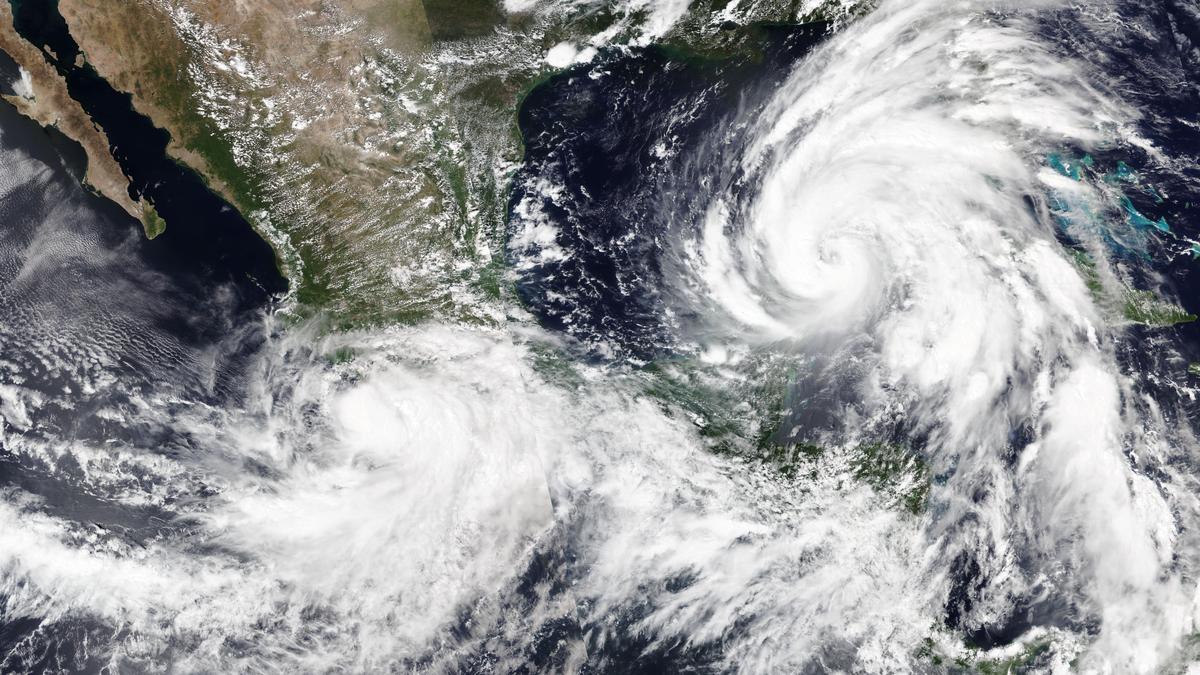
Tropical Storm John along Mexico’s Pacific coast and Hurricane Helene over the Gulf of Mexico on September 25.
| Photo Credit: NASA
Meteorologists had previously forecast a historic hurricane season for 2024 based on the expectation that a strong La Niña would emerge this winter. But while the hurricanes Helene and Milton may seem consistent with this forecast, 2024 has evolved to be a year with a summer with no major hurricanes.
One important reason is that the strong La Niña has played truant thus far. In fact weather agencies are currently downgrading their La Niña forecasts.

The 2023 hurricane season was history’s fourth-most active despite the strong El Niño that year. Meteorologists expect a subdued hurricane season during an El Niño and an earnest one during a La Niña. Now, are they to assume that the record warming during 2023-2024 has flipped the hurricane season on us or that the link between hurricanes and El Niño/La Niña has flipped? They’ll need to wait and watch.
Forecasting seasonal cyclone activity is a challenging task but hurricane forecasts have overall become more accurate, especially in terms of narrowing the cone of uncertainty of the storms’ landfall. Some major challenges remain vis-à-vis forecasting the intensities, however.
The more worrisome fact is that the forecasting community has acquired hardly any skill in terms of the aftermath of a hurricane, i.e. after it makes landfall. Post-landfall rain and winds wreak considerable damage to property and lead to loss of lives.
The challenge of forecasting cyclones
A shortcoming in any forecast automatically raises the stakes for how well people and governments can plan for hurricanes and, in India’s part of the world, cyclones. The climate models used to develop projections don’t explicitly resolve cyclones. Any projections for the future are based on other resolved metrics that indirectly indicate cyclonic activity and its potential intensity.
Historical analyses of global cyclones suggest there hasn’t been a detectable increase in the total number of cyclones. However, the number of strong cyclones has increased. Cyclones draw the energy they need from the upper ocean, and the upper oceans are warming in all cyclone-producing regions of the planet. This has led to many instances of rapid intensification: when the maximum cyclone wind speed increases by 55 km/hr or more within a 24-hour period. Rapid intensification has proven hard to predict.
The North Indian Ocean is also reported to be experiencing an increasing number of cyclones, especially in the Arabian Sea. The fact that the last few years have been unusually quiet only underscores the challenge of predicting seasonal cyclone numbers, cyclones as individual events, how they react to global warming, and of course their post-landfall effects.

Good, bad, and ugly
India has made impressive progress in forecasting cyclones together with a disaster management plan that has been equally effective at reducing the loss of lives. More good news for the North Indian Ocean is that the typical stretch of ocean where cyclones intensify is relatively small, over both the Arabian Sea and the Bay of Bengal, thus limiting the size and strength of the cyclones. Most cyclones over the Arabian Sea also tend to be steered northwestward, away from India.
The bad news is that the Indian subcontinent and other countries along the rim of the Indian Ocean are highly vulnerable not only to the chronic stressors of climate change but also to the acute stressors. The chronic stressors refer to the warming, rising sea levels, and the increasing incidence of rainfall extremes and dry spells, all of which happen in the background. The acute stressors ride on top of the chronic stressors and exacerbate their effects. These include heavy rainfall events, flash droughts, and cyclones. For example, inundation from a cyclone will get worse as sea levels rise. Or a heatwave that co-occurs with a drought will make water scarce, wilt crops, and disrupt power supply (because power plants need water, too).
A few days ago, parts of Tamil Nadu suffered heavy rain and flooding. This has become an annual event because warming in the Indian Ocean, especially the Bay of Bengal, has been extending the southwest monsoon into the northeast monsoon and delivering both excess and extreme rainfall. Forecasting woes are also in full display: a low-pressure system predicted to cause flooding in Chennai veered north and completely missed the city.
Now, imagine a city has to evacuate thousands of people when a cyclone is predicted. Forecasts will continue to get better but our expectations will also continue to rise.
From nation to region
Our region needs critical advances in the quality of the predictions of rapid intensification and landfall and of the cyclones post-landfall. Additional efforts are also required to project the cyclone risk in the coming years at hyperlocal scales.
India remains an economically developing country, and any increments in its ability to manage its financial and human resources will be critical for the foreseeable future. This is essential context for why hyperlocal risk maps can make a big difference: it will be too expensive for us to cover all regions for cyclone risk. India has also started to bring mitigation and adaptation actions into its mainstream fiscal policies and budgetary processes by investing in renewable energy, electric vehicles, weather and climate forecasting, early warning systems, and disaster management.

The ugly news is that India’s dreams of sustained economic development can never materialise unless the entire subcontinent is resilient.
India’s (and the Indian subcontinent’s) vulnerabilities to chronic and acute climate stressors aren’t only India’s socio-economic vulnerabilities: they are also India’s national security issues. The country’s strategies for building cooperation, trade, and stability in the region have to now include the constituent countries’ climate risks as well.
This can start by establishing subcontinent-wide weather and climate networks and improving forecasts and projections for all parts of India’s wider neighbourhood.
Raghu Murtugudde is professor, IIT Bombay, and emeritus professor, University of Maryland.
Published – October 18, 2024 07:30 am IST