




New Delhi:
Iran on Tuesday fired 200 missiles, including hypersonic weapons, at Israel as tensions in the Middle East reach breaking point. Israel has vowed that Iran will “pay” for the attack. But relations between the two countries were not always sour. Unthinkable as it may sound, Israel and Iran had collaborated, with help from the United States, to fight a common enemy.
In the 1960s, both Israel and Iran found a mutual adversary in Iraq. While Israel was locked in a broader struggle against hostile Arab regimes, Iran, under the Shah, viewed Iraq’s leadership as a direct threat to its security and regional ambitions. This laid the groundwork for one of the most secretive partnerships of the era, involving the Mossad – Israel’s intelligence agency – and SAVAK – Iran’s secret police – both of which played key roles in bolstering Kurdish insurgents against the central Iraqi regime. These Kurdish groups, seen as the Achilles’ heel of Iraq’s Arab nationalist leadership, were crucial to undermining the Iraqi government from within.
The cooperation between Israel and Iran reached new heights with the formation of a trilateral intelligence alliance code-named Trident, which also included Turkey. Beginning in 1958, Trident saw these three non-Arab powers exchange critical intelligence and engage in joint counterintelligence operations. As the relationship matured, Israel and Iran became even closer, forming deep military and intelligence ties that extended well into the Shah’s reign.
The Shah’s Ambitions And Israel’s Influence
The Shah of Iran, Mohammad Reza Pahlavi, was driven not only by shared geopolitical interests but by a belief in Israel’s influence in Washington. The Shah saw Israel as a potential means for enhancing relations with the United States, especially after the Kennedy administration voiced concerns about his authoritarian rule.
The burgeoning Israeli-Iranian relationship became a key feature of Iran’s strategy to align itself with the West, resulting in the establishment of a permanent Israeli delegation in Tehran by the mid-1960s, which functioned as a de facto embassy.
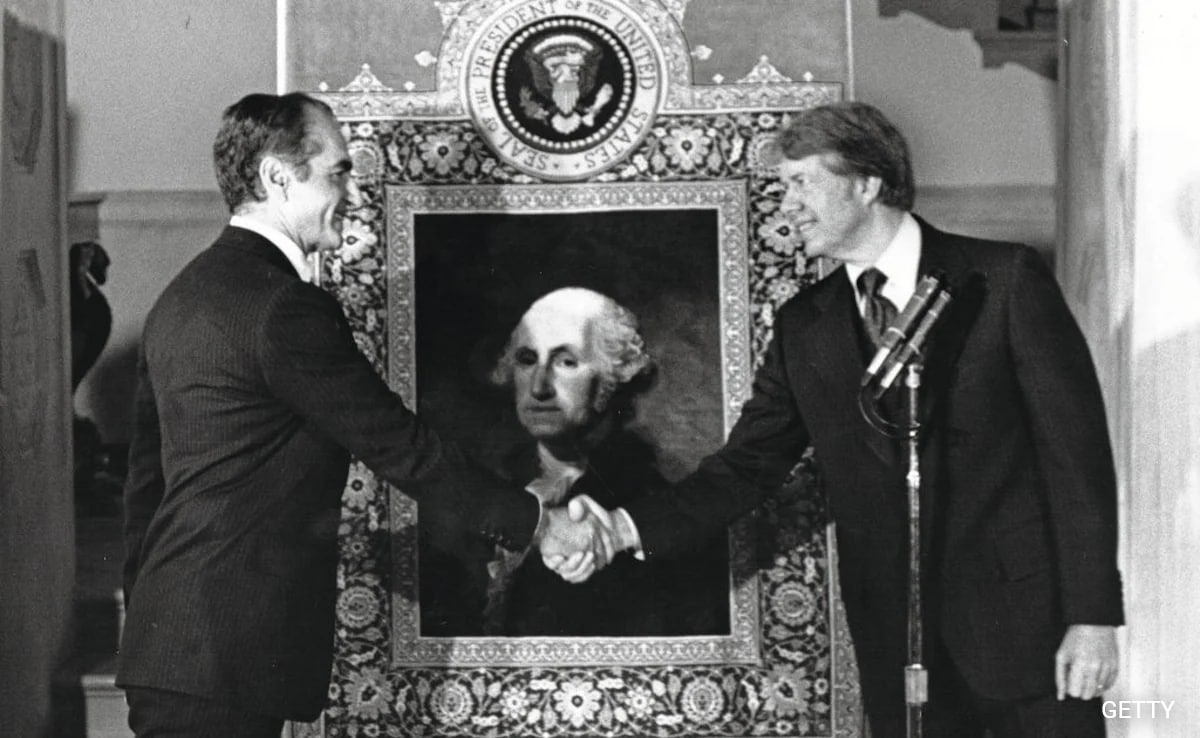
The Shah of Iran, Mohammad Reza Pahlavi with US President Jimmy Carter
Photo Credit: Getty
However, the relationship was not without complications. The Shah, aware of the widespread anti-Israeli sentiment across the Arab world, carefully managed the public face of Iran’s relationship with Israel. While he became more critical of Israel after the 1967 Six-Day War, his strategic interests continued to outweigh ideological or diplomatic positions.
Cooperation In The Shadows
The 1979 Islamic Revolution in Iran drastically changed the country’s political landscape, transforming it into an anti-Israel Islamic Republic. Yet, even after Ayatollah Khomeini’s rise to power, the new regime found itself quietly collaborating with Israel, driven once again by common enemies. As the Iran-Iraq War (1980-1988) dragged on, both countries recognised the advantage of working together against Saddam Hussein’s Iraq.
Israel, too, saw an opportunity in aiding Iran. In particular, it viewed Saddam Hussein’s Iraq as a more immediate and dangerous threat to its security, given Baghdad’s ambitions for regional dominance and its pursuit of nuclear capabilities. Iraq’s formidable military, supplied by both the United States and the Soviet Union, posed a risk, and Israel’s shipment of arms to Iran – particularly after Prime Minister Menachem Begin approved the sale of military equipment in 1980 – was a calculated decision to undermine Iraq’s strength.

Israeli Prime Minister Menachem Begin (L) chats to Egyptian President Anwar al-Sadat at his home where the ministers discussed events in Iran in 1979.
Photo Credit: Getty
These covert arms deals were conducted despite US policy that barred military support for Iran until the release of American hostages held in Tehran. In exchange for Israeli military aid, Khomeini’s regime allowed a significant number of Iranian Jews to emigrate to Israel or the United States, a concession that underscored the pragmatic nature of the relationship.
The Iran-Contra Affair
By the mid-1980s, Iran’s need for military support reached a critical point. The Iran-Iraq War had drained the country’s resources, and its economy was teetering on the brink of collapse. It was against this backdrop that the Iran-Contra affair unfolded – a secretive, high-stakes operation involving arms sales facilitated by Israel, with the backing of senior Ronald Reagan administration officials, to secure the release of American hostages held by Iran-sponsored Hezbollah in Lebanon.

Algeria’s President Houri Boumedienne, (center), is flanked by Shah Mohammed Reza Pahlevi of Iran, (left), and Iraq’s Saddam Hussein, (right) in 1975.
Photo Credit: Getty
For Israel, these arms deals were lucrative and strategically valuable, further enhancing its role as a clandestine ally of Iran in its war against Iraq. Iran, desperate for arms and resources, was willing to engage with both Israel and the United States, even as it continued to publicly vilify Israel.
The Secret Missile Project: Operation Flower
The Israeli-Iranian partnership extended beyond conventional arms deals. One of the most ambitious projects was Operation Flower, a secret multibillion-dollar initiative that began in 1977 under the Shah’s regime. The project involved the modification of surface-to-surface missiles, potentially capable of being fitted with nuclear warheads, for sale to Iran. However, the nuclear aspect of the project was not pursued.
As part of the deal, Iran made a substantial down payment in 1978 by sending $260 million worth of oil to Israel, a New York Times report from 1986 claimed. Work on the missile program continued until the Islamic Revolution in 1979, after which Khomeini’s regime abruptly halted the collaboration.
Spare Tyres For F-4 Fighter Jets
Israel covertly supplied Iran with 250 spare tyres for American-made F-4 fighter jets in October 1980, as Iran waged war against Iraq, according to a New York Times report from 1981.
After Saddam Hussein’s invasion of Iran in September 1980, Israel found itself in an unusual position. The Israeli sale of 250 retreaded tires, valued at around $300,000, was a secretive transaction aimed at bolstering Iran’s air force. The F-4 Phantom jets, a key component of Iran’s military, had been grounded due to wear and tear. With no immediate access to parts due to the embargo placed by the US on Iran, Israel stepped in to fill the gap. According to the New York Times, retreaded tyres were produced in Israel and then covertly transported to France, where they were flown to Iran on chartered planes.

The Shah of Iran, in St. Louis to discuss buying F-4 Phantom jets built by McDonnel Douglas aircraft company.
Photo Credit: Getty
The transaction occurred during a delicate period for US-Iran relations, with 52 American diplomats still held hostage in Tehran. The Jimmy Carter administration, keen to secure their release, urged Israel to suspend further military deals with Iran until the hostages were freed. According to officials involved, Israeli Prime Minister Menachem Begin agreed to American pressure and paused all military dealings, despite Israeli strategic interests in preventing an Iraqi victory in the war.
Beyond regional power politics, Israel had a more personal concern: the fate of the Jewish population in Iran. At the time, approximately 60,000 Jews lived in Iran, and there were growing fears in Israel that they could become targets of repression or persecution under the new regime. Maintaining some form of back-channel communication with Iran was seen as a way to protect these Jewish communities.
Hostility And Rivalry
By the 1990s, the era of cooperation between Israel and Iran had all but evaporated. The geopolitical factors that had once united them -Arab socialism, Soviet influence, and the threat of Iraq – had disappeared, leaving little incentive for continued collaboration. Iran, now firmly under the control of its revolutionary government, embraced an anti-Israel ideology, supporting groups like Hezbollah and Hamas in their conflicts with the Jewish state.
By the early 2000s, the election of Iranian President Mahmoud Ahmadinejad, whose Holocaust denial and aggressive rhetoric against Israel stoked tensions further, cemented Iran as Israel’s most prominent adversary in the region. As Israel fought wars with Hezbollah in 2006 and Hamas in 2008, Iranian support for these non-state actors – collectively termed the ‘Axis Of Resistance’ – became a central concern in Israel’s strategic calculations.
2024 And Threat Of All-Out War
Ties between Iran and Israel are now non-existent. The two Middle Eastern countries are now on the brink of all-out war, evidenced by Israel’s multi-frontal conflict against Hamas in Gaza, Hezbollah in Lebanon and Houthis in Yemen. All three of these armed militant groups are part of Iran’s ‘Axis Of Resistance’.