





Skip to content
  • Facebook
  • X
  • Linkedin
  • WhatsApp
  • Associate Journalism
  • About Us
  • Privacy Policy
  • 033-46046046
  • editor@artifex.news
Artifex.News

Artifex.News

Stay Connected. Stay Informed.

  • Breaking News
  • World
  • Nation
  • Sports
  • Business
  • Science
  • Entertainment
  • Lifestyle
  • Toggle search form
  • SEBI chief Madhabi Puri Buch invested in Chinese firms, alleges Congress  Business
  • Medical Exam Question Paper, Answer Key Sale Announced Online, Kerala Cops File Case Nation
  • Gautam Gambhir’s Competitor WV Raman Shares 2-Word Post Amid Battle For India Coach Job Sports
  • Yulu to operate in 10 metros; explores tie-ups in smaller cities Business
  • 3.5 Magnitude Earthquake Hits Manipur’s Chandel Nation
  • China Plans To Use AI To Disrupt Elections In India, US: Microsoft Nation
  • “Beyond People’s Imagination”: BCCI Vice President Rajeev Shukla On India’s Win vs Pakistan Sports
  • Parasites, Defaced Clothing Found In North Korea Trash Balloons, Claims South Korea World

Surviving in India’s salt desert

Posted on September 28, 2024 By admin


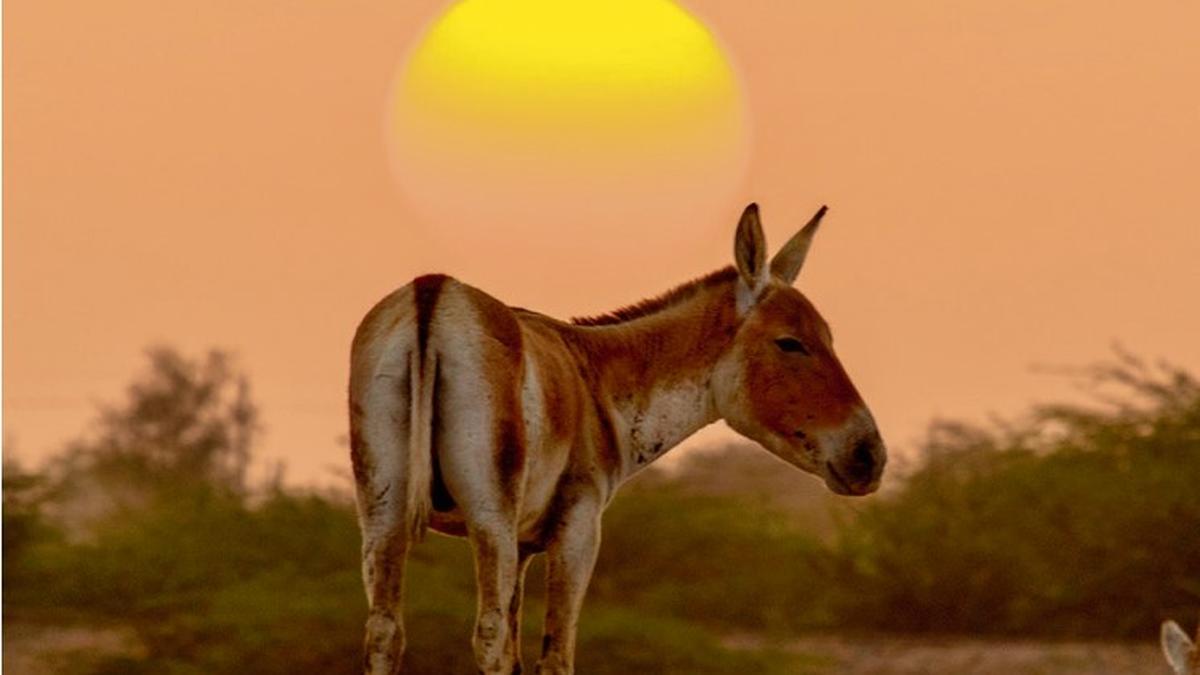
The Indian wild ass, locally called khur, has outlasted predators such as cheetah and lion.
| Photo Credit: Getty Images

The Rann of Kutch evolved when waters of the Arabian Sea made incursions into this region 150-200 million years ago. Geological upheavals led to the rise of a landmass that cut off the Kutch basin from the sea. The Little Rann of Kutch lies at the end of the Gulf of Kutch and covers an area of 5,000 sq.km, chiefly in the Surendranagar district of Gujarat.

For most of the year, this landscape consists of vast, barren and white salt flats. A striking alteration occurs when the monsoon sets in, and the Rann turns into a shallow wetland. About 75 elevated pieces of land turn into islands, called bets by the local Agariya and Maldhari communities.

The Little Rann of Kutch is home to the wild ass sanctuary, which is the only remaining habitat of the Indian wild ass (Equus hemionus khur), locally called khur. About 6,000 of these sandy and brown creatures live in this area. The terrain they occupy is harsh through most of the year, and the vegetation is dry and xerophytic. Khur, like donkeys and other members of the Asinus subgenus, possesses a remarkable ability to locate sustenance in desolate environments. Their digestive systems are adept at processing even the most arid vegetation. The khur has outlasted predators such as the cheetah and the lion, which were last spotted in this region in the 1850s.

The khur is almost the size of a zebra, and lives for 21 years. Stable groups of khur consist of females and their young. Stallions tend to be loners, especially in the breeding season. On the flat terrain of the Rann, they are capable of bursts of up to 70 km per hour. Life can be tough for the mares, as gestation periods are long, 11 to 12 months, and concurrent lactation and pregnancy is sometimes seen.

Back from the brink

The khur have recently overcome a near-extinction event on account of diseases. The viral African Horse sickness, and Surra (caused by the protozoan parasite Trypanosoma evansi and spread by biting insects) had decimated many herds, and only a few hundred survivors were estimated in the 1960s.

Analysis of the mitochondrial DNA of the khur by scientists at the Government Vidarbha Institute of Science in Amravati has indicated a low level of genetic diversity. This is because of a genetic bottleneck caused by disease outbreaks, which left only a small number of survivors. Thanks to persistent conservation efforts, the population of the khur has shown an upward trend in recent decades.

Conflicts with humans

The salt marsh attracts human enterprise — 30% of India’s salt comes from the Little Rann. Every year, a seasonal migration transforms this mirage-like landscape, bringing in 5,000 families and a surge of heavy vehicular traffic. This influx, coupled with extensive cattle grazing, poses a major threat to the delicate ecosystem and its wildlife. Irrigation canals that bring water to the southern rim of the Little Rann can also add salinity to the soil.

Increased human presence, both for salt farming and agriculture, has led to a dispersal of the khur. Herds are seen in adjoining areas of Gujarat and even Rajasthan. In the process, the wild ass has acquired the reputation of a crop raider. Other animals such as the nilgai and feral pigs cause more damage to crops, but the khur gets disproportionately blamed. A proper separation of the sanctuary’s starkly beautiful landscape from human-dominated areas would be better for both.

(The article was written in collaboration with Sushil Chandani, who works in molecular modelling)

Published – September 28, 2024 09:12 pm IST



Source link

Science

Post navigation

Previous Post: ‘Gutted Not To Watch Stars In Action’: Fans React As Day 2 Of India vs Bangladesh Test Gets Washed Out
Next Post: No ceasefire yet, says Israeli envoy, defends Israel war a year after October 7 attacks

Related Posts

  • Sci-Five | The Hindu Science Quiz: On Astronomical Instruments Science
  • Rhinos can’t sweat, making them vulnerable to overheating Science
  • This worm develops food habits and its offspring ‘inherit’ them Science
  • India selects two astronaut-designates for upcoming Axiom-4 mission to International Space Station Science
  • Probability of survival decreases with increased duration of CPR Science
  • Rocks with the oldest evidence of Earth’s magnetic field discovered Science

More Related Articles

Lancet paper provides proof for undeniable link between high glycaemic index and diabetes Science
ISRO shares video showing Pragyan rover roaming around Shiv Shakti point Science
Could global warming impede weather and climate forecasting? Science
Daily Quiz: On H2 fuel and batteries Science
What is ‘Net Zero’, anyway? A short history of a monumental concept Science
New light-based tool could cut cost of spotting viral infections Science
SiteLock

Archives

  • October 2024
  • September 2024
  • August 2024
  • July 2024
  • June 2024
  • May 2024
  • April 2024
  • March 2024
  • February 2024
  • January 2024
  • December 2023
  • November 2023
  • October 2023
  • September 2023
  • August 2023
  • July 2023
  • June 2023
  • May 2023
  • April 2023
  • March 2023
  • February 2023
  • January 2023
  • December 2022
  • November 2022
  • October 2022
  • September 2022
  • August 2022
  • July 2022
  • June 2022
  • May 2022

Categories

  • Business
  • Nation
  • Science
  • Sports
  • World

Recent Posts

  • Helicopter Carrying 3 People Crashes In Pune, Shortly After Take-Off
  • Texas Man Put To Death For Murder Of Twins In 1989
  • Ravi Shastri’s “Name One Wicketkeeper Who…” Question Backfires, Gets Epic MS Dhoni Reply
  • How badly was the Indian crypto investor community hit by the $230 million WazirX hack?
  • How badly was the Indian crypto investor community hit by the $230 million WazirX hack?

Recent Comments

  1. TpeEoPQa on UP Teacher Who Asked Students To Slap Muslim Classmate
  2. xULDsgPuBe on UP Teacher Who Asked Students To Slap Muslim Classmate
  3. KyJtkhneiLmcq on UP Teacher Who Asked Students To Slap Muslim Classmate
  4. mOyehudovB on UP Teacher Who Asked Students To Slap Muslim Classmate
  5. GFBvgSrWPcsp on UP Teacher Who Asked Students To Slap Muslim Classmate
  • In Pic By Kate Middleton, A Birthday Wish For Youngest Son Prince Louis World
  • “It Was Crazy”: Faf Du Plessis’ Blunt Take On Virat Kohli’s Controversial Dismissal vs KKR Sports
  • Sensex falls in early trade after eight days of rally Business
  • Union Budget | Centre to expand electric vehicle ecosystem to support charging infra Business
  • Congress MP Gaurav Gogoi Named Deputy Leader In Lok Sabha Nation
  • Pakistan shopkeepers strike nationwide over inflation World
  • Gaza Has Become A “Graveyard” For Thousands Of Children: UN World
  • Pakistan vs Bangladesh LIVE Score, 1st Test Day 4: Bangladesh Near Pakistan’s Total Sports

Editor-in-Chief:
Mohammad Ariff,
MSW, MAJMC, BSW, DTL, CTS, CNM, CCR, CAL, RSL, ASOC.
editor@artifex.news

Associate Editors:
1. Zenellis R. Tuba,
zenelis@artifex.news
2. Haris Daniyel
daniyel@artifex.news

Photograher:
Rohan Das
rohan@artifex.news

Artifex.News offers Online Paid Internships to college students from India and Abroad. Interns will get a PRESS CARD and other online offers.
Send your CV (Subjectline: Paid Internship) to internship@artifex.news

Links:
Associate Journalism
About Us
Privacy Policy

News Links:
Breaking News
World
Nation
Sports
Business
Entertainment
Lifestyle

Registered Office:
72/A, Elliot Road, Kolkata - 700016
Tel: 033-22277777, 033-22172217
Email: office@artifex.news

Editorial Office / News Desk:
No. 13, Mezzanine Floor, Esplanade Metro Rail Station,
12 J. L. Nehru Road, Kolkata - 700069.
(Entry from Gate No. 5)
Tel: 033-46011099, 033-46046046
Email: editor@artifex.news

Copyright © 2023 Artifex.News Newsportal designed by Artifex Infotech.