



Did you know that the word “photograph,” arrived at by combining the Greek words phos, which means “light,” and graphe, which means “drawing, writing,” was coined in 1839 by English polymath Sir John Herschel? He used it as a noun and as a verb, along with the related words photography and photographic. The verb form, along with the related versions, were first employed by him in a paper he read before the Royal Society on March 14, 1839.
The only child of Sir William Herschel, a celebrated astronomer, John was born in 1792 and was briefly educated at Eton and then privately, before heading to the University of Cambridge in 1809. It was here that he found the company of Charles Babbage, mathematician and originator of the concept of digital programmable computer, and George Peacock, also a mathematician.
Together, the trio founded the Analytical Society of Cambridge in 1812 in order to bring the continental methods of mathematical calculus into practice in England. They were able to replace Isaac Newton’s difficult symbolism with that of Gottfried Wilhelm Leibniz, a German mathematician.
Apprenticeship with father
After earning a place in the Royal Society on submitting his first mathematical paper in 1812, Herschel began to study for the bar in 1814, only to discontinue it the following year as he wasn’t happy with it. By 1816, he had begun his apprenticeship with his father in astronomical research, and benefited immensely from his father’s knowledge – knowledge that could only be acquired through decades of experience.
Being among the founders of the Royal Astronomical Society in 1820, Herschel’s first major undertaking in astronomy was the re-observations of double stars catalogued by his father. Working alongside John Smith, a collaborator, he compiled a catalogue between 1821-23 and published it in the Philosophical Translations in 1824. This work won them the Gold Medal of the Royal Astronomical Society and in 1825 the Lalande Prize from the Paris Academy of Sciences.
South African expedition
With a sense of obligation to complete his father’s work, Herschel began planning for an expedition to the southern hemisphere in 1832 in order to survey the skies that were not seen in England. Four years of rigorous scientific activity in South Africa meant that by the time he returned in 1838, he had recorded the locations of thousands of stars and had detailed descriptions of a couple of galaxies best viewed from the southern hemisphere. As if that weren’t enough, he also observed the Halley’s Comet in 1835 and observed the satellites of Saturn.
An established chemist, Herschel discovered the solvent power of hyposulphite of soda on otherwise insoluble salts of silver in 1819. This enabled him to become a key partner to photography pioneer William Henry Fox Talbot in his development of photography. When Talbot struggled with stabilising his photographic images, Herschel realised that the need of the hour was sodium thiosulphate, or hyposulphite of soda, as the fixing agent.
Still in vogue
While Herschel can thus be considered a co-inventor of photography, there is no doubting the fact that he coined the term “photograph.” He was also the one responsible for using the terms “positive” and “negative” to images, now well used in the context of photography.
One of the first photographs to be taken on glass and the earliest still remaining.
| Photo Credit:
John Herschel
In addition to these, Herschel tried experimental photography himself and one of his photographs is that of a 40-foot reflecting telescope – a telescope that was made by his father and aunt Caroline Herschel, also an astronomer. Constructed in the 1780s and erected on the grounds of the family house at Slough, it formed the subject for John’s glass photograph taken on September 9, 1839. Apart from being one of the first glass photographs, it is now the earliest glass photograph still in existence.
Barring a period as the master of the Mint from 1850-56 – a spell that cost his health and well-being – Herschel largely remained devoted to his chosen fields. After resigning his post at the Mint, Herschel spent his years doing what he did best, cataloguing double stars, nebulae and star clusters until his death in 1871.
The woman who gave us this photograph
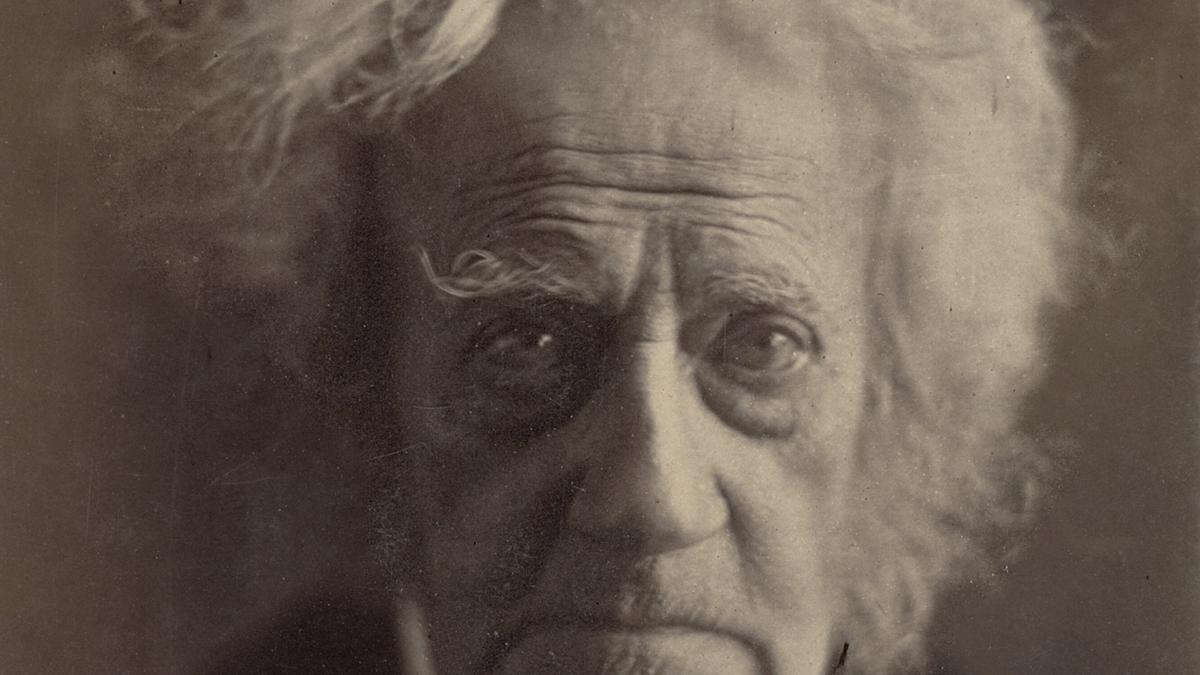
The photograph that we have used here is a portrait of John Herschel taken by Julia Margaret Cameron in April 1867.
Born in Calcutta (now Kolkata) in 1815, she was famous in her youth as one of the seven Pattle sisters and married legal reformer Charles Hay Cameron in 1838.
Gifted a camera in 1863, she took to photography and employed her position in Victorian society to get access to portrait-sitters, including Herschel.
She saw her photography as an artform and it comes through in her portraits.
Herschel and Cameron met in South Africa in 1835 and became close friends. This meant that Herschel was more than just a renowned scientist for her when she prepared him for the portrait more than three decades later.
“He was to me as a Teacher and High Priest,” wrote Cameron of Herschel, whom she saw as a mentor, before adding that he was “illustrious and revered as well as beloved friend.” As a result, she didn’t have him stiff and formal as was largely the norm for portraits back then, but instead had him wash his hair and took her camera close to his face, thereby ensuring that she could catch the light on his face.
The result, as we can see, is indeed a work of art.
Published – September 08, 2024 12:54 am IST