





Budget 2024-25 promised that “a policy for promoting pumped storage projects will be brought out for electricity storage and facilitating smooth integration of the growing share of renewable energy with its variable and intermittent nature.”
Why pumped storage
India has planned to create an ambitious 500 GW of non-fossil power by 2030. In around two years, from 2021 to 2023, it created some 23 GW of non-fossil generation capacity. Out of 10 GW added in eight months in 2023-24, 7.5 GW were wind and solar, pointing to how renewables will account for most of the new power generation that will be added in India.
Actual renewable power generation has crossed 10% of the total generation and its share will only increase many times. This power will necessarily vary and is “infirm.”
Indian policies have laid down that all the power that renewable sources generate should be used and their curtailment should be the last priority. State-of-the-art forecasting techniques have helped to predict more accurately how much will renewable power generation vary in the course of a day. This has helped grid operators plan in advance how to increase or decrease power generation from other sources to provide steady power to the consumer.
Hydro power generation can quickly ramp up or ramp down in a matter of seconds. Hydro helped to ensure there were no blackouts during the lights-off campaign during the pandemic, for instance. Gas turbines come next. Coal and nuclear need hours of notice.
When the world’s attention turned to renewables and the problem of variable power generation, many solutions were proposed for storing energy and releasing it when wind and solar are down. Until then, no electricity generated was stored in large scale.
Among energy storage methods thought of were scaling up batteries and pumping in compressed air into large caverns and then drawing on them to generate power when required. But, much of the energy storage adopted across the world today is pumped storage that uses water. These are like super large batteries but natural and use water.
India’s experience
India has 3.3 GW of pumped storage. Main ones are Nagarjunasagar, Kadana, Kadamparai, Panchet and Bhira. Some four are under construction and two in advanced levels of planning.
China leads the world with 44 GW of pumped storage supporting 1,300 GW of wind and solar. India would therefore need to ramp up its pumped storage capacity by several times if it wants to meet its renewable power generation targets.
Pumped storage is of two types: on river and off river. On-river is like any hydroelectric project supplied by a river. Existing hydro projects could become pumped storage. Off-river projects are those that have two reservoirs at two different levels to which the water is pumped up or falls down to under gravity in a closed loop. Abandoned mines can, for instance, be converted to such reservoirs. When there is surplus power, water is pumped up from lower to upper reservoir and when power is needed the water can fall down under gravity to turn the turbines and generate power.
How Kadamparai operates
In Tamil Nadu, at noon on a typical day in July, wind and solar can generate half of all power. This is among the highest in the country.
While the State was an early starter and leader in wind power capacity, more recent renewables have been solar.
On a summer day, solar plants in Tamil Nadu produce some 5,000 MW at noon. But that power dwindles as the day progresses and drops to zero when the sun sets. Wind has its own vagaries too. The wind season is May-September.
Tamil Nadu has peaks of around 17,000 MW to 20,000 MW on a daily basis. This year in July, maximum wind power generated reached 5,499 MW and maximum solar reached 5,512 MW. Wind and solar have Must Run Status in the State which means whatever they produce must be taken.
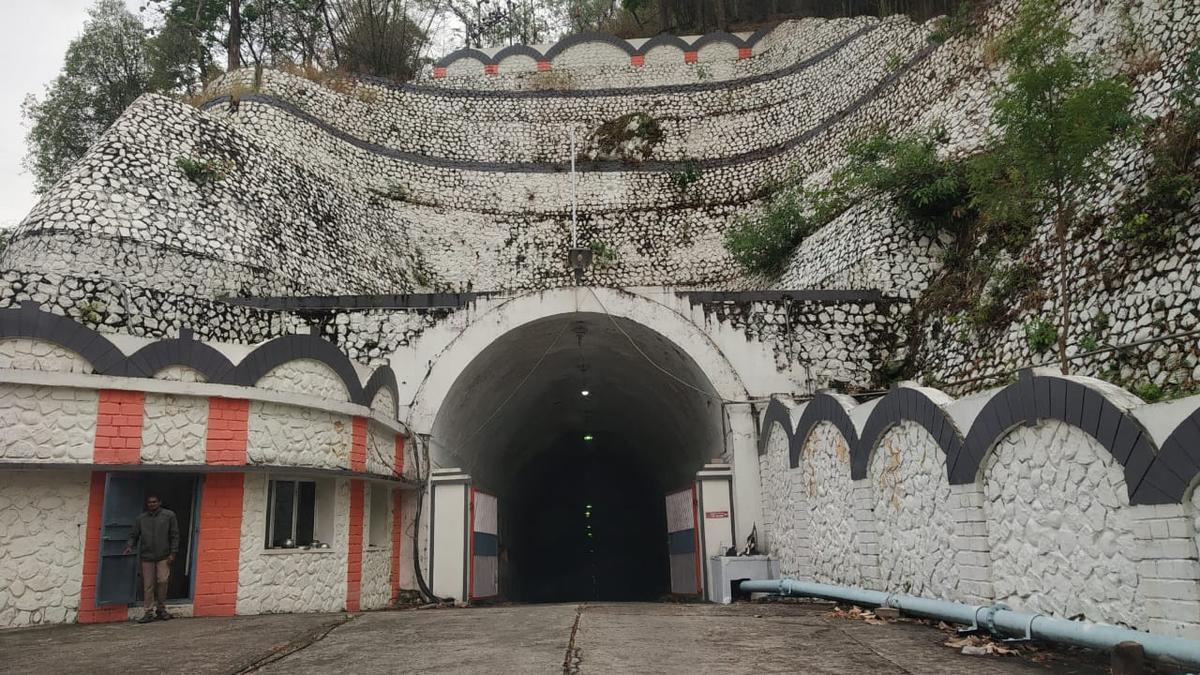
The Kadamparai plant near Valparai in Coimbatore district came up some 37 years ago before wind and solar of any scale was there. The purpose was to help balance the grid and the plan has come in handy when Tamil Nadu took the lead in renewable power generation.
The plant has a higher reservoir that is at a height of around 380 m above a lower reservoir. Each unit is a turbine generator set producing electric power when the water flows from the upper reservoir to the lower. The same unit can function as a pump consuming electric power when it pumps water from lower to higher reservoir.
The previous day morning, power managers in Tamil Nadu plan for the next day how much and when to operate each power plant in the State based on several factors such as demand expected as well as a forecast of wind blowing and sun shining. Typically, when the sun shines brightest, there is a power surplus coming from solar. That power is used to pump up the water at Kadamparai. Each unit needs 20% more power to operate as pump than what it can produce as generator. But this is solar power and no fuel is burned to produce that electric power.
When the Kadamparai plant is operating as a pump to store energy, it would need about an hour and half to switch to generating mode. When stopped, it would need about half hour to start and generating at full load.
When solar generation stops and the evening peak load begins after 6pm, Kadamparai plant becomes a generator. It can produce 400 MW of full power for three to four hours and help support the evening peak loads. Sometimes the plant is operated at less than full load late into the night depending on the conditions.
The upper reservoir has around 1 TMC feet of water. Leakages are marginal and are often replenished by natural rainfall.
When the solar is coming in full, power managers in the State stop drawing power from hydro of which the State has around 1,000 MW. Hydro can be quickly turned on if there is a sudden drop in power generation, such as in the case of an outage. Barring water for irrigation and drinking, hydro is used for power generation when demand peaks.