




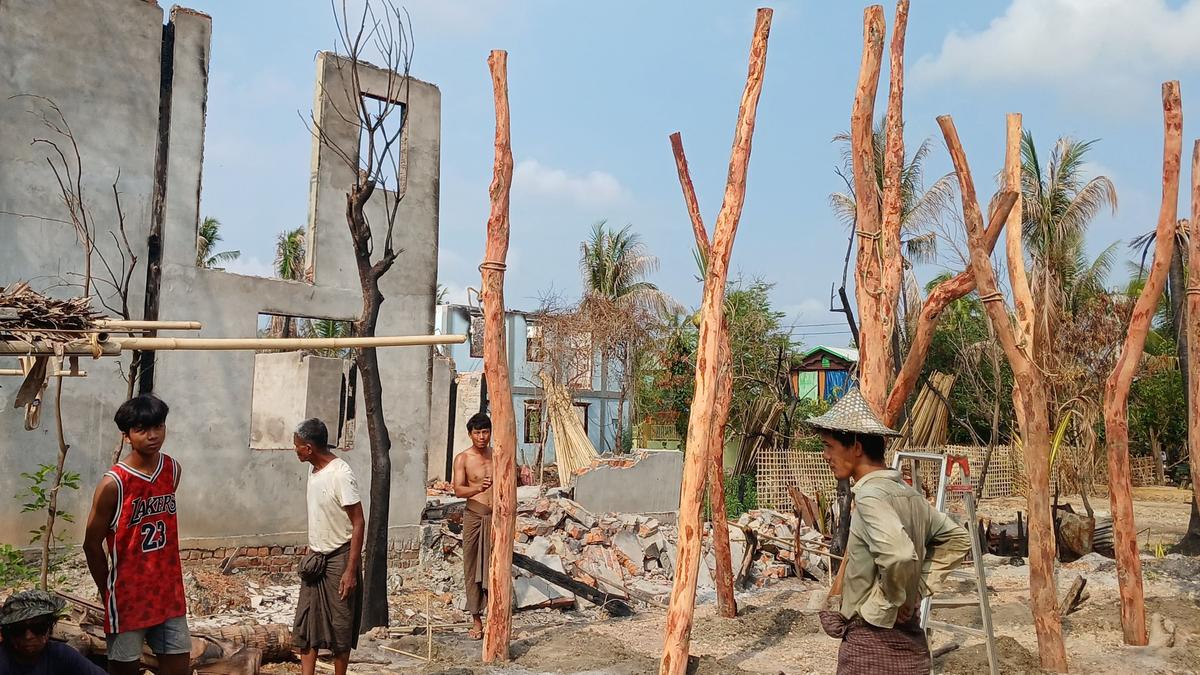
The Myanmar military’s coup d’état in 2021 has brought about a seismic shift in the country’s politics. The military leadership’s assumption that resistance to the coup would quickly dissipate proved to be a gross miscalculation. The removal of Aung San Suu Kyi and other civilian leaders from the political scene prompted sustained violent resistance. Unable to contain this, the military has resorted to indiscriminate use of force, which has dented whatever little legitimacy it had.
The military has lost control of large parts of the country. Ethnic Armed Organisations (EAOs) and resistance groups such as the People’s Defence Forces (PDFs) have made considerable gains. The Brotherhood Alliance — comprising the Arakan Army, the Myanmar National Democratic Alliance Army, and the Ta’ang National Liberation Army — has demonstrated prowess in holding onto territory after making rapid territorial gains.
The ceasefire between the military and the Alliance in Shan State proved to be fragile, and clashes resumed last month. Additionally, the Brotherhood Alliance captured a few strategically important towns, with the military on the verge of losing complete control of its regional military headquarters in Lashio, in the northern Shan State. Meanwhile, the Kachin Independence Army has seized about 70 military posts and gained control of important border trade routes with China. With the PDFs gaining ground in central Myanmar, the military is reinforcing its positions near Mandalay.
The dominance of the Arakan Army
In the west, large parts of the Rakhine province have fallen into the hands of the Arakan Army, with its cadres belonging to the Rakhine Buddhist ethnic group. The armed group has also seized territories on the borders with Bangladesh, including towns such as Buthidaung. Moreover, the Arakan Army is also knocking on the doors of other important port cities/towns on the Bay of Bengal coast such as Kyauk Phyu, Sittwe, and picturesque Ngapali. Oil and gas pipelines run from Kyauk Phyu to the Yunnan province in China. Kyauk Phyu is also a vital node in China’s Belt and Road Initiative, with proposals to expand the deep sea port and other related investments.

Similarly, peace and stability in Sittwe is critical for the success of India’s Kaladan project, which seeks to connect Kolkata with Mizoram via Myanmar. With its ability to impact the implementation of various infrastructure projects and the trajectory of the Rohingya crisis, the Arakan army may emerge as one of the key players in defining the regional security dynamic of the Bay of Bengal.
The agenda of EAOs
In the south, the EAOs have made their presence felt on highways around Dawei, with the Karen National Union coming close to dislodging the military in Myawaddy, a strategically important town close to the Thailand border. The loss of these coastal and border towns means losing access to critical resources and much-needed revenues for the military.
There are also concerns regarding Myanmar’s possible Balkanisation and its deleterious impact on the neighbourhood. Recently, Bangladesh Prime Minister Sheikh Hasina alleged that attempts are being made to create a new sovereign state by carving out territories from Bangladesh and Myanmar. However, major EAOs in Myanmar have refrained from declaring independence by announcing the creation of new nation-states. It can be speculated that EAOs have tactically refrained from creating such nation-states, before the complete disintegration of the military, as such a move could rally renewed support for the military. On the other hand, perhaps the EAOs want to establish a genuine federal democratic structure with maximum autonomy for provinces, with some advocating for a confederation.
The reluctance of various EAOs to carve out new countries may also be due to complex ethnic geographies. Over the decades, because of the considerable movement of people, there are no ‘pure’ ethnic homelands. Consequently, many geographies are multi-ethnic, and members of various ethnic groups often share urban spaces in towns and cities. Further, there is considerable overlap in the imagination of various ethnic homelands. For instance, there are differences of opinion on the boundary of homelands between Arakan and Chin organisations, and similar challenges may confront the Wa, Kachin and Ta’ang ethnic groups in Shan state. Amid fluid ethnic boundaries, creating nation-states with new boundaries may generate considerable inter-ethnic friction. Overall, with multiple armed groups contesting for and asserting power in different regions, many refer to Myanmar as a space with fragmented sovereignty.
China’s influence
China has responded to the fluid political process by engaging with multiple actors. Given its massive investments and economic interests in the region, China has often extended support to the Myanmar military on various international platforms. Simultaneously, it has also kept substantive relations with many armed groups, including the Brotherhood Alliance and the United Wa State Army (UWSA).
It was Beijing which facilitated some ceasefires between the military and the EAOs, such as the Haigeng ceasefire agreement in January this year, which proved to be temporary. Recently, Myanmar’s former president Thein Sein and Gen Soe Win, regarded as second-in-command in the military, travelled to China to participate in forums pertaining to peaceful coexistence and green development. The military’s foreign minister and representatives of a few political parties also travelled to China. These visits indicate enhanced Chinese diplomatic engagement with Myanmar.
Beijing’s policy towards Myanmar is also guided by emerging security threats, such as the activities of online criminal syndicates operating near the China-Myanmar border, which are targeting Chinese citizens. Reports suggests that China may have given tacit consent to the Brotherhood Alliance offensive in October last year to eliminate such criminal networks.
However, China’s approach towards the EAOs’ more recent operations and their steady territorial gains merits closer examination. Over the years, the UWSA was purportedly the conduit through which some of the armed groups received Chinese weapons. The EAOs reportedly procured commercial drones from the Chinese market and used them in their operations against the military. On the other hand, China also, supposedly, ensured a steady supply of defence equipment to Myanmar’s military. According to a UN report released this month, China supplied ‘fighter aircraft, missile technology, naval equipment and other dual-use military equipment’ to Myanmar in the past two years.
Over the years, China has extended support to EAOs as well as the military, which ensured that Myanmar remained a country with fragmented sovereignty. Beijing’s pursuit of such a policy had two premises: (a) the Myanmar military would not be a significant force in large tracts of the country; (b) that China had enough leverage to ensure that EAOs would not undermine its interests. A tense stalemate between various armed groups gives China sustained leverage in Myanmar.
The recent experiences demonstrate that a persistent confrontation-ceasefire dynamic may continue to define the interactions between the military and EAOs. To transcend such a dynamic, Myanmar will require a new compact, and there will be no sustainable peace under the rubric of the current 2008 Constitution. All legitimate stakeholders need to come to the table to discuss a new constitutional framework that celebrates the principles of federalism and democracy.
India’s role
India can share its experiences and toolkit on federalism, such as institutional frameworks, financial arrangements and special provisions stemming from agreements like the Mizoram Peace Accord, with all the stakeholders in Myanmar. If India, despite a lack of geographic contiguity, could construct massive infrastructure projects amidst the civil war in Afghanistan, there is no reason why it could not do more in neighbouring Myanmar for regional peace and prosperity.
Sanjay Pulipaka is the Chairperson of the Politeia Research Foundation. The views expressed are personal.