
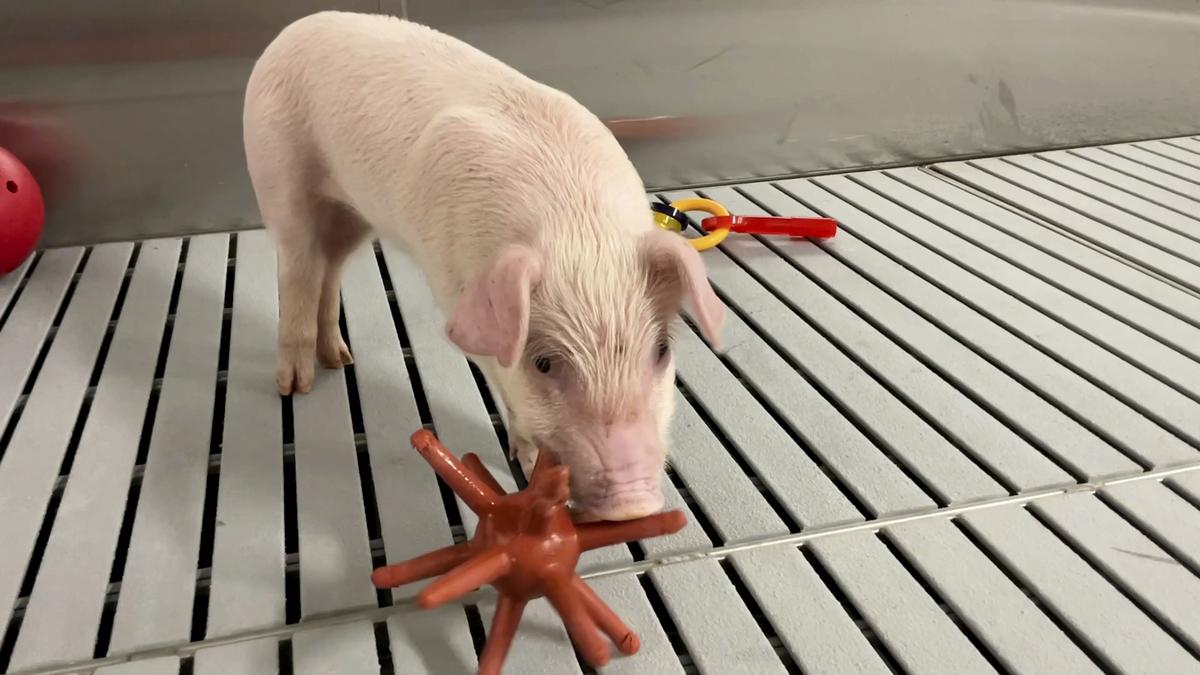
Wide-eyed piglets rushing to check out the visitors to their unusual barn just might represent the future of organ transplantation – and there’s no rolling around in the mud here.
The first gene-edited pig organs ever transplanted into people came from animals born on this special research farm in the Blue Ridge mountains – behind locked gates, where entry requires washing down your vehicle, swapping your clothes for medical scrubs and stepping into tubs of disinfectant to clean your boots between each air-conditioned barn.
“These are precious animals,” said David Ayares of Revivicor Inc., who spent decades learning to clone pigs with just the right genetic changes to allow those first audacious experiments.
The biosecurity gets even tighter just a few miles away in Christiansburg, Virginia, where a new herd is being raised – pigs expected to supply organs for formal studies of animal-to-human transplantation as soon as next year.
United Therapeutics’s designated pathogen-free facility in Christiansburg on May 29, 2024.
| Photo Credit:
Shelby Lum/AP
This massive first-of-its-kind building bears no resemblance to a farm. It’s more like a pharmaceutical plant. And part of it is closed to all but certain carefully chosen employees who take a timed shower, don company-provided clothes and shoes, and then enter an enclave where piglets are growing up.
Behind that protective barrier are some of the world’s cleanest pigs. They breathe air and drink water that’s better filtered against contaminants than what’s required for people. Even their feed gets disinfected – all to prevent them from picking up any possible infections that might ultimately harm a transplant recipient.
“We designed this facility to protect the pigs against contamination from the environment and from people,” said Matthew VonEsch of United Therapeutics, Revivicor’s parent company. “Every person that enters this building is a possible pathogen risk.”
The Associated Press got a peek at what it takes to clone and raise designer pigs for their organs – including a $75 million “designated pathogen-free facility” built to meet Food and Drug Administration safety standards for xenotransplantation.
Thousands of people each year die waiting for a transplant, and many experts acknowledge there never will be enough human donors to meet the need.
Animals offer the tantalizing promise of a ready-made supply. After decades of failed attempts, companies including Revivicor, eGenesis and Makana Therapeutics are engineering pigs to be more humanlike.
So far in the U.S. there have been four “compassionate use” transplants, last-ditch experiments into dying patients — two hearts and two kidneys. Revivicor provided both hearts and one of the kidneys. While the four patients died within a few months, they offered valuable lessons for researchers ready to try again in people who aren’t quite as sick.
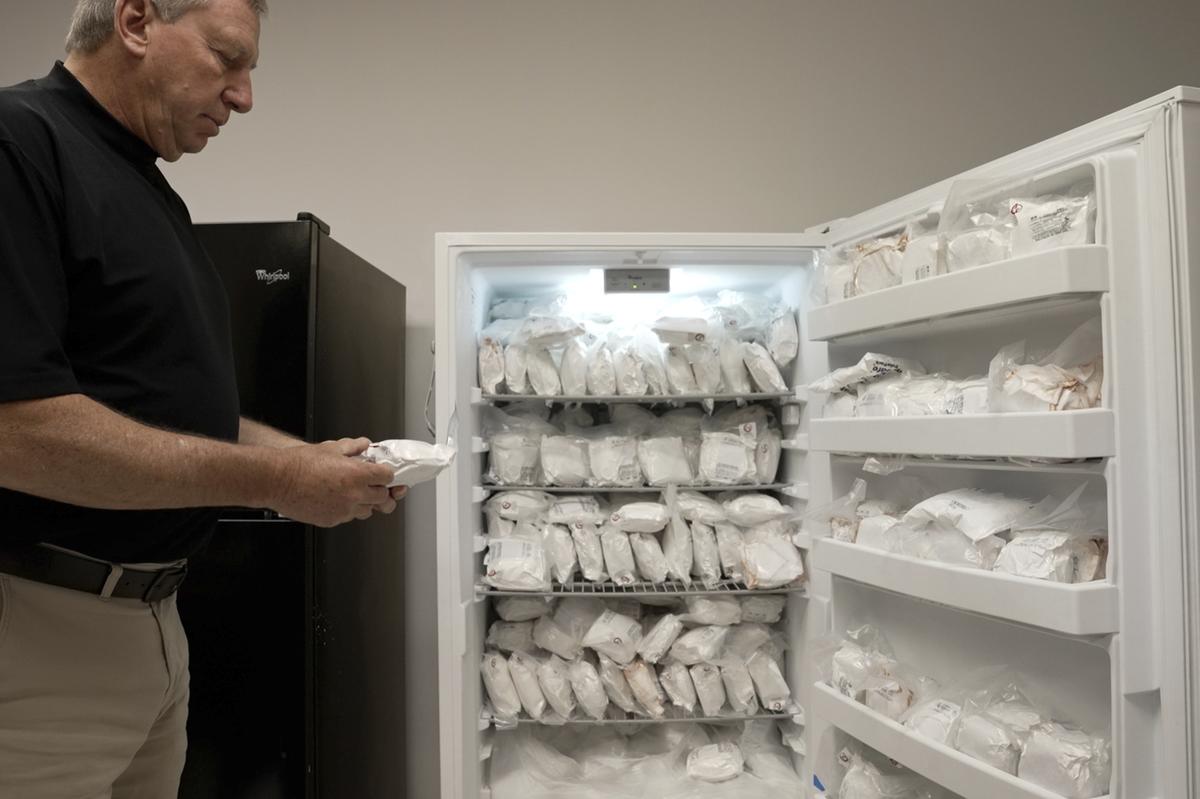
David Ayares, president and chief scientific officer of Revivicor, holds a package of frozen meat during an interview at the company’s offices in Blacksburg, May 30, 2024. His company genetically modified pigs, known as GalSafe pigs, so they no longer carry a sugar responsible for alpha-gal syndrome, an allergy to red meat.
| Photo Credit:
Shelby Lum/AP
Now the FDA is evaluating promising results from experiments in donated human bodies and awaiting results of additional studies of pig organs in baboons before deciding next steps.
They’re semi-custom organs — “we’re growing these pigs to the size of the recipient,” Ayares noted — that won’t show the wear-and-tear of aging or chronic disease like most organs donated by people.
Transplant surgeons who’ve retrieved organs on Revivicor’s farm “go, ‘Oh my god that’s the most beautiful kidney I’ve ever seen,’” Ayares added. “Same thing when they get the heart, a pink healthy happy heart from a young animal.”
The main challenges: how to avoid rejection and whether the animals might carry some unknown infection risk.
The process starts with modifying genes in pig skin cells in a lab. Revivicor initially deleted a gene that produces a sugar named alpha-gal, which triggers immediate destruction from the human immune system. Next came three-gene “knockouts,” to remove other immune-triggering red flags. Now the company is focusing on 10 gene edits — deleted pig genes and added human ones that together lessen risk of rejection and blood clots plus limit organ size.
They clone pigs with those alterations, similar to how Dolly the sheep was created.
Twice a week, slaughterhouses ship Revivicor hundreds of eggs retrieved from sow ovaries. Working in the dark with the light-sensitive eggs, scientists peer through a microscope while suctioning out the maternal DNA. Then they slip in the genetic modifications.
“Tuck it in nice and smooth,” murmurs senior researcher Lori Sorrells, pushing to just the right spot without rupturing the egg. Mild electric shocks fuse in the new DNA and activate embryo growth.
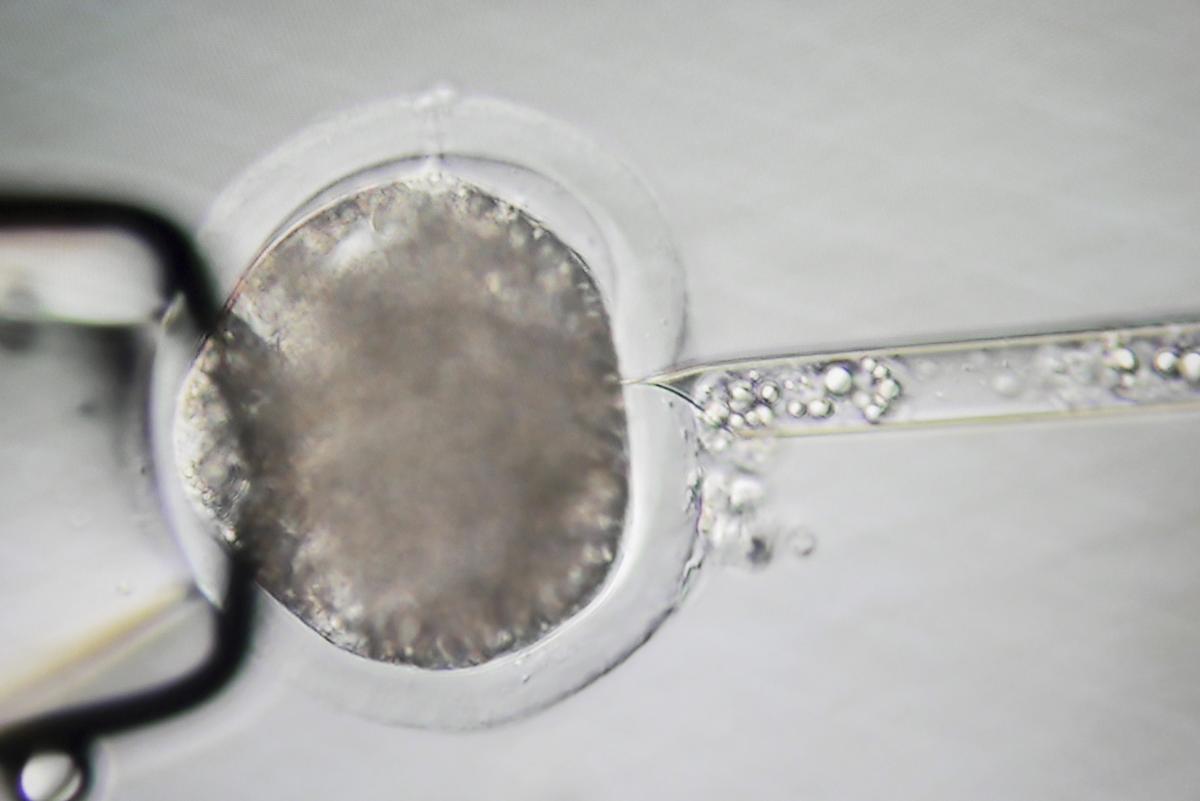
Seen through a microscope, DNA is removed from a pig egg cell, May 30, 2024, before a genetically modified cell is inserted.
| Photo Credit:
Shelby Lum/AP
Ayares, a molecular geneticist who heads Revivicor and helped create the world’s first cloned pigs in 2000, says the technique is “like playing two video games at the same time,” holding the egg in place with one hand and manipulating it with the other. The company’s first modified pig, the GalSafe single gene knockout, now is bred instead of cloned. If xenotransplantation eventually works, other pigs with the desired gene combinations would be, too.
Hours later, embryos are carried to the research farm in a handheld incubator and implanted into waiting sows.
On the research farm, Tom Petty’s “Free Fallin’” was serenading a piglet barn, where music acclimates the youngsters to human voices. In air-conditioned pens, the animals grunted excited greetings until it’s obvious their visitors brought no treats. The 3-week-olds darted back to the security of mom. Next door, older siblings laid down for a nap or checked out balls and other toys.
“It is luxury for a pig,” Ayares said. “But these are very valuable animals. They’re very smart animals. I’ve watched piglets play with balls together like soccer.”
About 300 pigs of different ages live on this farm, nestled in rolling hills, its exact location undisclosed for security reasons. Tags on their ears identify their genetics.
“There are certain ones I say hi to,” said Suyapa Ball, Revivicor’s head of porcine technology and farm operations, as she rubbed one pig’s back. “You have to give them a good life. They’re giving their lives for us.”
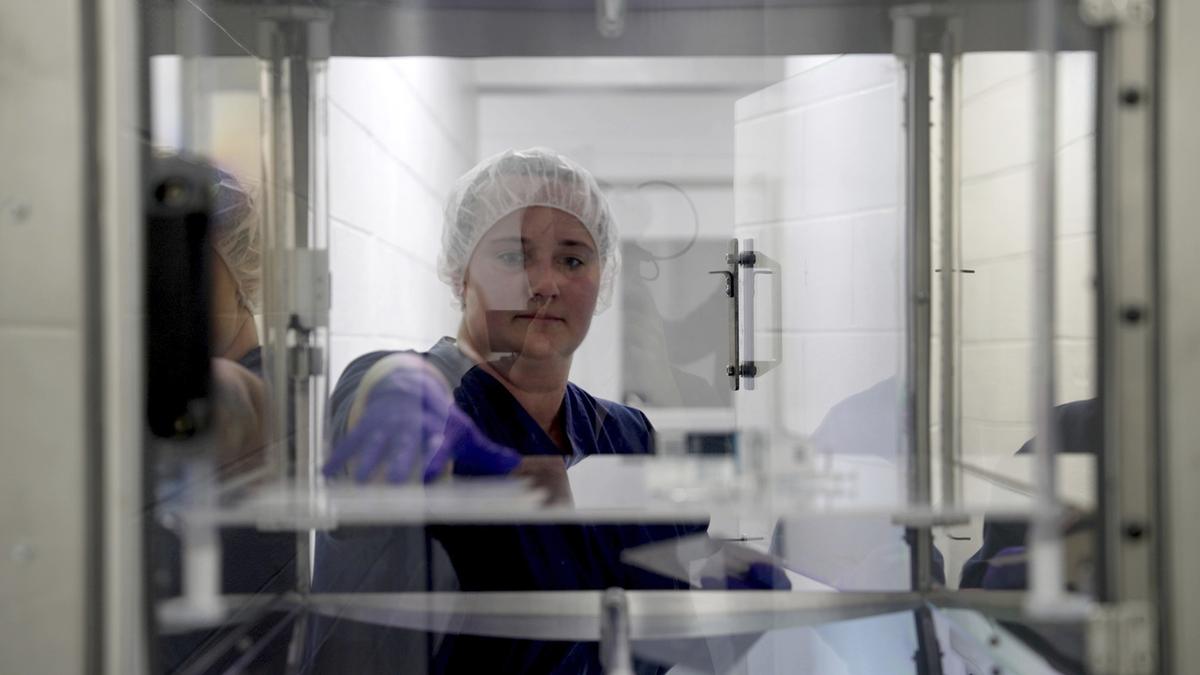
A worker at United Therapeutics’s designated pathogen-free facility in Christiansburg retrieves a UV-sterilised item from behind a protected barrier within the facility, May 29, 2024.
| Photo Credit:
Shelby Lum/AP
A subset of pigs used for the most critical experiments – those early attempts with people and the FDA-required baboon studies – are housed in more restricted, even cleaner barns.
But in neighboring Christiansburg is the clearest signal that xenotransplantation is entering a new phase — the sheer size of United Therapeutics’ new pathogen-free facility. Inside the 77,000-square-foot building, the company expects to produce about 125 pig organs a year, likely enough to supply clinical trials.
Company video shows piglets running around behind the protective barrier, chewing on toys and nosing balls back and forth.
They were born in sort of a porcine birthing center connected to the facility, weaned a day or two later and moved into their super-clean pens to be hand-raised. In addition to the on-site shower, their caretakers must put on a new protective suit and mask before entering each suite of pig pens — another precaution against germs.
The pig zone is surrounded on all sides by security and mechanical systems that shield the animals. Outside air enters through multiple filtration systems. Giant vats hold backup supplies of drinking water. Standing over the pig rooms, VonEsch showed how pipes and vents were placed to allow maintenance and repair without any animal contact.
It will take years of clinical trials to prove whether xenotransplantation really could work. But if it succeeds, United Therapeutics’ plan is for even larger facilities, capable of producing up to 2,000 organs a year, in several places around the country.
The field is at a point where multiple kinds of studies “are telling us that there’s no train wrecks, that there’s no immediate rejection,” Ayares said. “The next two or three years are going to be super exciting.”