
Skip to content
  • Facebook
  • X
  • Linkedin
  • WhatsApp
  • Associate Journalism
  • About Us
  • Privacy Policy
  • 033-46046046
  • editor@artifex.news
Artifex.News

Artifex.News

Stay Connected. Stay Informed.

  • Breaking News
  • World
  • Nation
  • Sports
  • Business
  • Science
  • Entertainment
  • Lifestyle
  • Toggle search form
  • Legendary Canadian Actor Donald Sutherland Dies At 88 World
  • Afghanistan vs Bangladesh LIVE Streaming T20 World Cup 2024 Super Eight Live Telecast: Where To Watch Match Live Sports
  • Trump’s Rhetoric On Campaign Trail World
  • Thirty Years On, Brazil Pays Tribute To Late F1 Hero Ayrton Senna Sports
  • Toying with toys and making it big Science
  • One dead, several injured in Paris suburb shooting World
  • WikiLeaks Founder Julian Assange, A Free Man, Lands In Australia World
  • Complex PTSD: When trauma persists… Science

Study brings lifestyle of enigmatic extinct humans into focus

Posted on July 4, 2024 By admin


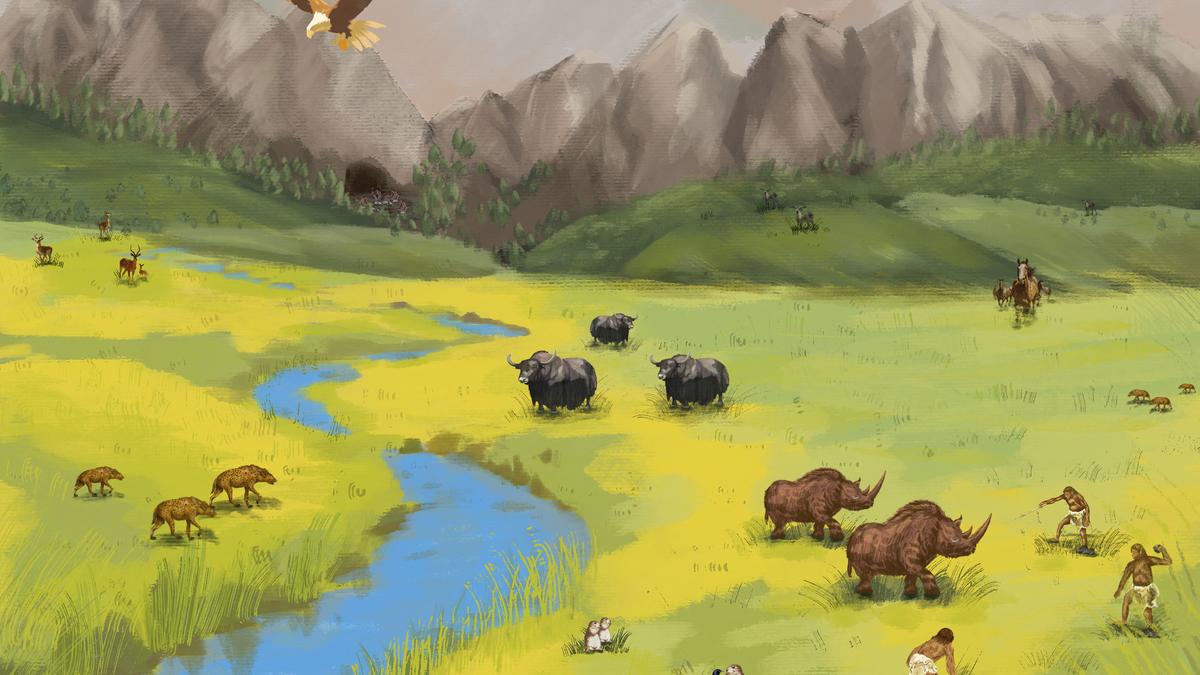
An undated artist’s impression of members of the extinct archaic human species called the Denisovans seen in the landscape of Ganjia Basin on the northeastern edge of the Tibetan Plateau in China’s Gansu province, depicting some of the animals whose bones were found at Baishiya Karst Cave.
| Photo Credit: Reuters

Thousands of bone fragments discovered in a cave on the Tibetan Plateau in China are offering rare insight into the lives of Denisovans, the mysterious extinct cousins of Neanderthals and our own species, showing they hunted a wide range of animals from sheep to woolly rhinoceros in this high-altitude abode.

Researchers studied more than 2,500 bones found inside Baishiya Karst Cave, which is situated 10,760 feet (3,280 meters) above sea level and previously had yielded Denisovan fossil remains.

They used ancient protein analysis on these remains to reveal that the Denisovans exploited various animals for their meat and skins, and also excavated and identified a rib bone from a Denisovan individual dating to 48,000-32,000 years ago – the youngest Denisovan fossil yet known.

Most of the bones were identified as belonging to blue sheep, also called bharal, a goat species still seen on high slope mountains and cliffs in the Himalayas. Other bone remains came from woolly rhinos, yaks, small mammals like marmots, birds, and even from the spotted hyena, a large carnivore that prowled the region called the Ganjia Basin.

It was a grass landscape with small forested areas, teeming with life despite harsh conditions. The animals were butchered for meat, based on cut marks found on various bones, and there was evidence of bone marrow extraction and skinning activities. The researchers also found four tools fashioned from animal bone, shaped for use in processing animal carcasses.

“It is the first time we have gotten an understanding of the subsistence behaviors of Denisovans, and it shows us they were highly capable of accessing and utilizing a wide range of animal resources,” said University of Copenhagen molecular anthropologist Frido Welker, one of the leaders of the research published on Wednesday in the journal Nature.

“I think the diverse animal remains found in Baishiya Karst Cave suggest that this location offered relatively better resources compared with the neighboring higher Tibetan Plateau to the west and the Chinese Loess Plateau to the north, especially in the glacial period,” said archeologist Dongju Zhang of Lanzhou University in China, another of the study leaders.

The existence of Denisovans was unknown until researchers in 2010 announced the discovery of their remains in Denisova Cave in Siberia, with genetic evidence showing them to be a sister group to Neanderthals, the stoutly built extinct archaic humans who inhabited parts of Eurasia. Both experienced significant interactions with Homo sapiens, including interbreeding, before vanishing soon after for reasons not fully understood.

“From genetics, we know they diverged from Neanderthals around 400,000 years ago,” Welker said.

Denisovans are known only from dental remains and bone fragments from the Baishiya Karst and Denisova caves and Cobra Cave in Laos, though their existence at those three far-flung locations demonstrates a wide geographic dispersal.

Their presence at a high latitude in Siberia, a high altitude on the Tibetan Plateau and a subtropical location in Laos “implies that Denisovans had high flexibility to adapt to different environments,” Zhang said.

A lower jaw of a Denisovan adolescent previously found at Baishiya Karst is 160,000 years old. The researchers suspect Denisovans were present there as far back as 200,000 years ago. The newly identified rib fragment shows that Denisovans still existed as recently as 48,000-32,000 years ago.

“We don’t know if the rib was from an adult or a child, nor its genetic sex. It is the first time a rib specimen has been identified as a Denisovan. Previous remains are all dental or cranial or mandibular (lower jaw),” Welker said.

Our species, Homo sapiens, did not populate the Tibetan Plateau until about 40,000 years ago, having first appeared in Africa a bit more than 300,000 years ago.

So what happened to the Denisovans?

“Great question. We know so little,” Welker said. “We know that Denisovans interbred with modern humans. We know that based on some Denisovan DNA that is present in the genomes of some modern humans living today. But when, where and why Denisovans ultimately went extinct, that we don’t know anything about.”



Source link

Science Tags:Denisovans, human evolution, science news

Post navigation

Previous Post: Crowd’s Special Gesture For Hardik Pandya At Wankhede Stadium Months After He Was Booed – Watch
Next Post: Suspect In Slovak PM Shooting Faces Charge Of Carrying Out Terrorist Attack

Related Posts

  • Pfizer reports patient death in Duchenne gene therapy study Science
  • Eye care diagnosis from a distance Science
  • NASA’s LRO captures Chandrayaan-3 landing site on the Moon Science
  • Antimatter observed to be falling down under influence of gravity Science
  • A strange intermittent radio signal from space has astronomers puzzled Science
  • One-third of TB patients received no payment for nutrition support Science

More Related Articles

Scientists untangle mystery about the universe’s earliest galaxies Science
RRI researchers develop new algorithm which can produce better images to study ultracold atoms Science
NZ treaty may allow people to sue on ‘behalf of whales’ Science
Undervaluing faculty fellowships is bad for scientists, and science Science
Japan provides up to $80 million subsidy to moonshot startup ispace Science
How diapers use quantum physics to attend to nature’s call | Explained Science
SiteLock

Archives

  • July 2024
  • June 2024
  • May 2024
  • April 2024
  • March 2024
  • February 2024
  • January 2024
  • December 2023
  • November 2023
  • October 2023
  • September 2023
  • August 2023
  • July 2023
  • June 2023
  • May 2023
  • April 2023
  • March 2023
  • February 2023
  • January 2023
  • December 2022
  • November 2022
  • October 2022
  • September 2022
  • August 2022
  • July 2022
  • June 2022
  • May 2022

Categories

  • Business
  • Nation
  • Science
  • Sports
  • World

Recent Posts

  • Top line can grow to ₹2.5 lakh crore in 5-10 years if we execute well: Zepto CEO
  • Is pregnancy-related brain impairment also seen in fish?
  • AI comes to the rescue of elephants
  • Bandhan Bank appoints Ratan Kumar Kesh as interim MD & CEO
  • Pankaj Advani Beaten By Dhruv Sitwala To 2024 Asian Billiards Championship Title

Recent Comments

  1. GkJwRWEAbS on UP Teacher Who Asked Students To Slap Muslim Classmate
  2. xreDavBVnbGqQA on UP Teacher Who Asked Students To Slap Muslim Classmate
  3. aANVRzfUdmyb on UP Teacher Who Asked Students To Slap Muslim Classmate
  4. YQCyszVBmIP on UP Teacher Who Asked Students To Slap Muslim Classmate
  5. aiXothgwe on UP Teacher Who Asked Students To Slap Muslim Classmate
  • Meta Rebuffs Google’s Virtual Reality Tie-Up Proposal: Report World
  • Lionel Messi Scripts Copa America History With This Huge Record Sports
  • Mitchell Starc Makes Perfect Start To Cricket World Cup 2023 Preparation, Takes Hat-Trick Against Netherlands Sports
  • Arvind Kejriwal Approaches Delhi High Court Against Probe Agency Summons Nation
  • Ukraine claims its drones hit a Russian oil facility, sparking a huge blaze World
  • Two dead, two hurt, in Dutch bridge collapse: officials World
  • On CCTV, Speeding Bus Runs Over 6 Women In Uttarakhand, 1 Dead Nation
  • Gulmarg Hotel On Fire, Local Residents’ DIY To Douse Flames Nation

Editor-in-Chief:
Mohammad Ariff,
MSW, MAJMC, BSW, DTL, CTS, CNM, CCR, CAL, RSL, ASOC.
editor@artifex.news

Associate Editors:
1. Zenellis R. Tuba,
zenelis@artifex.news
2. Haris Daniyel
daniyel@artifex.news

Photograher:
Rohan Das
rohan@artifex.news

Artifex.News offers Online Paid Internships to college students from India and Abroad. Interns will get a PRESS CARD and other online offers.
Send your CV (Subjectline: Paid Internship) to internship@artifex.news

Links:
Associate Journalism
About Us
Privacy Policy

News Links:
Breaking News
World
Nation
Sports
Business
Entertainment
Lifestyle

Registered Office:
72/A, Elliot Road, Kolkata - 700016
Tel: 033-22277777, 033-22172217
Email: office@artifex.news

Editorial Office / News Desk:
No. 13, Mezzanine Floor, Esplanade Metro Rail Station,
12 J. L. Nehru Road, Kolkata - 700069.
(Entry from Gate No. 5)
Tel: 033-46011099, 033-46046046
Email: editor@artifex.news

Copyright © 2023 Artifex.News Newsportal designed by Artifex Infotech.